A Closer Look at Liquavista’s Latest ElectroWetting Screen Tech (video)

Update: This post was published in January, at a time when I was the only one who believed the rumor about Amazon buying Liquavista.

My post yesterday on Amazon and Liquavista hasn’t generated much notice in the blogosphere yet, but it has turned up a useful little video which IEEE Spectrum magazine shot a few weeks back.

Spectrum spent some time at Liquavista late last year and they got a look at Liquavista’s latest demo units. This video is going to give you a much better idea about the color quality and possible uses of Liquavista’s screen tech.

As you can see, this screen tech is visible outside and has been developed as a 9″ display, making it a serious possibility for notebook and tablet screens. Other improvements include better than LCD battery life and the fact that this screen tech can be made in LCD factories. FYI: There is an excess of LCD production capacity right now.

But it also doesn’t have nearly as good a color quality you would expect to see on current generation LCD screens, and I find that detail a compelling argument in favor of Samsung selling Liquavista to Amazon.

One of the commenters on yesterday’s post raised the issue of why Samsung would want to sell. As he saw it, there was little obvious reason for Samsung to want to part with the company when they could just as easily make Liquavista screens and sell them to Amazon.

Speaking in terms of the mindset of Samsung and the tech blogosphere, Samsung makes products which compete with Apple. That means Samsung needs to makes screens comparable or better than the screens Apple uses, and that’s something Liquavista’s screen tech cannot do. Why not part with the company?

Liquavista might be able to get their screens into construction, military, and other rugged devices, but that is a niche market that is already being cornered by Pixel Qi. With that in mind I would argue that the biggest market for Liquavista screens would be ereaders (the commercial uses are ancillary).

If the screens are cheap enough then they will make a very attractive alternative to E-ink screens. I could easily see Amazon wanting to buy Liquavista in order to keep everyone else from using these screens. At the very least I think Amazon would be willing to throw a lot of money at Samsung just to make sure they have a color ereader no one could match.

Spectrum via eReaders.nl

Amazon is Going to Buy Liquavista

Amazon has long been rumored to be interested in making a color Kindle, but so far all the rumors have turned out to be hooey. Now I wonder if perhaps Amazon’s interest in Liquavista goes back far enough that it inspired all those rumors.

Remember last week when I reported that there might be a connection between Amazon and the screen tech company Liquavista? I didn’t have any proof last week, and I don’t have solid proof now, but I do have some evidence that is strong enough that I am going to go on the record and say that this deal is in the works.

Amazon is going to buy Liquavista from Samsung.

Last week I showed you that Amazon’s hardware subsidiary Lab 126 employed a screen tech person and a CPU architect, 2 interesting details that suggest Amazon is going to develop custom components for the Kindle hardware. I happened across this info while looking for a connection between Liquavista and Amazon, but I didn’t receive any proof until after I posted that story.

The next day a friend of mine, Martijn Joosse of eReaders.nl, got back to me with the business records I asked him to look for. There’s no paperwork that shows Amazon owns Liquavista (that’s how we proved Samsung bought the company), but there is a new registration for

  • Amazon Development Center (Netherlands) B.V.

According to the records this company was formed as a software developer and a financial holding company. That doesn’t look like much, but once I started to look into the company things got really weird – so weird that it’s pretty clear that this is not one of Amazon’s usual subsidiaries.

For example, there’s no job listings on Amazon or any job site which mentions that location. Amazon is hiring lots of software people in Europe but none in the Netherlands. Of course, the company is only a few weeks so they might not be ready to hire people , but it does make you wonder.

And then there’s the location. This company is based at the Schiphol Airport World Trade Center. That is fairly expensive office space, and if this were really a software development office I would expect it to be located elsewhere in the Netherlands. This location is more suited to, say, a financial holding company owned by folks from Seattle where they could meet folks from Korea  and negotiate a deal concerning a Netherlands based screen tech company.

Edit: A reader pointed out that the address I found was most likely a mail drop, not an office. That makes things even stranger, IMO, given that the software developers won’t be able to fit inside the mailbox.

But that’s not the most interesting bit of detail about this business registration. No, the best part is that I can’t prove this company belongs to Amazon. It leads back to a faceless LLC registered in Delaware, and the trail dead ends in a faceless holding company called CSC (remember them?).

I can’t actually tell you for certain who owns the newly registered company in the Netherlands. But that’s okay, because we’ve been in this situation before.

When Amazon filed the FCC paperwork for the recently launched Kindle Fire HD tablets, they used a number of different faceless front companies to try to hide their connection to the devices. Someone is using that exact same trick to hide a connection between this new company in the Netherlands and whoever is really making the deal.

If this isn’t Amazon then it is someone who is as equally obsessed with secrecy and I can’t think of anyone who would copy this trick so carefully.

Amazon is buying Liquavista. Or at the very least they are buying part of the company (making a major investment) and plan to use Liquavista’s screen in the next Kindle.

Samsung bought Liquavista in early 2011, and quickly renamed the company Liquavista/SNRC (Samsung Netherlands Research Center). They’ve been funding research at Liquavista for the past couple years but so far as I know they have not actually released a device which used a Liquavista screen. This tech is going to have the same color qualities as LCDs while also being much more energy-efficient. It’s been under development for 10 years now and was supposed to enter mass production in 2010, 2011, and this year (it keeps getting pushed back).

From what I can tell Liquavista has not shown off any new demos since June 2011 2010. They were partnered with Freescale at the time and showed off a few demos at Freescale’s HQ in Toulouse, France. This was of course before Samsung bought the company.

Liquavista was at SID Display Week 2011 where Engadget shot this video:

The latest info I have is that Liquavista expected to have their screen tech in mass production this year. This deal could be a sign that the screen tech is ready, and that Amazon is so interested that they are investing in Liquavista.

But we won’t know for sure until Amazon makes it official.

You Can Have My Notebook When You Pry it From My Cold, Dead Fingers

I have long been a proponent of a paperless office but today I need to share my great secret shame: I am addicted to taking notes on paper. When I was at CES I carried around a laptop, tablets, camera, and still got my fix with a small notepad. When I attended B&N’s most recent press briefing I brought an 8.5×11 notepad.

I’ve had a 20 years plus fixation with paper notes, so I was particularly annoyed when I read an article in the Harvard Business Review last week:

I knew right away, when you walked in here with a paper notebook — a paper notebook! — I realized that this meeting was not going to be a good use of our time.

You’d make better use of your time if you took your notes in digital form, ideally in an access-anywhere digital notebook like Evernote that makes retrieval a snap. If you had that, I could shoot you the link of the book I want you to read, or the contact card of the person you want to meet. And if you planned to act any of the ideas or outcomes from this meeting, you would want to pop the follow-up tasks into your task management program.

Leaving aside the fact that even Evernote has conceded the value of paper notebooks when they helped develop a new paper notebook with Moleskine, I want to challenge any proponent of digital notes with matching the use cases and functionality of a paper notebook.

In my experience a paper notebook is a strong contender against digital notes in the categories of cost, battery life, screen space, durability and persistence, and it also comes in a close second for certain types of sharing.

I want someone to show me a digital note-taking platform that is as cheap as a 10 cent spiral notebook. I want to see the platform that can match the battery life of that notebook, the way I can tear a page out and share it with anyone in my physical presence, or the way that the effective screen size of that notebook can expand to cover

want to see the platform that can match the battery life of that notebook, the way I can tear a page out and share it with anyone in my physical presence, or the way that the effective screen size of that notebook can expand to cover 8 ,9, or 10 pages torn out and spread across my desk, thus enabling me to see vastly more content at once.

I want to see a digital note-taking platform that can match the persistence of the paper notebook.

If you think digital content will last longer then the joke is on you. Last fall I went through my old files and threw away a lot of my college notebooks. Some of those notebooks had been languishing in my attic for 10 or more years and yet I still had them.

Don’t even think of asking me for the digital files from that era. Thanks to the vagaries of dead computers, a stolen laptop, and time, I can’t reliably put my hands on any of my work which is more than 4 years old. I doubt I am alone in that.

And I doubt I am alone in that.

I’ve taken notes on cash register receipts. I’ve taken notes on business cards. I’ve even taken notes on my hand and arm (being white and male is good for more than just societal acceptance). No digital note-taking platform can even come close to fulfilling those use cases.

Anyone who says that digital notes are hands down better than paper is either a fool or selling something. The author of the above article falls in the latter category; she’s shilling her new book Work Smarter with Evernote.

'Nuff said.

image by Wm Jas

Amazon is Going to Use Custom Screens and CPUs in Future Kindles, Might be Buying Liquavista

Do you recall the story about the Kindle hiring spree from a couple weeks ago? Amazon was (and is) hiring a lot of new people to develop more Kindle products, but they were also hiring all sorts of corporate positions as well with the apparent goal of building up Lab126 so it could stand on its own 2 feet.

That was an interesting piece of news, but it’s dwarfed by the information I just uncovered today. Amazon is not only developing new consumer products; they are also developing original components to put in their next Kindle hardware.

Earlier today a confidential source tipped me to a rather interesting connection on LinkedIn. I cannot see the connection myself, but I was told that Tony Slack, the CTO at Liquavista, was now directly connected to Carolin Fischer. She’s the HR Manager for Mergers and Acquisitions at Amazon. That raises some interesting questions does it not?

Could this be a sign that Amazon is investing in Liquavista?

Liquavista is a screen tech company owned by Samsung which is working on a replacement for LCDs. Their tech is going to have the same color qualities as LCDs while also using low-power. They’ve been working on it for 8 years now but have yet to release a product to the market. That was supposed to have happened in 2010, 2011, and 2012.

Amazon could be looking at Liquavista for screens for the next Kindle hardware.

Yes, but it could also simply mean that those folks spoke briefly at some trade show and later connected on LinkedIn. That happens a lot and is in fact much more likely to be true. And given that I have not found any other connection I’m not going to get too excited about the possibilities.

Besides, I found something just as interesting. I might not be able to show that Amazon is working with Liquavista, but I can show that there is a high probability that Amazon is developing their own screen tech and CPUs.

I was rooting around on LinkedIn, looking at Lab126 employees and I found a couple recent hires that tell me a lot about Amazon’s hardware plans.

I might not be able to show a connection between Amazon and Liquavista, but I did find the profile of Jerry Chung. He’s been the manager for display hardware at Lab126 since May 2012, and before that he was a manager at Pixel Qi, Apple (he managed screen tech development), and Sipix.

And then there is Siamack Haghighi. He’s a system and chip architect at Lab126, and before Amazon hired him in June 2012 he held similar positions at other companies.

There are over 1,000 Lab126 employees on Linkedin, and I’m sure that if I looked through all the profiles I would find other profiles which confirmed my conclusions. But I’m not sure it’s necessary.

Amazon has screen tech people. They have chip designers.

Those are pretty good signs that Amazon is working on custom components for their next generation Kindle hardware. They’ve moved beyond simply designing the device to designing the components that go into it.

On a related note, I think we now know why Amazon hasn’t bought Texas Instruments' Omaps CPU division. It was widely rumored in October 2012 that Amazon was interested in picking up the division, which TI had planned to simply shut down.

Three months later that deal still has not happened and today I think I found out why.  Amazon already has their own chip people in house working on the chips Amazon plans to use in the next Kindle hardware. They might not see a need to take on an entire development team whose attention was divided among several different TI customers.

And given that in November TI laid off 1,700 people from the Omaps division, I would bet at this point Amazon could simply hire the folks they wanted rather than buy the entire division.

We could also look at that lay off as confirmation of a sort. Amazon might be one of the ex-TI customers which are developing their own chips, so TI isn’t keeping the staff around anymore.

In any case, the next Kindle hardware is likely going to surprise us.

Dueling Reports Suggest 54% and 46% of Kids in the US Now Read eBooks

It looks like this is shaping up to be the week of the dueling digital reading surveys.

On the one side we have a report from Scholastic which say that 46% of kids are reading ebooks, while on the other side we have a new report being sold by Digital Book World which claims that 54% of kids in the US are reading ebooks.

I wonder which one has the better data?

I’m not sure. I can’t compare the reports because although the Scholastic report is freely available the one from DBW is not. The only public data from the DBW digital reading survey are a few bits here and there and there isn’t much context. But what I can see in the press release tends to make me question the accuracy of the unseen report.

For example, DBW asked parents what their kids are reading and got a response of 54% read ebooks. Scholastic asked kids the same question and got an answer of 46%. Which do you think is more accurate?

For this particular figure I tend to go for the Scholastic report because I can recall how many times my mother only thought she knew what I was doing. And given that the DBW press release indicates that 1,300 parents were surveyed but does not mention if any kids participated, I think that’s a good reason to stick with the Scholastic report.

The DBW report would best be looked at as not a survey of what kids are reading but a survey of what their parents believe they are reading. That nuance could result in a discrepancy between what is occuring vs what the survey reports.

Rumor: Google Nexus 7.7 to Launch in May With Tegra 4 CPU

There’s an old rule about gadgetry which states that no matter what you buy something new will come along in a few weeks which will be better, faster, and prettier. The Nexus 7.7 is going to make you feel that way about whatever Android tablet you just bought.

According to some recently leaked specs on a Korean website, Google’s next Android tablet is going to be the Nexus 7.7 and be built by LG.

This tablet is rumored to have the new Tegra 4 bajillion-core CPU with 2GB of RAM, a 7.7″ screen with a resolution of 1920×1200 (294ppi). The other rumored specs include front and rear cameras, with the front-facing camera being 5MP.

It’s supposed to ship with 8GB of Flash storage and retail for $299. There’s no word on what version of  Android it will run nor when it will be released, but my guess is that Google will unveil it at Google I/O in May. It might run Android 5.0 Key Lime Pie (assuming it is done in time).

Okay, I can see the rumors about the screen size and the CPU being true but surely that detail about the storage is wrong. 8Gb is not nearly enough storage in this day and age. If Google actually announces it then they’ll be laughed off the stage.

Mike Cane thinks that the Nexus 7.7 will have a card slot, but I don’t. Google doesn’t like them (or at least someone does not). So I’m guessing this tablet will have a minimum of 16Gb of storage.

Assuming it exists at all. This could just be fiction.

But if it’s not fiction, would you buy this tablet?

source

via

E-Ink’s Triton 2 Color Screen Gains Frontlight, Loses Weight (video)

Here’s one of those stories which I didn’t think were important at CES. As you can see in the video, I was wrong.

About a month ago Ectaco announced their second doomed large-screen ereader, the Jetbook Color 2. This ereader is the first to have the Triton 2, the newest generation E-ink screen. At that time neither E-ink nor Ectaco were willing to share specific details on the technical specs for this screen but it seems that E-ink changed their mind for CES 2013.

The following video shows Sriram Peruvemba as he talks about the new screen. It has an improved color filter (it lays on top of the grayscale E-ink screen) as well as a frontlight. The Triton 2 screen is also thinner than it’s predecessor.

The tech looks cool but it’s probably never going to see much use. LCD screens are simply too good at color, and now that they’re cheap and are found on tablets with decent battery life there isn’t much of a market for color E-ink any more.

And then there’s the screen resolution issue, which i think is the real reason Amazon and the other major ereader makers never adopted the Triton color screen.

The Triton screen gets its color from a filter layer which sits on top of a regular grayscale E-ink screen. In order to provide the standard RGB color pixels, the filter assigns one of the grayscale pixels for each color (and reserves a 4th pixel for white/black). This effectively cuts the screen resolution by 75%.

A color E-ink screen has a much higher resolution grayscale underneath it. The Jetbook Color, for example, has a screen resolution of 1200×1600 but in reality it can only display color at a resolution of 600×800 (and that’s on a $500 device with a 9.7″ screen). If you gave the KPW a color E-ink screen the resolution would drop to 512×379 or less than you could get on the average smartphone.

Do you see why Amazon went with an LCD screen for the Kindle Fire? It’s not that Amazon could not buy color E-iink screens; the screen tech could have been made 4 or 5 years ago.

It just wasn’t worth it.

The Majority of Dutch eBooks Are Available Uncrippled by DRM

Earlier this week I reported that the POD and ebook distributor service Lulu had dropped DRM from their ebookstore, and it seems they’re not the only ones. Some time next week Centraal Boekhuis, the leading distributor of books and ebooks in the Netherlands, will start distributing more ebook titles unencumbered by Adobe DRM.

They’re not giving up on DRM entirely, but they have indicated that another 8,426 ebooks will be available protected only by digital watermarks. Counting the DRM-free titles (both Epub and PDF) this means that nearly three-quarters of the 20,000 ebook distributed by CB will either have no DRM or have so little DRM that the average user likely won’t notice.

CB is describing these 74% of ebooks as being DRM-free, but that’s not quite the case. First, there’s no guarantee that these ebooks will be DRM-free when sold through the major ebookstores (Kindle, Nook, iBooks), but of course we knew that. Also, the 16% of titles carried by CB as truly DRM-free are more likely to stay that was when sold via the major ebookstores.

The more important detail here is that there is a difference between having no security and having some security. Digital watermarks still provide a measure of control. While they don’t get in the way of a paying customer, they can still be used to identify who originally bought a piece of content. That can be useful data should an ebook, mp3, or other content show up on a pirate site.

I’ve mentioned digital watermarks before, so rather than repeat myself may I suggest that you read this, this, or this.

This deal mainly affects the smaller ebookstores which work directly with CB to stock Dutch titles (because digital watermarks need to be applied at the time of download).

source

via

PlasticLogic Shows Off a Dual Screen eReader at CES 2013

PlasticLogic may have overstated the involvement they had with the PaperTab flexible tablet, but they did have a couple interesting gadgets of their own to show off.

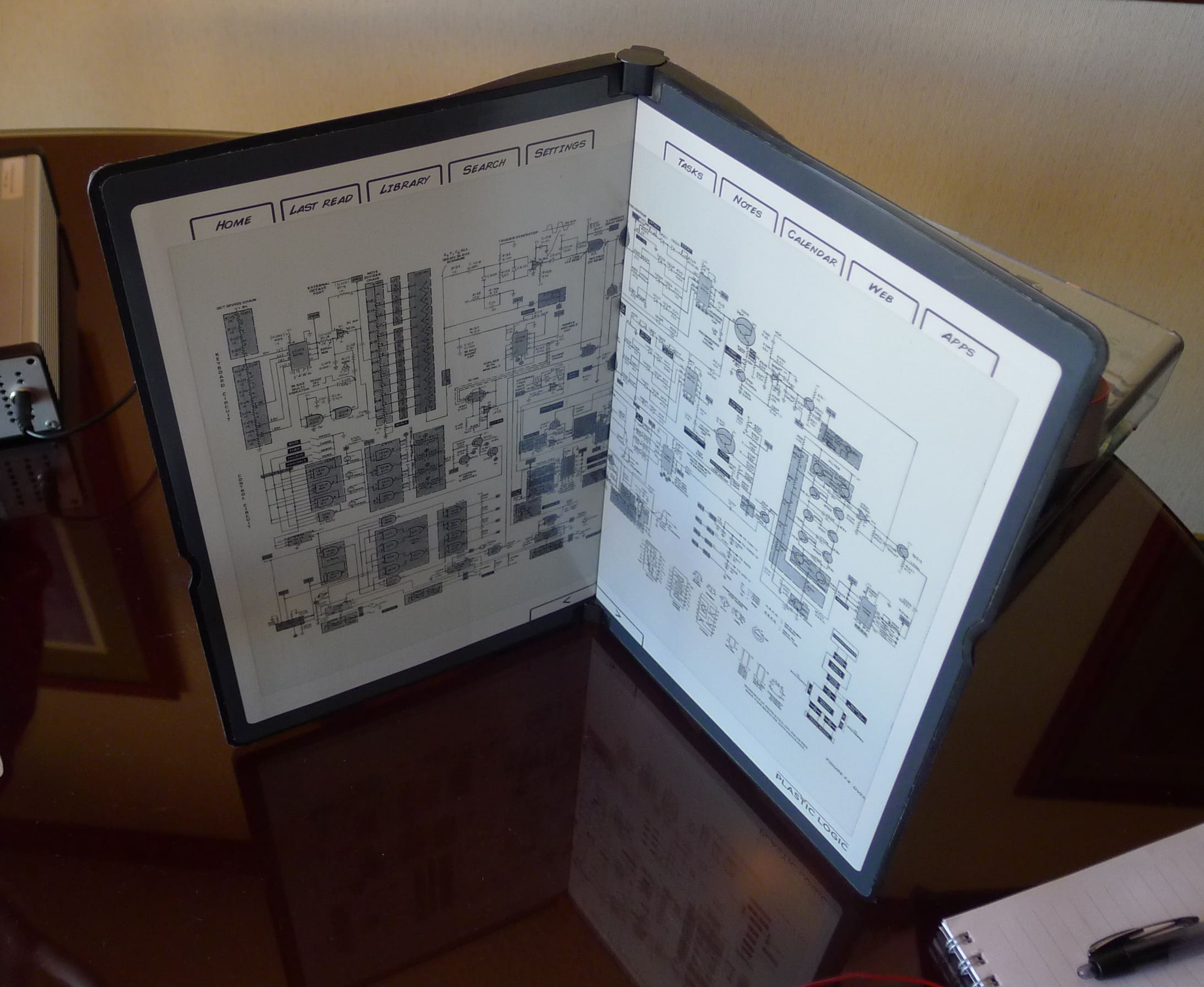
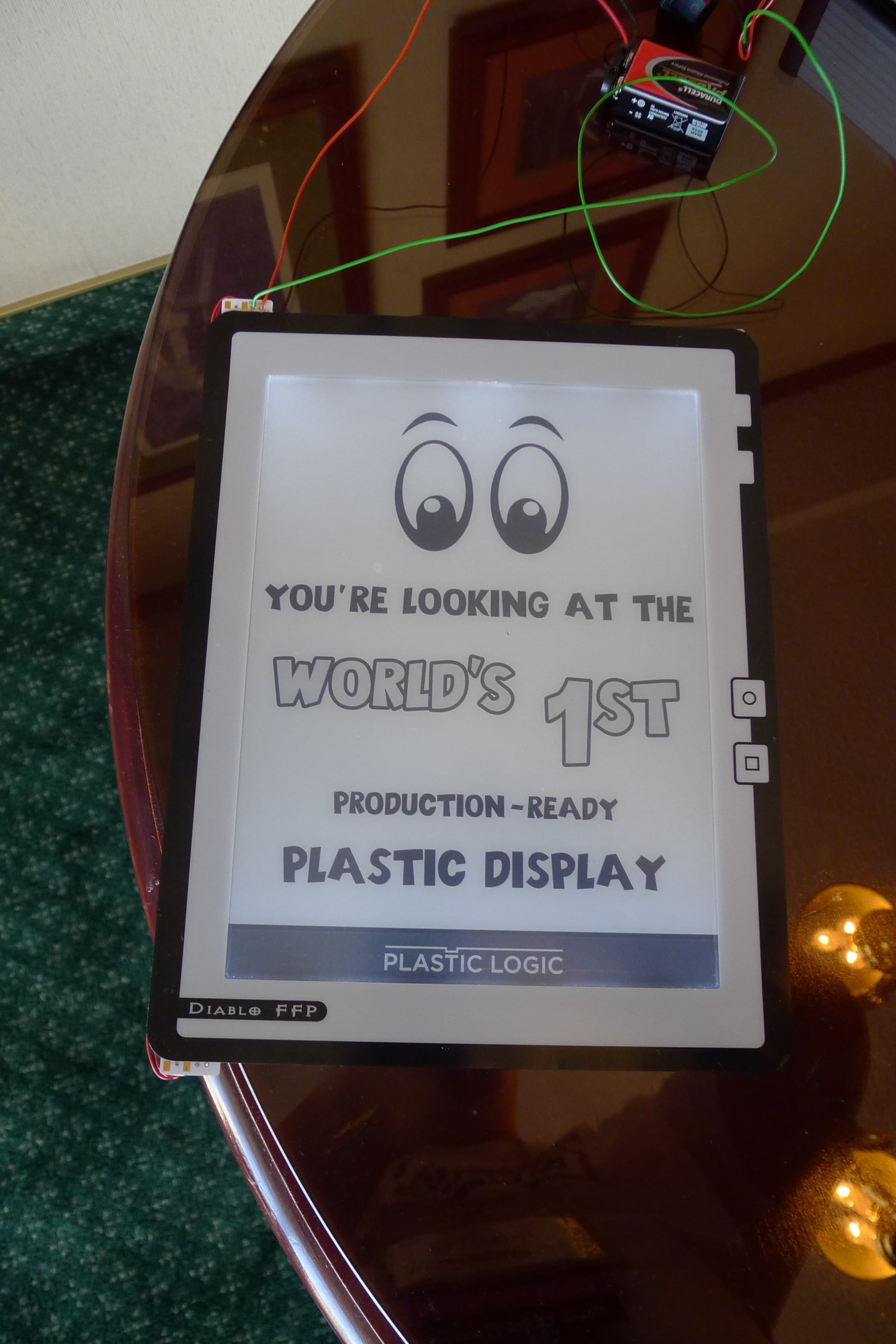
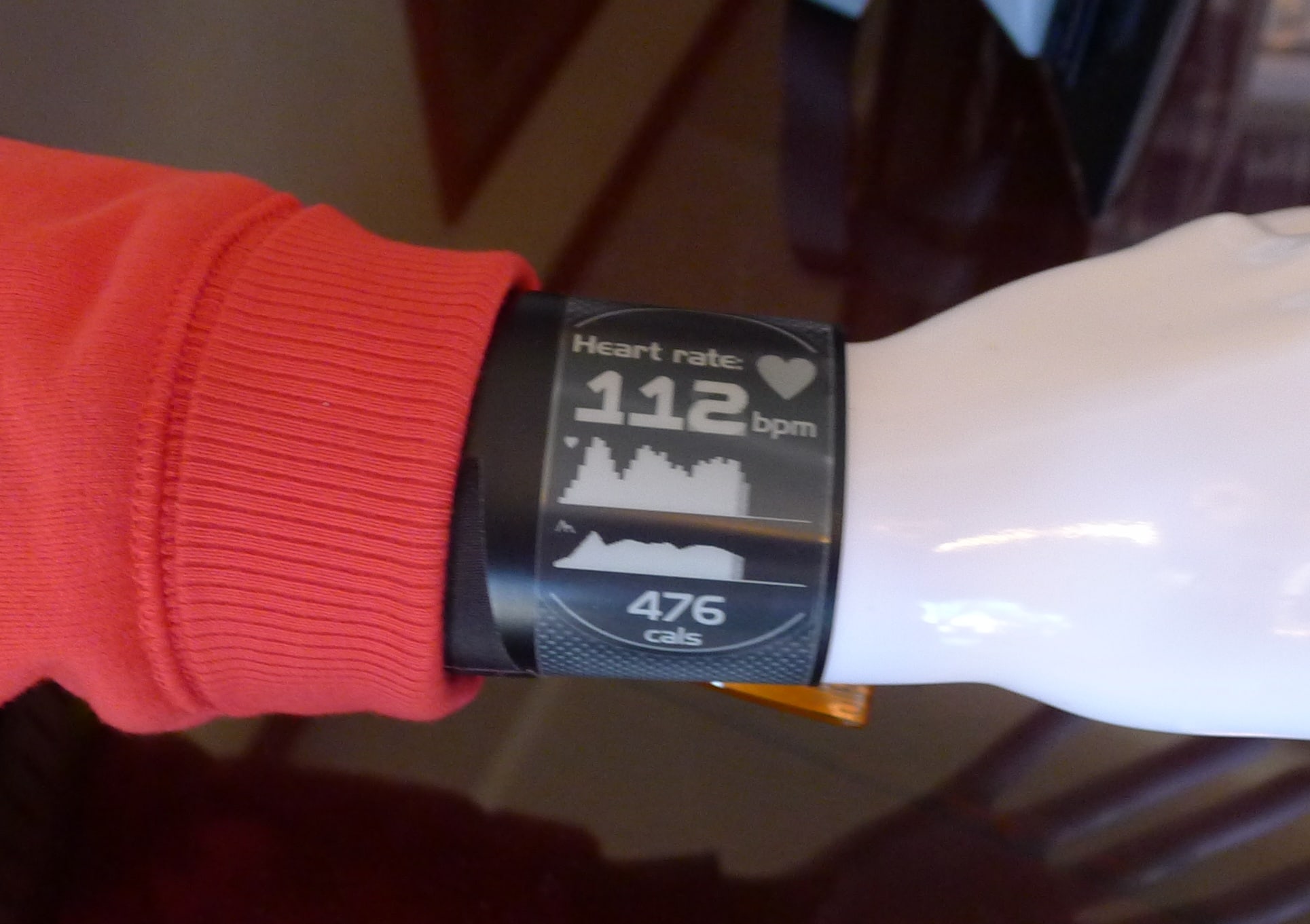
In addition to the lighted PL screen we’ve seen before and a watch, there was also a dual screen ereader concept. It’s tied to a cable and can’t do more than play a slideshow of page images, but thanks to PlasticLogic’s screen tech it is also quite thin.

The 2 screen panels are each one of PlasticLogic’s 10.7″ screens, and they are connected via a double hinge in the spine. The pages could be changed together or separately.

Update: PlasticLogic posted a demo video on Youtube:

I had shot a video showing this ereader in action but unfortunately my camera seems to have eaten it.  I’m kicking myself right now because it was a very cool sight to see.

I’ve always been a fan of really large screen ereaders, though I don’t think I’ve ever seen one on the market. I’ve always wanted to see an epaper alternative to displaying large-scale documents like blueprints, diagrams, or posters.

Sure, there are things like Microsoft’s Surface Table, but staring into a bright light like that is not good on the eyes – not on that scale.


PlasticLogic’s New ePaper Tablet to Debuts at CES 2013 (video)

I almost didn’t go CES this year because I didn’t think would be any new or really cool gadgets to write about, but now that PlasticLogic Intel has proven me wrong I’m glad I’m here.

A new partnership has been announced between PlasticLogic, Intel, and Queen University’s Human Media Lab. This Ontario based university has just revealed the PaperTab, a new flexible tablet based around PlasticLogic’s  epaper screen.

This tablet is running on a second generation Intel Core i5, and it uses the same 10.7″ plastic display which had previously been developed for PlasticLogic past failed devices like the Que and the PL 100, which was developed for the Russian education market. This tablet also has a touchscreen, and as you can see in the video it uses a rather fascinating way to transfer files from one screen to the next which looks to be similar to the tap-and share technology used in Samsung’s smartphones.

Other tricks shown off in the video include flexing the tablet to turn the page, something we’ve seen before in the Snaplet, a smart watch style device which the HML unveiled last year. That device was probably never planned as a commercial release, but clearly that project has influenced the PaperTab.

Before someone points out that a tethered device hardly qualifies as a tablet, let me say that I agree.  That doesn’t mean it’s not cool, though it does suggest that this won’t ever be a less-than-ridiculously device.

The several screens used in the demo video cost some hundreds of dollars, and that puts it out of the running. I’m someone who is in the habit of working on 3 or more screens at once, a work process which is enabled by cheap Android tablets.  While they might not be able to integrate as well as the PaperTab, my Android tablets function better as standalone devices.

In any case, this device is said to be at CES this week. I’ll seek it out.

WSJ Predicts the Death of eBooks: Oh, The (Digital) Humanities!

The Wall Street Journal is one of the best business newspapers out there, but when they try to cover a tech topic they tend to articles verging on the nonsensical.  You might recall the WSJ columnist who in August gave up on his Kindle because he forgot to charge it before a cross-country flight; today I have an article which argues that ebooks are a failed product niche simply because the adoption rate has slowed.

This article was written by Nicholas Carr, and it is based in part on the recent survey results released by Pew Research Center last week. He points to the detail that more readers have read a paper book than read an ebook and uses that as a basis to pretty much proclaim that everyone who is a proponent of ebooks is wrong.

Mr. Carr is quite fond of straw man arguments, and in fact he starts his article with one:

Ever since Amazon introduced its popular Kindle e-reader five years ago, pundits have assumed that the future of book publishing is digital. Opinions about the speed of the shift from page to screen have varied. But the consensus has been that digitization, having had its way with music and photographs and maps, would in due course have its way with books as well. By 2015, one media maven predicted a few years back, traditional books would be gone.

I’m not sure I know anyone who would have claimed that paper books are going away – not in 2012, in any case. Sure, some people thought that in the early days of the Kindle (2008, 2009) but I doubt that anyone really believed in that aspect of ebook hype past late 2009 or so. I know I did not.

Mr Carr also seems to like mis-characterizing the rise in popularity of ebooks in the past few years:

The initial e-book explosion is starting to look like an aberration. The technology’s early adopters, a small but enthusiastic bunch, made the move to e-books quickly and in a concentrated period. Further converts will be harder to come by.

The reality is that an explosive growth in a market as people rush in to adopt a new product is not an aberration; it is a basic truism of economics. The point at which the rate of adoption slows down is called saturation (Wikipedia).

Yes, folks, this WSJ writer did not bother to consult Wikipedia while trying to understand the economics of the ebook market.

Mr. Carr goes on to mistakenly identify a particular literati subculture as being the only ones who read so-called literature:

Readers of weightier fare, including literary fiction and narrative nonfiction, have been less inclined to go digital. They seem to prefer the heft and durability, the tactile pleasures, of what we still call "real books"—the kind you can set on a shelf.

The problem here is that I know any number of people who read heavy-duty, dense books on ereaders and smartphones. That, and arguably it’s a mistake to claim that a title identified as literary fiction is actually of higher quality than a popular novel like The Hunger Games (here’s why).

But once Mr Carr gets past the weak arguments and misunderstood economics, he begins to reach the conclusion that many people in digital publishing figured out years ago:

E-books, in other words, may turn out to be just another format—an even lighter-weight, more disposable paperback. That would fit with the discovery that once people start buying digital books, they don’t necessarily stop buying printed ones. In fact, according to Pew, nearly 90% of e-book readers continue to read physical volumes. The two forms seem to serve different purposes.

Welcome to 2009, dude. Once you have adjusted to the changes, perhaps you could join us in 2013? We don’t have flying cars, but we do have Skynet.

And finally, Mr Carr closes out the article with a historical inaccuracy:

Having survived 500 years of technological upheaval, Gutenberg’s invention may withstand the digital onslaught as well. There’s something about a crisply printed, tightly bound book that we don’t seem eager to let go of.

Um, Gutenberg didn’t invent the book, or to be more exact he didn’t invent the codex (the technical term for a book with paper pages, spine, etc). The codex dates to at least the first century AD (Wikipedia, again). Johannes Gutenberg invented the printing press. Even if books had died out, I seriously doubt that printing presses would no longer exist in any form; they are used for far too many purposes besides printing books.

All in all, this is a disappointing article, especially coming from what used to be an august publication like the Wall Street Journal. Hell, I’ve done better, and the total sum of my writing training consists of just the few writing classes required to get an engineering degree from a state university.

Surely Nicholas Carr can do better.

image by Lynn Gardner

B&N Lost a Ton of Money This Holiday Season

For the past year or so I have been pointing out that B&N’s sky is falling, and today have come true. Barnes & Noble released details today on their sales this holiday season, and the details are so bad that I am reminded of Borders' news in early 2011 that they were insolvent. B&N is not quite that bad, but now I see why they needed that 90 million dollars which Pearson invested in Nook Media.

Today’s news covers the 9 week holiday season, the period in which American retailers expect to cover their losses from the rest of the year, to "put them in the black".

FYI: That is an reference to old-fashioned ledgers, where a profitable day was recorded in black ink, and a money-losing day is written in red ink. It’s also where Black Friday got its name.

Sales via B&N brick-and-mortar stores and the B&N website dropped 10.9% this holiday season, compared to the same period last year. Retail sales of Nook hardware in particular fell below B&N’s expectations, belying the initial good sales over Black Friday weekend. “Nook device sales got off to a good start over the Black Friday period, but then fell short of expectations for the balance of holiday,” CEO William Lynch said. “We are examining the root cause of the December shortfall in sales, and will adjust our strategies accordingly going forward.”

The Nook segment had revenues of $311 million for the nine-week holiday season, down 12.6% as compared to last year. This is attributed to both fewer units sold as well as lower selling prices, and the loss was only partially ameliorated by an increase in digital content sales, which were up 13.1%.

Even though quite a few of my readers disagreed with me, I’ve been worried about B&N’s Nook sales for quite some time. Ever since they ran a couple BOGO sales last Spring, and then followed them up with regular sales on refurbs, I’ve been convinced that the Nook hardware has been the albatross around the neck of B&N. And even as far back as the last holiday season there were signs that B&N was having difficulties moving hardware; sales of the Nook Touch were far below what B&N would have liked.

That’s why they decided to spin it off, and that’s why they’ve picked up piecemeal investments from MS and Pearson.

It’s a pity they have not sold it yet. When I last covered this bad news, one of my readers pointed out that there were any number of potential buyers, including Rakuten, Microsoft, Best Buy, or a retail conglomerate like BAS Group or Tesco.

Right now I’m really hoping one of them might be interested in rescuing the Nook.  In spite of the bad news today, there is still some real value in Nook Media. Oh, it’s not worth the couple billion valuation which B&N has placed on it, but as an ebook platform what it really needs is to go international and or be picked up by a company which has the deep pockets B&N lacks.

image by Monica Arellano-Ongpin

Irish Newspaper Collective Wants to Charge License Fees for Links

It’s a fact of life that legacy industries are often killed off by newer industries spawned by new inventions, so the generally worsening situation of the newspaper industry should come as no surprise as more news moves online.

What does surprise me is that some in the industry seemed determined to speed up the process and hasten the deaths of their companies. I’ve just read that the National Newspapers of Ireland has adopted a new licensing scheme where they expect websites to pay to link to one of their members.

I’m not kidding. They’ve been sending out notices, demanding payment:

The Newspaper Industry (all these newspapers) had its agent write out demanding money. They wrote to Women’s Aid, (amongst others) who became our clients when they received letters, emails and phone calls asserting that they needed to buy a licence because they had linked to articles in newspapers carrying positive stories about their fundraising efforts.

Note that this is not paying for an excerpt, which is not that unreasonable, or some punitive measure for the copying of an entire article. No, the NNI wants to charge for links like this, this, or this.

For those 3 links, I now have to pay the NNI 300 euros. Seriously. Apparently this group of 15 newspapers is under the impression that merely mentioning an article on one of websites is not legal; they think it is copyright infringement.

Don’t hurt yourself trying to understand their reasoning; it’s utter nonsense. First and foremost, let’s consider the business aspect. There’s the fact that naming a work’s title does not and cannot be copyright infringement – not under US law (I’m not familiar with Irish copyright law). A link (or the URL inside it) is little more than a name, so arguably the same rule would apply. And even if it is more than a name, the URL can be regarded as a factual statement (you can find the content here) and facts arguably cannot be copyrighted in the US (some courts disagree).

Crazy, no?

Unfortunately this is not the first time this insanity has appeared, though none have gone quite so nuts as the NNI. There’s an ongoing push in Germany to pass a law which would force Google to pay publishers for using the tiny snippets in Google’s search results, and Belgian newspapers recently settled a similar dispute with Google.  France is also considering a similar law.

What’s even better is that the Belgian settlement came after Google lost the court case, and complied with the judge’s order to delist the newspapers from the search engine. That of course cost the Belgian newspapers a lot of traffic and reducing their revenue.

And that, my dears, is the true crazyness about demanding payments for links and snippets. A link from one website to another is free advertising. It’s a source of page views which the recipient didn’t have to pay for.

One commenter on the source article put it into perspective:

By that same rational….. Do the newspapers intend to pay for each link to an advertisers site that they host? Possibly ending up paying more for the traffic they drive to advertisers sites than they receive for hosting links in the first place? Surely they’re killing their own revenue model.

What we’re really talking about here is that these Irish newspapers want everyone else to pay for the privilege of giving the NNI member websites more traffic. That alone is enough to show what a nutty idea this is.

source


Digital Subscriptions Are Not Exactly Taking Off – Hearst Only Boasts of 800 Thousands Subscriptions

It’s long been obvious that the pipedream of selling content on the iPad was never going to generate as much revenue the early hype suggested, and today there are new signs that selling subscriptions to the digital content might not be as lucrative as some had believed – a detail which the failure of The Daily made quite clear.

David Carey, president of the magazine and media publishing conglomerate Hearst, sent out a "state of the company" email this week. There are a bunch of interesting details in the email (which you can find here) but I just want to cover exactly 2 points:

Print is doing very well, with a number of new titles launching successfully in a bunch of international markets. Digital is not doing quite as well, though Mr. Carey is still pleased with the progress:

In keeping with our UNBOUND positioning, we made impressive gains in digital media. By the end of the year, we counted nearly 800,000 monthly digital subscriptions in the U.S. across iPads, NOOKs, Kindle Fires and Android devices—the highest in the industry. Those subscriptions are now generating profits after 24 months of investment. And how exciting to see how this business is developing organically: More than 80 percent of our digital subscribers are new to our files, and their engagement levels meet or exceed the high levels we see from our print products.

While 800 thousand subscriptions sounds like a lot, it really isn’t. According to their website, Hearst publishes 20 titles in the US, so if you divide the total number of subscriptions by the title count you end up with a much less impressive 40 thousand. Considering that any one of those 20 titles has a subscription base in the millions, 40,000 subscriptions isn’t a whole lot.

Take Seventeen, for example. While I’m sure all Hearst magazines have their subscription data where advertisers can find it online, I happened to find this one first. This magazine boasts 2,000,000 print subscriptions. Cosmopolitan, another Hearst title, has 3,000,000 print subscribers.

Between the 2 magazines, Hearst has 5 million print subscribers vs a nominal 80,000 digital subscribers. That’s not much, and that figure comes nearly 3 years into the iPad app era, 3 years from the point where digital magazine content was supposed to have taken off. What’s more, Hearst has actually been into digital magazines since long before the iPad. I can find them listed as a Zinio partner way back in 2006 and 2007.

Just to put this into perspective, Hearts boasts of reaching 87 million Americans each year, making the 800 thousand worth only about 1% of their reach.  They also launched a new title this year, HGTV Magazine, and its print subscriptions hit 750,000 subscribers this year.

I won’t go so far as to say digital magazines are a failed concept, but I do think that we still have not yet seen the ignition point. Sales are growing, but they’re not exploding like ebook sales were after the Kindle Store launched.

People simply aren’t adopting digital magazines in droves.

If anything, I think publishers are going to have to rethink the magazine paradigm. Existing print titles are tied to the idea that the content comes out in a huge monthly (or weekly) bundle, half of which is adverts. That single monthly bundle is a business decision, not one based on the original non-ad content, and it perhaps should go by the wayside.

Edit: As Jon Jermey pointed out in the comments, a monthly magazine issue is to an article what the CD was to a track. I think it’s time to break up the bundle into smaller pieces of content, and possibly even to selling the individual article. Given the growing recognition of  short works like Kindle Singles, it’s not such a stretch to think that this could be a functional business model.

The digital magazines which I will be watching this year are the several newbies which have only a few stories per issue. The Magazine and Symbolia are offering content in smaller bite sized bundles rather than the single huge monthly bundle. This could be the way forward.

Apple to Launch iBookstore in Japan in January 2013

The Nikkei reported today that Apple will be expanding their ebookstore soon. Some time in the near future, possibly as early as next month, Apple will start selling ebooks in Japan. They have reportedly already signed a number of Japanese publishers, including Kadokawa, Kodansha, Shogakukan, and others.

Apple reportedly has 80 thousand titles lined up, all from local publishers. When combined with their dominance of the Japanese tablet market (iPad has a 60% market share), Apple will likely have a sizable advantage over the competition, one which is should be enough to help overcome the fact that Apple was beaten to the Japanese ebook market by Kobo, Google, and Amazon.

All this competition is expected to boost the growth of the Japanese ebook market. It’s currently estimated to be worth 70 billion yen, and some believe it will grow to 200 billion yen in the next few years.

If today’s news is a sign of what’s to come then 2013 promises to be a very interesting year.

Not sure what I mean?  If you look at the pattern of the ebookstore launches in the past 60 months I’m sure you’ll see why I think that.

Twice in the past 6 months one of the maj0r ebookstores launched a local store, just to have their competition follow suit weeks or months later.

  • Brazil? Kobo, Apple, Amazon
  • Japan? Kobo, Amazon, Google, and Apple (soon)
  • China? Amazon, for now
  • India? Amazon again

The pattern of where you don’t see competing launches, China and India for example, is going to make for an interesting comparison. Will those ebook markets grow as fast as the hyper competitive markets?

More importantly, which ebook market will be the next to see multiple ebookstores launch? I’m thinking Russia, myself, B&N is already sniffing around in that market, so Amazon is probably hot on their heels.  If there’s anything that I learned from the Waterstones-Amazon deal, it’s that Amazon won’t let B&N get the slightest advantage. Why else did Amazon sign with Waterstones if not to keep the bookseller away from B&N?

source

image by thms.nl