EU Takes Next Step Towards Lower Taxes on eBooks

Remember all that foofaraw over the past few years where France and other countries lowered the tax they collected on books, the European Union ruled the tax rate illegal (because ebooks weren’t books), the countries protested, and then the EU decided in May 2015 that, okay, maybe lower taxes on ebooks weren’t such a bad idea?

Moving at a typical glacial bureaucratic pace, the European Union has taken the next step towards changing regulations so its member countries can charge a lower tax rate on ebooks.

Last week the EU launched a public consultation on the topic of VAT collected on ebooks. They’re inviting comment from the public on this proposal to "allow Member States the application of reduced rates for electronically supplied publications".

They want to know what you think about the possibility that ebooks might be sold tax-free (as newspapers and books are sold in the UK), what types of digital content should be included, and any possible side effects of the change.

For example, should digital comics be included, or only the more traditional ebooks? What about ebook apps, or ebooks-on-a-stick?

You can find more info, and share your opinion, on the EU’s website.

image by Images_of_Money


This Wisconsin University Launched a Bookstore Without Books

For some unknown reason many people are convinced that only Amazon could open a college bookstore with no books, but that simply isn’t true. Amazon has several competitors currently disrupting the college bookstore industry, including eCampus and textbook distributor MBS Direct.

Owned by B&N founder Len Riggio, MBS Direct offers a virtual bookstore platform which dispenses with a physical location entirely. It has signed private high schools as well as colleges and universities like Liberty University, including most recently Chadron State College in Nebraska.

CSC announced this week that it was opening the virtual bookstore just in time for the fall term. Its previous bookstore operator  had been sold, and after investigating the various options CSC concluded that online was clearly the best choice for students.

“We are pleased to be working with MBS Direct and expect to provide students with affordable and reliable service into the future,” said Dale Grant, Chadron State College vice president for administration and finance.

The space occupied by the bookstore in the CSC Student Center will be taken over by Outlaw Printers, a Chadron, NE -based printing service. It has a contract to operate a store which carries CSC-branded merchandise – but not books. The store will look a lot like a traditional college bookstore – just without the textbooks and class materials.

When it comes to college bookstores Amazon is getting all the press, but what the media isn’t telling you is that the college bookstore industry is facing serious disruption as college students buy more and more stuff online. College bookstores are closing left and right, including a bookstore in the college town where I grew up.

Jayhawk Bookstore has been serving students at Kansas University for decades, but it closed this summer. Its owners noted that instructors have been changing how assign course material for their classes. "There’s also more a drive towards using course packets, smaller chunks of information from different sources," said Jeff Levin, co-owner of Jayhawk Bookstore.

Levin also reported losing business to online retailers like Amazon. "The landscape of retail in general has been changing, in particular college textbooks. It’s not just traditional textbooks. There are obviously e-books and rental books," Levin said.

That shift to online retailers has lead a lot of colleges and universities to replace the traditional college bookstore with either an online virtual store or with a book-less pickup location.

As I’m sure you know Amazon has plans for fourteen unstores at US colleges and universities, including most recently at the University of Illinois Urbana-Champaign, but in this area they are dwarfed by eCampus. The latter has a Virtual Bookstore Program which currently serves as the official bookstore for over 150 schools nationwide. Many of the schools went the way of Wilson College, whose bookstore is completely virtual, but others chose to also have an Amazon-style pickup location.

For example, the University of Wisconsin Milwaukee elected to have eCampus put in a virtual bookstore when the vendor won the contract bid last August.

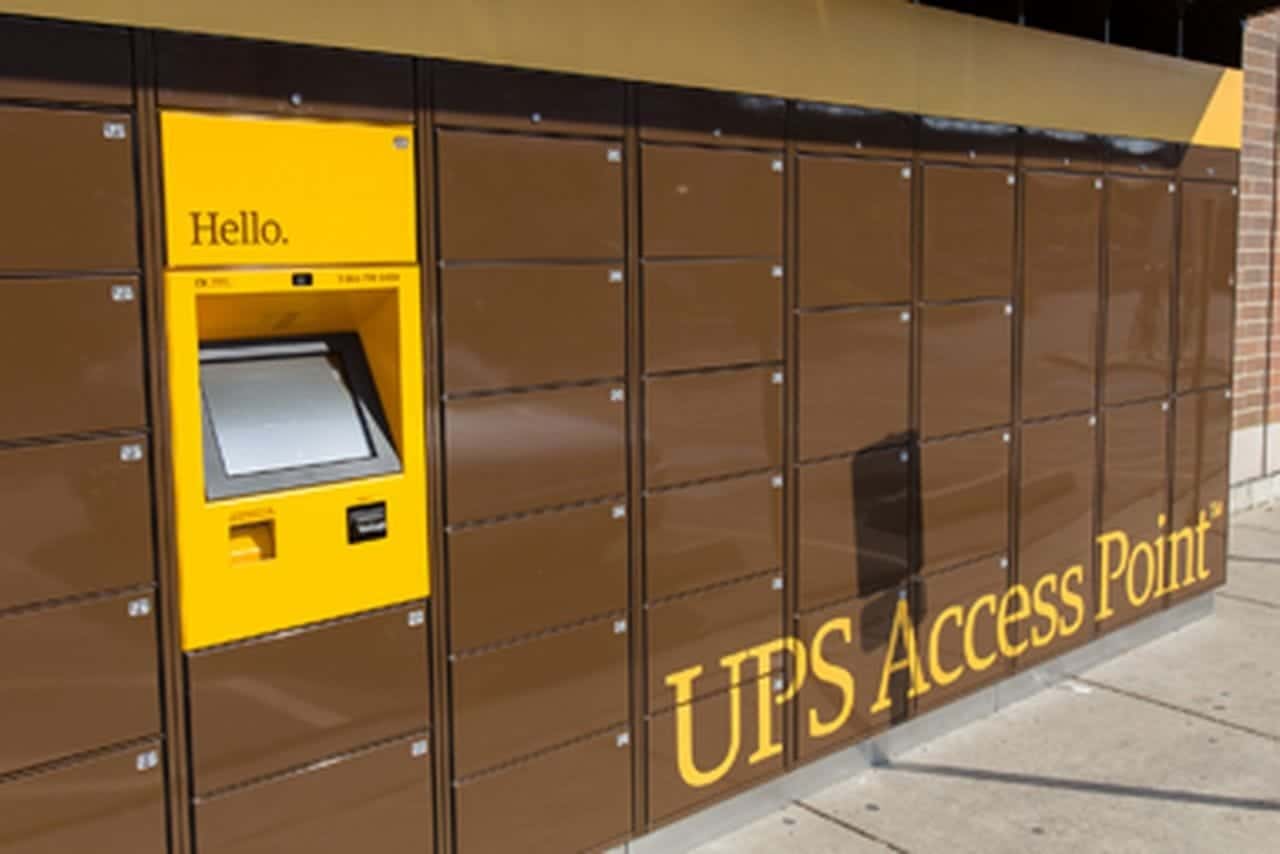
As you can see in the photos, it looks not dissimilar from the Amazon unstores which dot the college landscape. It has kiosks, a service counter, and UPS delivery boxes (in place of Amazon’s delivery boxes).

eCampus promises delivery within two business days (without any pricey membership fees). Students are notified of a textbook’s arrival by email or text message,  and they  can come to the store to pick up their order before heading off to class.

This, folks, is the future of college bookstores, one where almost everything is bought online and where the college bookstore is reduced to little more than a gift shop and a convenience store.

If you are in love with the idea of bookstores, that might sound frightening. Me, I can recall just how much textbooks cost and how little value I got out of a college bookstore, so it bothers me not at all.

Updated: Reading Books Will Help You Live Longer, Researchers Say

The NYTimes and other news orgs may have just fallen into another correlation/causation trap. Yesterday they published an article which implies that you will live longer if you read books:

Reading books is tied to a longer life, according to a new report.

Researchers used data on 3,635 people over 50 participating in a larger health study who had answered questions about reading.

The scientists divided the sample into three groups: those who read no books, those who read books up to three and a half hours a week, and those who read books more than three and a half hours.

The study, in Social Science & Medicine, found that book readers tended to be female, college-educated and in higher income groups. So researchers controlled for those factors as well as age, race, self-reported health, depression, employment and marital status.

Compared with those who did not read books, those who read for up to three and a half hours a week were 17 percent less likely to die over 12 years of follow-up, and those who read more than that were 23 percent less likely to die. Book readers lived an average of almost two years longer than those who did not read at all.

The NYTimes made it sound like reading more lead to living longer (see the headline) when in fact there’s no evidence showing causation which is exactly what the researchers concluded.

Edit: I followed up by email, and one of the paper’s authors told me that:

The NYT article did a good job summarizing our key findings: reading books confers a survival advantage, after adjustment for a whole host of covariates (sex, age, wealth, health, education, depression, etc). For this reason, we believe there is a strong connection between reading and longevity.

What are the chances they are right?

I for one don’t believe them. But then again they are the ones with the PhDs.

Do you think there’s a real connection, or is this a spurious correlation?

What I think we have here is a study which looked at population data and found a correlation between life expectancy and reading. And without data to explain the connection, that correlation doesn’t mean anything. Without evidence of a real connection, I see it as it’s as much a spurious correlation as the relationship between suicides and US spending on science, tech, and space.

Thoughts?

 image by ZapTheDingbat

Do Indies Have to Do Print?

Editor’s Note: Will O’Neill kindly agreed to share his experiences with print-on-demand, and help indies decide whether they need release a POD edition, or participate in B&N’s vanity press.

Years ago I tradpubbed an espionage thriller, The Libyan Kill. In print, traditional offset printing, 10,000 copies. If they had all sold it would have paid off my advance, nearly. But after 6 weeks or so Norton pulled back several thousand unsold copies and remaindered them.

Nowadays, I probably wouldn’t bother with a print edition at all. The market for thrillers is mostly e-books.

And the money is mostly in e-books, what money there is. The cover price for The Libyan Kill was $10.95—equivalent to $28.50 today. And most sales were at cover price. Nobody gets that kind of money for thrillers today, but plenty of indie authors get as much or more per copy as the roughly $2.50 (today’s money) that I got then, thanks to the magic of the economics of digital publishing.

In fact, I’m selling a somewhat updated version of the book in Kindle form for $2.99, from which I net nearly $2.00 a copy.

I thought about putting out a CreateSpace version too, but dropped the idea as not worth the time and effort. It would have cost me scarcely anything and probably would have taken no more than another week or two’s effort, but the market isn’t there.

Aside from the fact that people who read thrillers (and even more so the readers of romance and sci-fi) mostly really like e-reading, there’s cost. According to CreateSpace’s nifty royalties calculator, in order to get a $2.50 per copy royalty on Amazon sales of a POD version I’d need to charge $10.85, and if I wanted to shoot for the moon and get $2.50 from bookstore sales the price would have to be $16.25.

Maybe I could churn out a really super-hot new thriller. Maybe a wild tale about a wacked-out real-estate heir who runs for president. Oh, wait…. Anyway, something that could support a $16.25 cover price (remembering that nowadays scarcely any buyer would actually wind up paying that much). My royalty on Amazon sales would be a sweet $5.74 a copy.

What about the e-book version? Taking the Kindle as a convenient example, and allowing a $0.15 network charge, I could get a $5.74 royalty if I charged $8.35, less than half of the POD cover price. Even if Amazon knocked down the POD book price by 40% early on there would still be a lot of daylight between the prices of the p-book and e-book.

But if we think in terms of more realistic pricing levels for books in this category, say $3.99 for the e-book with equal-royalty POD pricing, the story starts to look different. Now my Kindle royalty is a still-respectable $2.65 or so. If the POD version comes out at 364 pages in 6”×9” trim size then I’d need to set the cover price over $11 to get that much in royalty per Amazon sale. And the gap between p-book and e-book pricing starts to look YUUGE, which is going to kill much chance of substantial p-book sales.

And if I tried to price the p-book to match the price of the e-book, CreateSpace would tell me TILT! $6.70 is as low as it can go—resulting in one penny royalty per copy sold on Amazon.

In fact, however, my latest book is World War I military history, The Plan That Broke the World. It’s a really different market. (Of course, if you don’t know who buys your books, you’re already in trouble.) Lots of older guys who don’t do e-books. Lots of gift books for Grandad, or Uncle Clem. (You have to know someone really well to gift an e-book, and it’s never the same as a p-book.) So a p-book is needed.

The good news is that people will pay more for serious history than for genre fiction. Not saying it’s right or wrong, just the way it is. So the POD edition is a paying proposition, and I even get some bookstore orders. But even though the Kindle is priced much lower, it pays me more – both per-unit, and since unit sales are divided roughly equally between POD and Kindle, my net revenues are about two-thirds to three-quarters from the Kindle side.

I’ve really gone out of my way to make this a good e-book; photo reproduction in particular is better than most tradpubs manage. (You can download the free sample and see for yourself.) Nevertheless, I’ve sold nearly as many p-books as e-books. So for this book a POD book was definitely worthwhile.

I’d love to hear from other indie authors about their thoughts and experiences regarding POD.

image by NYC Wanderer

Kindle Unlimited Launches in Japan, Costs 980 Yen a Month

Here’s a surprising bit of news.

Nikkei reports that Amazon launched Kindle Unlimited in Japan several hours ago on Wednesday. The program costs 980 yen per month and offers access to more than 120,000 Japanese titles and over 1.2 million titles in other languages.

Like the KU program in the USA and other countries, the frontlist selection is sparse:

Leading publishers including Kodansha and Shogakukan have made a portion of their catalogs available, including best-selling novels and business books. Publishers report that they will receive a cut of the service’s revenue, based on how often their offerings are read.

Yet new releases are few and far between, with almost no new books published from the past six months available for unlimited reading. Popular periodicals and strong sellers on other unlimited services are also lacking. A number of hit manga series offer only introductory chapters or volumes through Kindle Unlimited, pushing readers wanting more to purchase the rest outright.

If you’re like me then you probably thought Kindle Unlimited launched in Japan a while ago, but you would be mistaken.

Yes, Amazon has been paying royalties for ebooks loaned through KDP Select in Japan, but that was through the Kindle Owners lending Library, a program which let Kindle-owning Prime members borrow one ebook each month.

I double checked the Amazon.co.jp website in the Wayback machine at the Internet Archive, and there was no mention of Kindle Unlimited last week. The service only just launched today in Japan.

Coincidentally, this is the second unlimited reading service for Amazon in Japan. Today’s launch follows that of Audible Unlimited, which launched in Japan in July 2015.

Authors, Please Keep Telling Readers How eBooks Should be Expensive

What with the AAP reporting on the decline of publisher ebook revenues, and Big Five publishers either posting falling ebook revenues or refusing to talk about the category at all, I thought today would be a good day to to return to the topic of authors justifying high ebook prices.

Michael J. Sullivan wrote a post for Amazing Stories about a month ago that combines the Joe Konrath method of debate with a collection of straw man and "price of tea in China" arguments to defend high ebook prices.

Here’s an excerpt from his sixteen-hundred word post:

I had lunch at Chipotle after the subject was brought up. A burrito and a soft drink cost me about $10. A movie ticket costs between $8 and $14, but to own a copy it will run from $15 to $30. A pair of jeans cost $30 bucks, a T-shirt $20, a pair of shoes $60. Ebooks tend to range mostly between $0.99 all the way up to as much as $14.99, but most range between $5 and $10. After reading the above question for the second time I had to double check Amazon’s numbers to make certain ebooks hadn’t jumped up substantially —but $5—$15 for many hours (or week’s worth) of entertainment? Sounds like a deal to me.

The idea behind the question, as I understand it, is: since no printing is involved, or any other out of pocket expenses in the form of raw materials, why aren’t ebooks free (or something very close to it) If authors don’t have to invest money to create the product, why charge people to read it? I wonder if these same individuals assume a lawyer, psychologist, home inspector, or tax preparer should also not be paid? After all they don’t invest any money in the services they provide. An argument might be made that these people invested money in their education or in the cost of maintaining an office. But don’t authors do the same?

Perhaps it is the bizarre notion that anyone can sit down at anytime and write a novel—no education, no practice needed, and ignore the costs incurred from rent, mortgages, heating and cooling, books, seminars, software, travel, etc. that those serious about a writing career incur. But what about the editing? What about the cover art? Even ebooks need these, and they aren’t cheap. So, of course, there are investment costs even in an ebook—quite a bit actually by the time you add up the multiple editing, layout work, the art, and then the months or years of promotion and marketing that goes into getting a book noticed.

Authors travel across the country promoting their work, doing signing as bookstores, conventions, and other events. So there is the cost of entering these events, the cost of travel, the cost of hotels, and the time lost from their day jobs, and the cost of ads (if they or their publishers run them), the cost of making swag such as bookmarks, bookplates  and postcards to help prompt the book. Authors can easily invest several thousand dollars in a single book. Given that a great many authors don’t sell more than 5,000 copies (and that’s considered pretty good in the industry even if you’re traditionally published), and that Amazon takes 30-70% off the top, it is very likely the writer will not recoup their out-of-pocket investment.

According to his Amazon profile, Sullivan is a hybrid author; he has published with Hachette and Del Rey, released a couple titles as a self-published author, and in the past he published with his wife’s small press, Ridan Publishing (now defunct).

From what I have seen, all of Sullivan’s ebooks are priced at ten dollars and up (with the exception of the Ridan titles, which were later republished by Hachette).

In the past I have taken the opposing view when authors defended high ebook prices as the cost of doing business. But Sullivan’s arguments were so empty that I merely included his piece in a morning coffee post, noted a few key details, and then dropped it.

I was reminded of  his post over the weekend when Hachette, S&S, and PRH released their various financial reports and demonstrated that readers, as a group, do not agree with Sullivan’s arguments and aren’t swayed by the similar arguments made in the past (assuming the readers saw the arguments; the larger book industry is its own echo chamber).

Hachette’s ebook revenues peaked in the US in 2013, and have dropped precipitously since then both in terms of dollar value and as a percentage of revenues.

Sullivan is defending a pricing policy which has lead to declining ebook revenues at his publisher, and that refutes any bogus arguments and justifications in favor of high prices.

Arguing for higher ebook prices at this point requires that one first ignore all the industry data which is almost uniformly is lined up against the idea.

There’s no need to refute these arguments, or even respond – not when we can simply point to the data and show that the market disagrees.

So authors, by all means keep telling readers that ebooks have to be expensive; it has taken on a "get off my lawn" vibe, but if it works for you then don’t stop.

image by Julian Partridge

Txtr Has Closed, Customers Advised to Transfer Accounts to Juke

Eighteen months have passed since German ebook startup txtr declared bankruptcy, and just over a year since the company was taken over by Saturn, a media retailer and one of txtr’s partners.

And now txtr is no more.

Saturn sent out an email this morning through Juke Entertainment, its digital media outlet. The email informed txtr customers to the effect that txtr had been shutdown. (I’m paraphrasing; whoever wrote the email was apparently terrified of using words like "shutdown" or "closed".)

Txtr customers were given a link to register for an account at Juke, and advised that Juke "combines the world of digital entertainment – with a limitless selection of movies, series, music, e-books, games & software".

Txtr’s ebookstore has already been turned off, and according to the email the txtr servers will be shut off shortly after 24 October 2016.

Launched in 2009, txtr was initially a hardware company which wanted to develop a Kindle competitor, the txtr Reader. That device was repeatedly delayed and ultimately canceled after the bottom dropped out of the ereader market in mid 2010. (Amazon, B&N, and Kobo had all lowered their prices to the point that there was no profit margin.)

Txtr then pivoted to developing an ebookstore platform which it licensed to telecoms and other companies. It also loaded its software onto 3rd-party ereaders, including Pocketbook, and later developed the Beagle ereader.

The Beagle was launched in 2012 as a smartphone accessory which would be bundled with new contracts, and then died in 2013 when it turned out that neither telecoms nor their customers liked the limited functionality (it could only read ebooks which had been transferred from a paired smartphone) or its 59 euro price tag – only 10 euros less than the Kindle.

And now txtr is as dead as its ereaders.

RIP

Apple Launches Instagram Account for iBooks to Market Book Quotes, Reviews, and More

Apple has Twitter accounts for iBooks and Apple News, and now they’re expanding onto Instagram.

Over the weekend Apple launched an Instagram account for iBooks

The account only launched a day ago, and it already has fifteen updates. From what I can see, and from Mac Rumors description, it looks like Apple will be using the account to market to its followers:

Apple also wished author J.K. Rowling a happy birthday through its new verified Instagram page, but otherwise the content appears to largely be focused on introducing followers to fresh and notable stories through quotes, author spotlights, and unique, short videos.

Some of the novels referenced so far on the new page include Blake Crouch’s Dark Matter, Emma Cline’s The Girls, and Wendy Walker’s All Is Not Forgotten.

A number of the updates are reposted from other accounts, including Hachette Books and James Patterson.

See anything you like?

Instagram via macRumors

"Harry Potter and the Cursed Child" Disappoints Fans

When Harry Potter and the Cursed Child hit best-seller lists last week I expected that a lot of fans would be angry when they discovered it was a script rather than a novel.

It turns out that readers were less upset about the story format than the fact that they paid $15 to $18 for what was basically a rough draft of the story.

Cursed Child has been out for just under 24 hours, and it has already racked up nearly 400 reviews on Amazon.com, including 124 one- and 2-star reviews. With an average rating of 3.5 stars, over 30% of the reviewers have given the script book a negative review (the percentage is higher if you factor in the disappointed 3-star reviews).

At the time of writing this post, there are far more 1-star reviews than 3-star or 2-star reviews.

Citing everything from plot holes to bad dialog, retcons, an overuse of time travel, and Mary/Gary Sue characters,  readers express regret for wasting their time and money.

Here is a selection of the higher rated reviews:

  • Plot holes that Hagrid could fit through and over-wrought writing. … With the greatest deus ex machinas ever, polyjuice potion and a time turner, the writing team still wrote themselves into a corner and ended up ignoring the rules of the world they created.
  • This script is being touted as "Book 8". Sadly, that’s not what it is at all. JK ruined the characters by allowing someone else to "puppeteer" her characters which she slowly allowed to grow and thrive. It’s proof that a "Book 9" won’t be written, because she’ll have to clean up what was essentially a ghost writer did to her characters.
  • I think casual fans will really like this, but if you’re a big Harry Potter fan it’s very disappointing. Years of character development are thrown out the window, and the plot holes are more like craters. Overall the dialogue is poorly written, the characters are over to top, and the basis of the plot is beyond ridiculous.
  • This play was not what i expecting. I want depth, i want character development, world building and an author who builds a story that captures my attention. This thing was none of them and I’m very disappointed in J.K. Rowling for even thinking this was acceptable. I’ve read fanfiction that had more depth in its first paragraph than the whole play had.
  • Fully aware that it’s a script, not a narrative, that’s not the issue. The 'story' itself, the plot, reads like straight up bad fan fic. Voldemort had a daughter with Bellatrix? lol. Established characters act completely out of character… Cedric a death eater? Yeah, just not. Harry having suffered much abuse by his aunt and uncle tells his own child that he is unwanted? Just no. Time turners are used over and over to fix the past? Contrived and a kinda soulless fix to revisit dead characters. Will forever love all HP books, but not this story that feels like a money grab because we as fans will buy anything, even this convoluted mess.

I have not read the book myself, but the reviews make t sound like the first and biggest problem is that the Cursed Child wasn’t written by Rowling at all, and so it lacked the expected Rowling touch. The reviews have given me the impression that fans will soon be denying that this book ever happened (just like that XKCD comic strip).

That may change when the final version of the script book is published later this year, but it remains to be seen whether this mess will be salvaged by JK Rowling in a later book. The Cursed Child story may be rewritten as the stage play is tweaked to work better before a live audience, but Rowling has said that there will be no ninth Harry Potter book.

"He goes on a very big journey during these two plays and then, yeah, I think we’re done. This is the next generation, you know," Rowling told Reuters. "So, I’m thrilled to see it realized so beautifully but, no, Harry is done now."

Some are taking that to mean that the series has ended, but a careful reading tells us that Rowling didn’t say anything about the next generation, or the Harry’s parent’s generation. Rowling has left herself openings to write prequels or sequels – just not ones featuring Harry Potter.

Have you read the book? How would you have her fix it?

Fact Check: If Almost Forty Percent of ABA Members Aren’t Actually Indie Bookstores, Can We Really Say There’s a Revival?

For the past several years it has been fashionable to write about the indie bookstore revival, but there’s a huge problem with many of the stories: they cite data which doesn’t stand up to scrutiny.

Starting in 2013, many bloggers and journalists have cited the membership count of the American Bookseller Association in support of the narrative that indie booksellers were going through a revival.

For example, one of the points Glenn Fleishman raised in his article in the Seattle Review of Books last week touched on this data point:

Now indie stores are seeing a resurgence — small, but noticeable, sustained, and continuous. The ABA says its membership has grown from 1,401 and 1,651 locations in 2009 every year through the current one, with 1,775 members and 2,311 stores even as Borders shut down and Barnes & Noble closed 120 outlets during the same period. (Not all indie stores are ABA members, though most are. This can result in apples-to-oranges comparisons among articles that rely on ABA numbers, industry figures, or government analyses.)

I was one of the first to report on the revival in 2013; at that time I saw the ABA membership stats as evidence which disproved the then-accepted belief that Amazon was killing indie bookstores left and right.

Today I would like to clue you in on a detail which a friend on Twitter pointed out a while ago: there’s a problem with the ABA data.

Sure, we’ve read many stories about new bookstores opening, including about a franchised chain of used bookstores. And yes, nineteen of the twenty new ABA members are bookstores.

But the fact remains that a significant number of ABA members simply are not bookstores.

While the ABA has positioned itself as representing indie booksellers, it will actually accept retailers of all type. In fact, its membership application form invites prospective members to identify as "non-bookstore", and the form welcomes all type of businesses, including online sellers, museums, colleges, and even "non-retail operations". (I am seriously tempted to join under that last option.)

As a result, the actual ABA membership rolls are more diverse than the group’s name would suggest. In Virginia, for example, the ABA lists 51 members. At least twenty of those members are not indie bookstores.

Four college bookstores in Virginia are ABA members, including two stores run by Follett. The membership roll also includes two online booksellers (one is just down the road from me) and an online retailer as well as the Marine Corps Association, three national parks, a toy store in Staunton, a museum, a community center, a holistic store, and five Hudson News airport concessions (actually around a dozen locations in five airports).

I’m sure all of these entities sell books, yes, but that still doesn’t make them indie bookstores any more than Walmart.

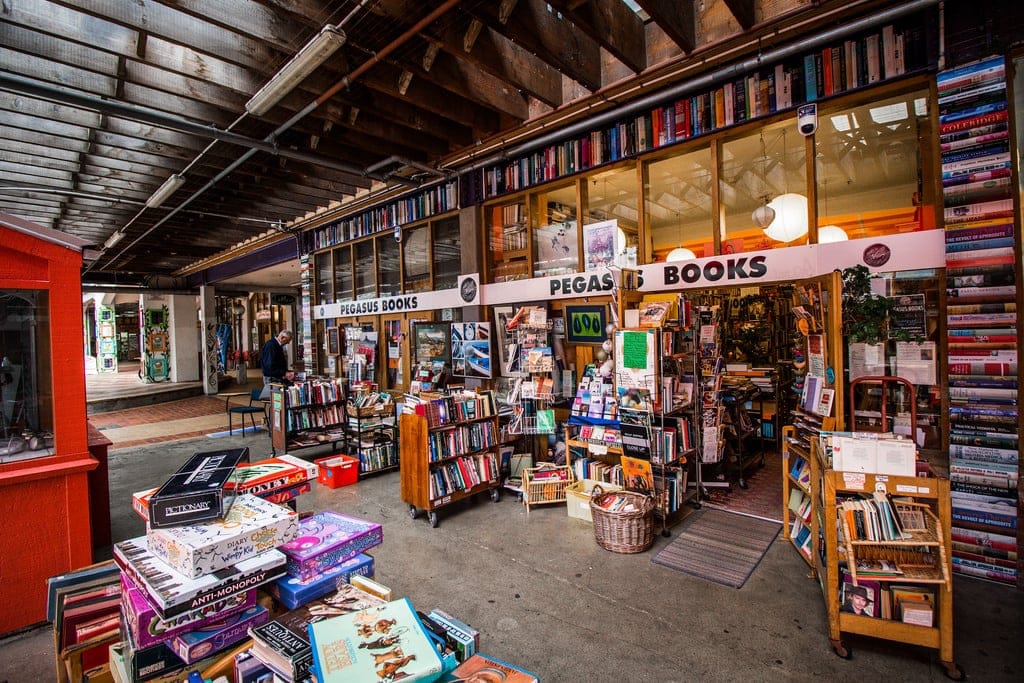
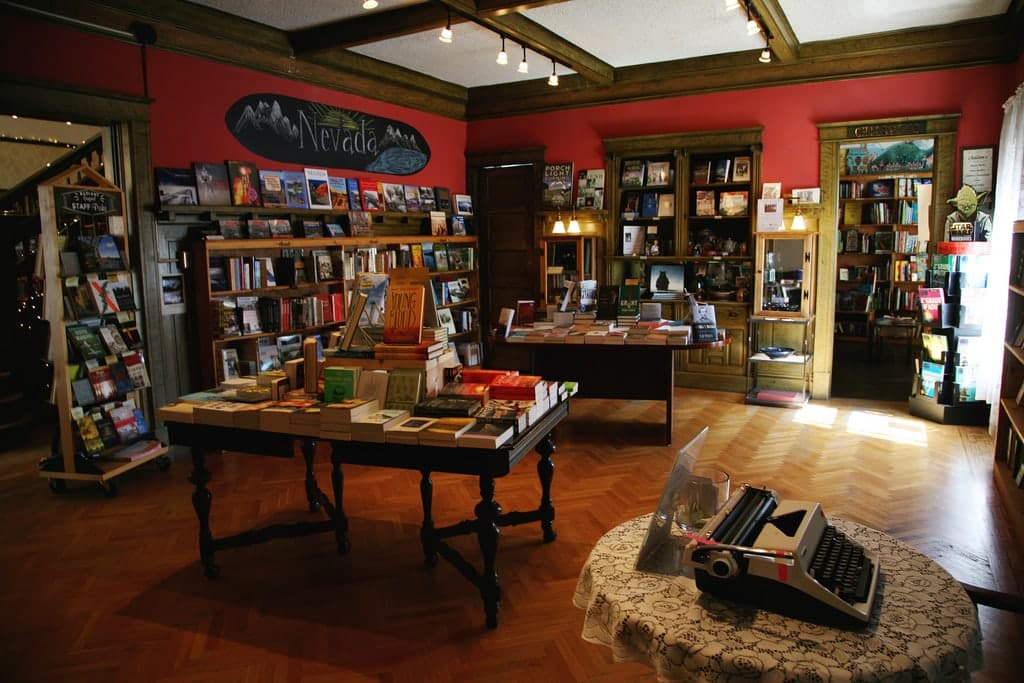
Remember, the phrase "indie bookstore" connveys the image of a small local bookstore which is run by the owner, and possibly looking something like this:

So tell me, with almost 40% of ABA members in VA not being indie bookstores, can we really say that there’s a revival?

Not from the ABA membership roll, no, but not all bookstores belong to the American Bookseller Association.

Just in my immediate geographic region, I can find four indie bookstores which don’t belong to the ABA. (What’s wrong with the ABA that I have more non-member indie bookstores within driving distance than ABA members? Is the membership really worth so little?)

If we could find a real source of statistics on bookstores, one which counted all indie bookstores and tracked the number of locations (one ABA member in Virginia has three bookstores) then perhaps we could answer that question.

But as it stands, there’s no way to know for sure.

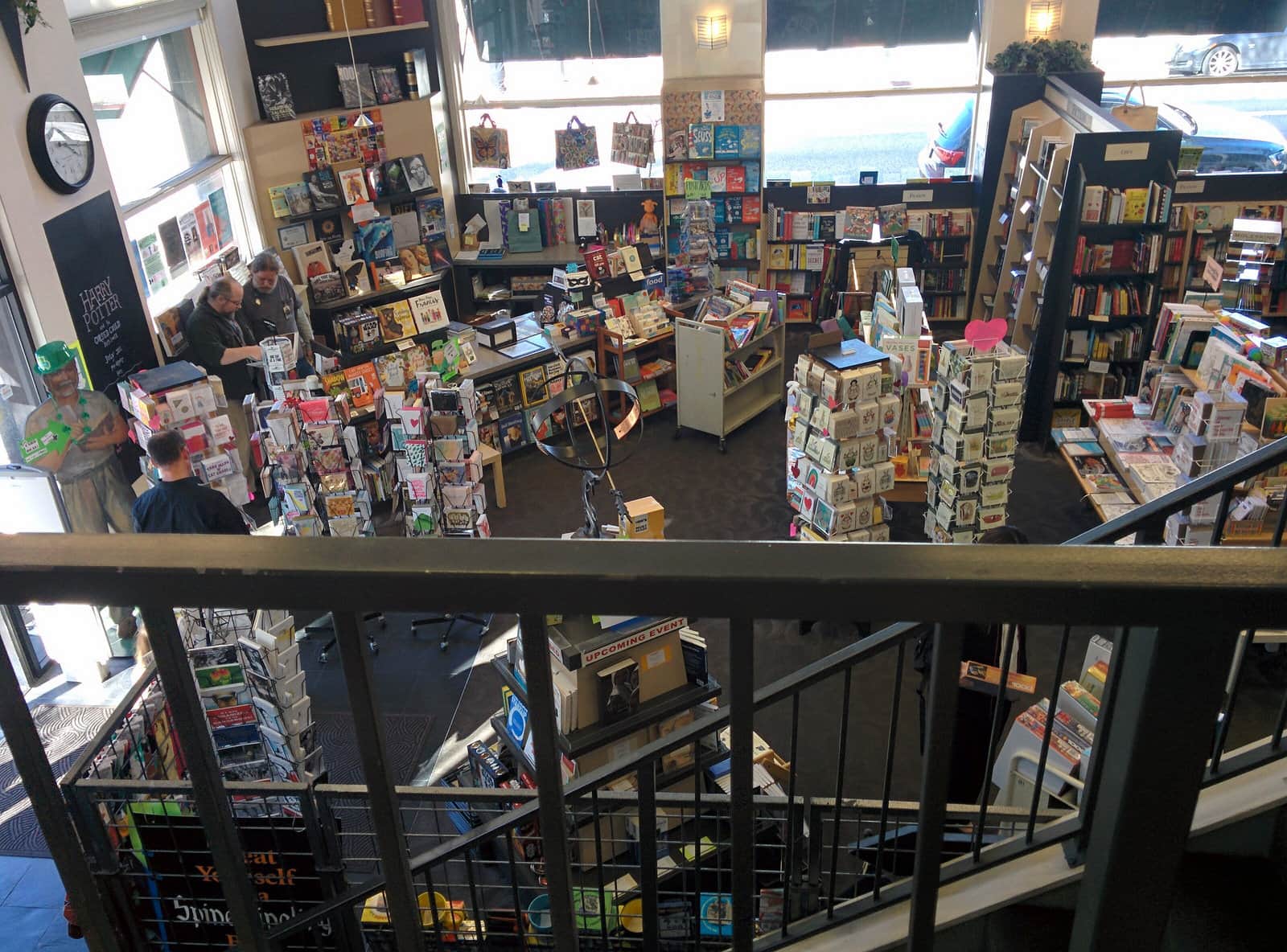
images by robwalsh0, TravelNevada, leighklotz
Simon & Schuster, Penguin Random House Don’t Want to Talk About Their eBook Sales

In past years the Big Five/Six touted their ebook sales as a percentage of total revenue. You sometimes had to dig for the details, but they were there to be found.

That changed this week. Something tells me that they aren’t quite so eager to let us in on just how poor their ebook sales have been since they regained control of their ebook prices in early 2015.

Over the past week three of the Big Five publishers have posted either quarterly, half-annual, or annual reports, and only one even came close to telling a complete story about its ebook sales.

First up is CBS Corp and the few nuggets they shared about Simon & Schuster in the second quarter CBS financial report. Revenues were down overall, and so were ebook sales as a share of said revenues (from 24% last year):

Publishing revenues for the second quarter of 2016 were $187 million compared with $199 million for the same prior-year period. Digital revenues represented 23% of Publishing’s total revenues for the second quarter of 2016. Best-selling titles included End of Watch by Stephen King and Foreign Agent by Brad Thor.

Publishing operating income of $26 million for the second quarter of 2016 was up 4% from $25 million for the same prior-year period, as the revenue decline was more than offset by lower production, selling, and inventory costs.

That is literally everything that CBS was willing to say about ebooks, and if you think that is sparse then you should see what Pearson said about Penguin Random House.

This is the entirety of PRH’s report on ebook revenue stats (aside from a few useless factoids):

Penguin Random House had a solid performance in the first half of 2016 with reduced demand for e-books following last year’s industry-wide digital-terms changes offset by the phasing of further integration benefits.

I am not joking; that’s it. eBooks aren’t even mentioned in the transcript of the investor conference call.

Apparently PRH is so embarrassed by its ebook stats that they aren’t even going to give any figures.

I bet Lagardère wishes they had thought of that, because the slides for their year-end financial report show that ebooks, as a share of revenues, peaked in 2013:

Lagardère’s US revenues were essentially flat in 2015 (down 0.3%). Their overall book publishing revenues were up 10%, but that reflects activity in a half dozen different markets so it means less to us.

So there you have it; one publisher obliquely referred to declining ebook sales, another provided minimal stats. and a third which revealed just things have gone awry since the return to agency.

Do you suppose it’s too soon to pressure Amazon for new contracts?

image by mikecogh

Why Indie Authors Don’t Need to Bother With B&N’s In-Store POD Program

Last month B&N expanded its vanity press operation Nook Press with a new POD option where indie authors might possibly if they are lucky get their books into Barnes & Noble store.

The coverage ranged from bland in the trade press to dismissive in the indie blogosphere, but one commentator thought that this was a coup for B&N.

Thad McIlroy describes it as B&N finally having "made a competitive move that Amazon cannot match". He justifies his claim with the argument that print still accounts for two-thirds of the market:

In my coverage of last fall’s NINC conference I noted some remarks from publishing expert Lou Aronica. Lou provided a forceful reminder that self-published authors can’t afford to ignore print: it still accounts for some two-thirds of book sales overall. The larger problem is getting retail access for print. Independent booksellers have always been more open to dealing with self-published authors than the chains. But trying to get into the 2,311 outlets operated by the 1,775 American Booksellers Association (ABA) members is a logistical impossibility. Barnes & Noble has fewer total outlets than the ABA, but a lot more floor space. And just one buying office. At least one report shows bookstore chains with two-and-a-half times the marketshare of independents. Further, getting self-published books into non-bookstore outlets like drug stores and supermarkets is just a dream. And so access to Barnes & Noble should be a big deal.

Do you see the flaw in his argument?

I didn’t see it until after Data Guy dropped his bomb at the RWA conference earlier this month. DG shared data on sales of romance novels in the US, and then in the comment section of his post he added a few additional details about thriller and SF&F sales.

To put it simply, the flaw in McIlroy’s argument is that he took industry-wide figures and assumed that they applied equally well to all of a single market, when in reality the industry stats reflect revenues generated in a variety of markets and genres, each with their own quirks.

Take romance, for example.

DG showed us that ebook sales accounted for 89% of US romance unit sales. I would say that is a market where authors could afford to ignore print sales, and the same is true for thriller/mystery/suspense.

When queried about the thriller genre, DG explained that his data showed that thriller ebooks accounted for 112 million sales in the US market in 2015, while print sales in this genre only added up 40 million units last year.

That’s 40 million out of around 152 million, or about 27% of the units sold. That is arguably a market which indie authors can ignore print if they want.

The same may be true for SF&F. Data Guy’s data showed that ebooks accounted for a little over half of unit sales in this genre. Print accounted for 54 million units, while ebooks totaled 73 million units.

Print SF&F titles accounted for around 43% of units sold in this genre.

While some might point to that and argue this is a market which indie authors can’t ignore, I would remind you that indie authors get into the print SF&F market through POD, which has relatively low profit margins when compared to ebooks.

In other words, it’s not worth as much to indie authors as you might think.

Really, the only reason I see for romance, thriller, and SF&F authors to be interested in B&N’s new POD program is for the ego boost.

The real money is in digital in general and the Kindle Store in particular, which is why I have dubbed Nook Press a vanity press operation.

There isn’t enough money in POD sales through Nook Press to count as a major market, not when digital accounts for such a huge share of certain genres, not when B&N has only 640 stores, not when B&N is converting more and more floor space to things like pasta and 3d printers, and not when all four of B&N’s new stores will be restaurants first and bookstores second.

Or did I overlook something?

The comments are open.

image by mikecogh

Kobo Teases August Launch Date for its New 7.8″ eReader. the Aura One

A little over a month ago Kobo’s next two ereaders showed up on the FCC website, and now it appears we’ll be seeing the hardware itself in a couple weeks.

Last night Kobo CEO Micheal Tamblyn tweeted a teaser image which showed part of the backside of some device.

For the sake of neatness, I cropped the image to show just the device and not pebbles it is laying on:

Everyone is calling that the Kobo Aura One because that is the name mentioned in the FCC paperwork last month. The name hasn’t been confirmed, however, nor has the assumption that the Aura One will have a 7.8″ screen as mentioned in the filing.

All we know at this time is that two devices from Kobo have cleared the FCC. Both filings showed screenshots from Kobo ereader software, which suggests that these really are ereaders rather than tablets or some exotic device. Both devices were test for Wifi, but that’s where the similarity ended.

The second device was referred to as the "Kobo Aura Edition 2″ and according to the test paperwork it has a 6″ screen to the Aura One’s 7.8" screen.

Whether those details will be confirmed when the new devices launch in a couple weeks is another matter.

Google Play Family Library Lets (Some) Share eBooks, Other Content

Google formally announced the launch of its family library sharing plan today, showing that early reports of Google Play Family Library’s flawed design were greatly exaggerated.

Google announced on its official blog on Wednesday that users in Australia, Brazil, Canada, France, Germany, Ireland, Italy, Japan, Mexico, New Zealand, the UK, and the US will shortly be able to set up a family account and share content.

The service first launched last year, but could only be accessed by paying for a Google Music subscription from inside the Google Play Android app.

Now we’re going to be able to set it up via the Google Play website. Or at least that is what reports claim; it’s not available to me. And according to the FAQ page, the family library is supposed to be available through Google Play Android app.

That isn’t working for me; how about you?

According to Google, it’s supposed to work like this:

When you buy an eligible app, game, movie, TV show, or book in the Play Store, you can now share it with your family—across devices—with no additional sign-up fee.

Today’s families have a lot of devices, and it should be easy to share content no matter where we are or what we’re doing. Everyone in my family loves the Star Wars movies and we all want to be able to watch them, on our phones, tablets, laptops, or TV. All purchases added to Family Library are available across Android devices, and movies, TV shows, and books can be enjoyed on iOS devices and the web.

Is that how it’s working for you?

New Survey Shows Used and Rented Textbooks Still Trump e-Textbooks

Digital textbooks are one of those ideas which publishers and technologists love but students don’t like so much. They failed to catch on for a couple obvious reasons (money, and the fact that college students lack the same) and as a recent survey showed us this is still true in 2016.

Campusbooks.com has released the results of a survey it conducted in the spring 2016 semester. It polled 1,067 college students in the US, and found that students would rather buy used or rent than buy an e-textbook.

The survey also showed that students were savvy consumers who tended to spend less on textbooks the longer they were in college. Survey respondents averaged $488 on textbooks, with freshman spending $572 and seniors spending an average of $421.

Other results include:

  • The largest proportion of students, 67 percent, buys used textbooks, 55 percent rent, 25 percent buy new and 25 percent download e-books.
  • Nearly 66 percent of students have opted out of buying a textbook due to the cost.
  • The proportion of students who buy new textbooks decreases as their tenure in school increases, and the proportion of students who rent textbooks increases significantly.
  • Students use creativity to overcome the lack of a textbook, primarily searching content online (63 percent) or sharing textbooks with friends (58 percent).

The problem for textbook publishers is that textbooks aren’t the special snowflakes they used to be. Much of the info in textbooks can be found online both as webpages, from other people, or via other sources like Youtube.

Thanks to the internet and the prevalence of cheap gadgets, students are spending a lot of time online. The survey found that the typical student spends 41% of their 168-hour (7 day) week on all electronic devices, combined. Most of that time was spent on smartphones, which 94% of students own (only 89% own a laptop).

But even though students are on their smartphone a lot, they’re not making calls. 36% of students said texting is their main use for their smartphone, while apps account for the second highest use (1%). And only 5% reported using their smartphone primarily for phone calls.

They’re also not using that smartphone for school. The survey found that students were 2.3 times likely to use their mobile devices for personal time than for academic purposes.

And when it comes to tablets and ereaders, ereader use declined 22% while tablet ownership climbed 15%.

image by mer chau