Google is Once Again Cracking Down on Interstitial, Pop-Up Adverts

Interstitial and pop-up adverts (like the one Google uses to harass mobile users of Gmail) are the bane of mobile browsing. 69% of a website’s mobile visitors will leave if prompted to install a mobile app, which is why Google had previously cracked down on pop-up ads which pitched mobile app installs.

And now Google is expanding their focus to include more types of annoying ads (like the ones supplied by Adsense, for example).

The ad network announced on the Google webmaster blog yesterday that it was cracking down on sites which used annoying pop-ups and interstitial adverts on their mobile site.

Google won;t be penalizing all sites for using interstitials, just those that use a particular type:

  • Showing a popup that covers the main content, either immediately after the user navigates to a page from the search results, or while they are looking through the page.
  • Displaying a standalone interstitial that the user has to dismiss before accessing the main content.
  • Using a layout where the above-the-fold portion of the page appears similar to a standalone interstitial, but the original content has been inlined underneath the fold.

Sites which use small banner ads, login pages for paywalls, and notification pop-ups for cookies will not be impacted, Google said.

Ads like those Adsense ads, or the annoying Youtube pop-up ads, will draw a penalty in Google’s search ranking.

On the Sad Puppies "Defeat" at the 2016 Hugo Awards

Over the past few years a certain subset of fans known as the Rabid Puppies and Sad Puppies have been collectively trying to game the annual Hugo awards for best SF and fantasy stories.

Depending on who you ask, their motivations were either to gather support for a type of SF which had been excluded from the Awards by insiders, or to introduce a reactionary slate consisting of white male authors.

Neither is quite accurate, but that matters less than the fact that in past years the Puppies didn’t have much success.

But this year, despite press reports to the contrary, they succeeded.

Despite having what appeared to outsiders as a cohesive voting block, the Sad Puppies have had less than complete success in past years . In 2015, for example, many of the Puppies' candidates didn’t just lose, in many categories they even ranked behind "No Award", a sign that more voters would rather give the award to no one rather than give it to a Puppies candidate.

In fact, in five categories (Best Novella, Short Story, Related Work, Editor Short Form, and Editor Long Form) no one got an award last year.

And now, in 2016, the Puppies are being described as having been defeated once again. The Guardian covered the Hugo Awards in an article this morning, describing it thusly:

Another attempt by the Sad and Rabid Puppies groups to hijack the science fiction award goes to the dogs, as authors and titles not in their campaign take top prizes.

The winners of the 2016 Hugo awards have been announced, with this year’s choices signalling a resounding defeat for the so-called “Puppies” campaigns to derail the venerable annual honouring of science fiction literature and drama.

The winners were announced on Saturday evening at MidAmeriCon II, the World Science Fiction Convention held this year in Kansas City.

The Guardian call this a defeat, but I would say it is at least a partial victory.

You can find the list of winners over on the official Hugo awards blog, as well as the voting records for this year.

As you can see when you compare the ballot to the Sad Puppies recommendation list, a fair number of Sad Puppies candidates made it through the nomination process and ended up on the ballot.

Last year the Puppies swept certain categories, filling all five slots in some categories with their candidates. They weren’t quite that successful this year, but they made their presence known.

For example, all five authors on the Best Novella ballot were Sad Puppies candidates, as well as three of the Best Novellette candidates and three of the Best Short Story nominees.

Four of the authors up for a Campbell were on the SP recommendation list, and last but not least two of the names up for Best Fan Writer were recommended by the Sad Puppies.

In all five of these categories, an SP candidate went on to win a Hugo.

And this is what The Guardian would describe as a defeat.

If this were politics, a five-person voting block (out of fifteen seats) would be considered a power to be reckoned with, if not the dominant force in its legislative body. The only ones who would phrase that as a defeat would be its political opponents.

But this isn’t politics, and it would be wrong to count these five wins as a block. And that is also true for the sixth Sad Puppies win.

Coincidentally, the Sad Puppies also recommended the winner of the Best Long Form Dramatic Presentation category (as well as three other candidates), but I’m not sure they should get credit for it because both the winner and the runner up were the odds-on favorite to win anyway, which brings me to the real point I wanted to make today.

The reason these Sad Puppies candidates won this year wasn’t coordinated action on the part of SPs but rather that the candidates were already popular choices.

Fury Road and The Martian were popular with film-goers, which is how they ended up being recommended by the Sad Puppies.

What some of the Sad Puppies detractors may have missed is that this year the SP nomination process was open to all.

The official Hugo nomination process has a poll tax in that you have to buy an associate membership for WorldCon to nominate or vote, but the Sad Puppies were more democratic. All you had to do to recommend someone for the SP list was to leave a comment on the SP blog defending your choice.

The Guardian and others may describe the Sad Puppies as right-wing reactionaries, but what they missed is that this year everyone who wanted to speak was given a voice.

As a result, the Sad Puppies list this year wasn’t the right-wing political slate of past years; instead it included diverse recommendations like Nigerian-American author Nnedi Okorafor.

As John Scalzi noted back in April, the Sad Puppies list this year was closer to a straight-up popularity contest:

This is a fact the Puppy groups have taken to heart. This year, once again, the two Puppy groups announced slates (or in the case of the “Sad” variant, a “recommendation list”) of people and works they wanted to see on the finalist ballot. Once again, many of their choices made the cut. But where last year’s slates were filled with nominees primarily of interest to the Puppies themselves, this year’s Puppy slates included works and authors already popular with science fiction fans and tastemakers, and (as a subset of both of these) Hugo voters.

Scalzi doesn’t give the Sad Puppies credit for shit, and instead wrote that "the Puppies are running in front of an existing parade and claiming to lead it".

Me, I see things differently.

What was a political fight in past years has been co-opted in 2016 into a popularity contest.

It may not stay that way in the coming years, but if the next Sad Puppies list is open for all to participate then you would have to be an idiot to continue to write off the Sad Puppies as right-wing reactionaries.

What authors should be doing instead is planning how to game the next Sad Puppies list, because it could become a whole lot more important in the coming years as a proto-Hugo nomination process.

The Hugo is said to represent all of SF, but in reality only a few thousand ballots are cast each year.

If you look at the Hugo voting records for the past few years, you’ll see that that the number of valid ballots grew from 1843 in 2013 (the first year of the Puppies) to 3587 ballots in 2014.

And then last year, when the Puppies campaign came to naught, there were 5950 ballots cast for the Hugo Awards. That is the largest number of ballots ever cast for the Hugo Awards in a single year, and judging by the number of ballots this year it may never be equaled because:

A grand total of 3,130 ballots were cast this year.

Yes, that is barely more than half the number of ballots cast in 2015, and now that the Puppies furor has passed we can expect even fewer ballots cast in 2017.

It’s going to take fewer votes to win a Hugo next year, which means that getting the support of an additional 100 to 200 votes from the followers of the Sad Puppies list could be enough to secure a nomination, which is the first step to winning a Hugo.

If nothing else, the publicity will get readers to take a look at your work. (That’s certainly true in my case; there are a half-dozen writers I discovered only because of the Sad Puppies coverage earlier this year).

You’re welcome to pull back in revulsion at the idea of working with the Sad Puppies, but if I thought I had a shot I would be planning next year’s Sad Puppies Hugo campaign right now.
Kobo Wins Appeal Over Agency eBook Pricing in Canada

Kobo has successfully appealed a 2014 consent agreement between the Canadian Competition Bureau and Hachette, HarperCollins, Macmillan, and Simon & Schuster where the publishers had agreed to abandon agency pricing and let retailers set the retail price of the ebooks they sell.

As a result, the Competition Bureau is back to square one, and the publishers are free to set their prices as they wish.

In 2012 Canada was set to follow the US and European Union in ending the agency model in the local ebook market. The Competition Bureau had worked out a deal in 2014 with four major Canadian publishers for the publishers to relinquish control over ebook prices, but unfortunately that consent agreement was never put into place.

Kobo objected to the agreement, arguing that they could not effectively compete without ebook price controls, and and they convinced a tribunal to issue a stay.

That was in early 2014, and for the past couple years the Canadian legal system ground forward at the usual glacial pace, with Kobo, the publishers, and the Competition Bureau filing various paperwork.

In June a tribunal ruled in favor of Kobo, and set aside the consent agreement while noting that it was based on allegations rather than conclusions backed up by evidence.

The CA that was reached between the Commissioner and the Respondent Publishers is rescinded, with prejudice to the Commissioner entering into a new consent agreement with any of those Respondent Publishers on the basis of allegations that are the same or substantially the same as the allegations that form the basis of the CA, but without prejudice to the Commissioner entering into a new consent agreement with the Respondent Publishers based on conclusions he may reach regarding the six elements of the reviewable conduct under subsection 90.1(1) of the Act, in accordance with these reasons.

Coincidentally, Kobo’s stalling lead to Canada keeping the same price controls which were removed from the US ebook market in 2012-2013 when US publishers settled with the DoJ, and which later returned when the publishers negotiated new contracts with Amazon and other retailers in late 2014 and early 2015.

Other countries, including Argentina, Germany, and Japan, have laws on the books where retailers are required to sell books and ebooks at the price set by publishers.

Thanks Anne, for the tip!

image by cam_rich345

Kobo & Overdrive – What We Know So Far

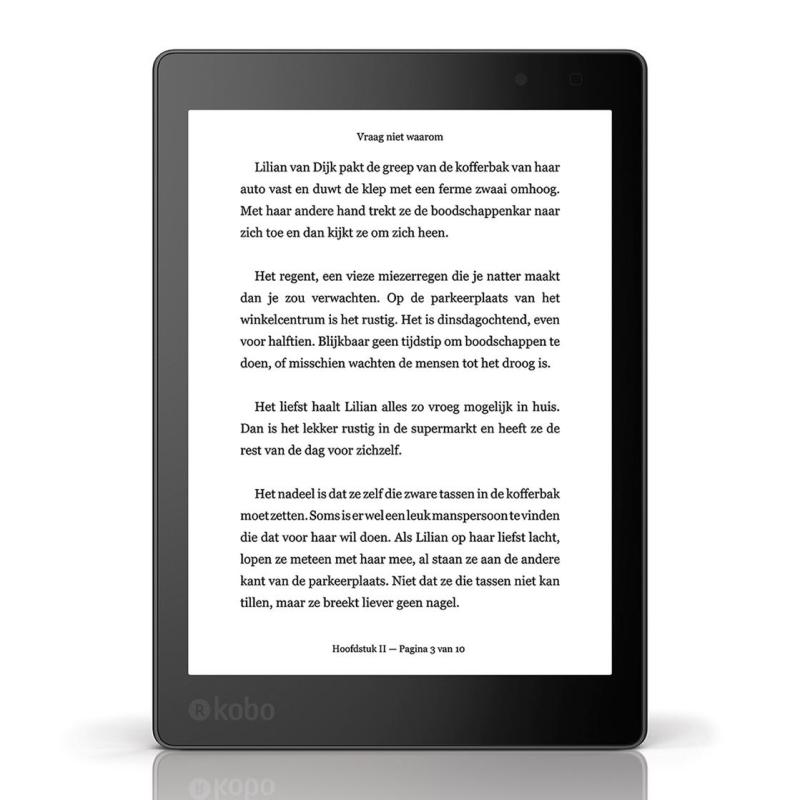
In addition to a night-reading mode, what sets the newly launched Kobo Aura One apart from other ereaders is the way it supports library ebooks.

The Aura One features close integration with Overdrive, the library ebook vendor bought by Rakuten last spring. There are no first-hand reports yet, and I am still waiting for Kobo and OverDrive to get back to me with answers to my questions, but here’s what we know so far.

  • the Aura One is running firmware 3.20.7280
  • no other Kobo ereader has this firmware, and it’s not mentioned on their product listings
  • the feature only works in US, UK, Canada, NZ, and Australia

The way this is supposed to work is that once you have entered your Overdrive info in the settings menu, you can simply search the Kobo store on the Aura One and the ebooks you see will list their price as well as whether they are available to be checked out of your library.

You can check out an ebook on the Aura One, and you can also place a hold for an ebook. Any borrowed book will indicate how long until the library loan expires. This detail is displayed when you put the Aura One to sleep.

I use the word "supposed" because this feature does not work yet.

My Aura One came with an OD account set up, but I couldn’t find any ebooks to borrow. There’s no way to filter for this option when browsing the Kobo store on the Aura One, and there’s no way to just browse your library’s ebook catalog.

Since I couldn’t find any ebooks,  I went into the settings menu, logged out of OverDrive, and tried to enter my account. This didn’t work. The Aura One wouldn’t accept my info, and with good reason.

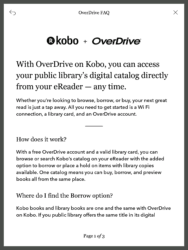
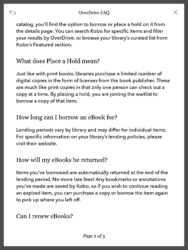
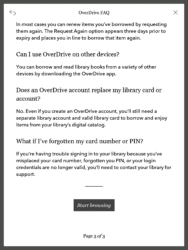
It turns out that the feature is not yet live. I’ve just been told by Kobo that the software is a demo, "a high-level overview of Library Lending (the feature is not yet live). When the device launches in September, you will be able to add your library card and borrow then."

In other words there’s not much I can say about this feature until Kobo turns it on sometime next month, but I won’t send you away empty handed.

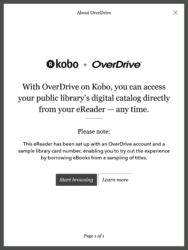
The following four screenshots show you all the info the Aura One has on the is feature. Until we can pry a user manual out of Kobo, this is most of what we know about how this feature will work.

Enjoy.

The Fourth Time is the Charm: Wattpad to Interrupt Stories With Adverts

Wattpad styles itself a community, but it has the same problem as any other site which hosts content: money.

Over the past few years the social reading community has dabbled in several ways to generate revenue: crowd-funding, native advertising, and selling content.

And now Wattpad is going to deploy ads inside the stories published on its site. From PW:

Wattpad, the online reading and writing community, is launching Wattpad Futures, a new program that will place paid advertising between the chapters of selected stories on the site. Every time a reader views an ad, the writer will earn money.

Ashleigh Gardner, head of content for Wattpad, said the new program will feature “interstitial” advertising between chapters of works posted on Wattpad. Gardner said the program, which will initially run video ads, will eventually include display ads as well. The ads will be placed every few chapters and will also appear every 30 minutes during a reading session.

According to Gardner, about 100 writers invited to be part of a beta test earned nearly a $1,000 a month through the program. Some, she noted, earned nearly $2,000 a month.

Given that ad-blocking is on the rise and the relatively low density of the ads, this venture won’t generate much revenue. And that’s a shame, because Wattpad could definltely use the money.

The thing about Wattpad is that its founders took a wrong turn in the early years. They focused too much on building the community and helping writers create rather than on developing a tool which authors could use to make money.

As a result, authors have been growing their audiences by developing stories on Wattpad and then listing the stories for sale elsewhere. That’s bad news for Wattpad because if it were also a distributor then it could earn a share of those sales. The same is true for selling ebooks on the site.

(Or at least, if Wattpad does sell ebooks or distribute ebooks to Kindle, iBooks, and other ebook retailers then it must be keeping this feature a secret because I sure as heck can’t find anything in the FAQ.)

The best part about selling or distributing ebooks is that the revenue stream would scale with Wattpad as the community grew. Now Wattpad has some 40 million visitors to the site each month, and not a lot of revenue to show for it.

But instead of distributing ebooks, Wattpad has experimented with other ways of making money, including adverts.

Oh, well.

Maybe this is something Wattpad’s future buyer can fix. Rakuten, for example, would be wise to buy Wattpad and partner it into Kobo.

There’s obvious synergy there, don’t you think?


Hands On With Kobo Aura One Night Mode (video)

When Kobo announced the Aura One ereader this morning, one question was at the top of everyone’s mind:

How the heck did Kobo add a night-reading mode with a red-orange filter?

Night-reading modes were a hot topic in the ebook world last year. Amazon, Google, and even Apple released updates for Android, iOS, and Fire tablets which added optional bluelight filters.

The thinking behind these filters is that they are better for you to use at night because the blue end of the light spectrum is most likely to keep you up, which is why there are apps for iOS and Android that can do this.

However, the apps use a trick which won’t work for E-ink screens; they variously disable the blue light coming out of the RGB pixels on a mobile device’s screen (some apps like do a lot more).

The best ereaders on the market have a grayscale screen and a white frontlight, so you would think it would be impossible to add a frontlight which could shift colors.

But Kobo found a solution – one so obvious that I have to wonder why no one else has used it in the seven years since Sony debuted a frontlight on the PRS-700.

A frontlight on an ereader is lit by tiny LEDs around the frame, and the ereader might have any where between 4 to 10 of them. Amazon made a big deal over the Kindle Oasis having ten LEDs (more than any other device) but Kobo found a better use for LEDs.

Kobo added an extra LED which provides a red-orange tint, and then changed the software so that users could adjust the brightness and the tint independently.

Correction: The Aura One has "9 white LEDs and 8 RGB LEDs (with 3 lights in each)".

I shot a couple videos to show it off. The first was in a room lit by sunlight, so it’s hard to see the night-reading mode.

https://www.youtube.com/watch?v=w8_2FP3J3cI&feature=youtu.be

The second video was shot in a fairly dim room so that you can see just how strong the red-orange color can get.

https://www.youtube.com/watch?v=dAqN5MchzE0&feature=youtu.be

I don’t know if you can see it in the video, but the red-orange LED appears to be located along the bottom edge of the screen. From what I can tell there is only one, and as a result I can see a noticeable color gradient between the bottom and the top of the screen.

Edit: No, that is just a quirk of the light interactig with the film over the screen.

Then again, I am looking at this screen with a critical eye which is trying to find fault. A regular user might not notice, or care.

What do you think of the night-reading mode?

Kobo Aura One Ships in September, Will Cost $230

Kobo hasn’t sent a press release yet with an official announcement, but a bunch of sites have posted reviews of the new Kobo Aura One on Wednesday.

I still don’t have one of these babies (I found out while writing this post that mine is literally on the UPS truck right now), but The Verge, Tom’s Hardware, and Techcrunch have all posted reviews which confirm the leaked specs and our guesses about the prices.

Update: the product listing is now up.

The Aura One will cost $230 when it goes on sale on 6 September. It’s going to be available in the US, Canada, UK, France, Netherlands, Germany, Spain, Japan, and Turkey. Prices will vary across markets (according to last week’s leak the Aura One will cost 229 euros).

This ereader is not only larger and as sharp as Amazon’s flagship Kindle, it also costs less and is nearly as thin.

And it looks pretty in the video:

And oh yes, it is waterproof; I just got the press release from HZO, the company which developed the tech for water-proofing the electronics (it’s not a waterproof case like on the Aura H2O). The Aura One meets the IPX8 standard, where the Aura H2O met the IP67.

Edit: And somehow Kobo has also added night reading mode which filters out the blue light:

I’m still reading the reviews, but a couple interesting points jumped out. According to The Verge, it’s thin (they also said the bezels are too small to hold it comfortably):

The first thing you notice about the Aura One is that it’s big for an e-reader. While Amazon used 9.7-inch displays on some of the early Kindles, and more obscure companies like Pocketbook have sold e-readers in that size range in the past, the industry (Kobo included) has since settled on a standard of 6–7 inch screens. But the Aura One sports a 7.8-inch, 300ppi display, which is large enough to make it not just Kobo’s biggest e-reader ever, but essentially the biggest high-resolution e-ink screen you can buy. That size increase doesn’t come with any extra bulk. The Aura One is just 6.9mm thick, and weighs 230 grams — thinner than an iPhone 6S, and not much heavier than a 6S Plus.

The reviewer also noted one of the more interesting software features.

Remember when Rakuten bought OverDrive last year? The Aura One benefited from that acquisition:

Kobo’s parent company, Rakuten, acquired a company last year called Overdrive that has deep ties with the growing e-book lending programs around the country, and so library lending also features prominently in the Aura One’s software. The most useful part of this is that, as long as you have your library credentials plugged in, titles that are available for borrowing will also show up when you search. It’s an important feature for the company’s business, too: Kobo boasts 5 million titles in its store, which is a lot, but it’s still not as deep a well as you can find on Amazon.

I don’t usually do library ebooks because they are more of a hassle than checking out a paper book, but this could change my mind. That sounds like an even easier solution than the Kindle-OverDrive integration, and I can’t wait to test it when my unit arrives.

Amazon Won’t Carry Kannada-Langauge eBook, Indian Literary Community Freaks Out

Remember back in 2011 when Amazon removed a Maltese-language book from the Kindle, and everyone lost their shit?

It’s happening again, this time in India.

The Times of India, Bangalore Mirror, and other sites are reporting that Amazon won’t let a Kannada-language ebook into the Kindle Store. (According to Wikipedia, there are around 50 million people in the world who speak that language.)

Amazon’s apparent reluctance to allow Kannada e-books on its Kindle platform has angered sections of writers and Kannada groups pitting the Kannada Development Authority, a statutory body, and Kannada Sahitya Parishat, the apex literary body, against the Seattle-based ecommerce behemoth.

The two organisations are gathering details to decide on its next move to get Amazon to respond to the request of writers to introduce Kannada e-books on Kindle.

The spat is showing signs of gaining momentum in the coming days as Amazon India, headquartered out of Bengaluru, is said to be planning to offer books in Hindi, Tamil, Marathi, Malayalam and Gujarati on its e-reader.

While the Kannada Development Authority has written a letter to Amazon, the Sahitya Parishat is consulting experts to guide it in the matter.

"We have written to Amazon requesting it to treat Kannada in the same way as it wishes to treat other Indian languages. We have also asked them to explain why they want to exclude Kannada from Kindle," Hanumanthaiah, the Authority Chairman told ET. "We will decide our future course of action after receiving Amazon’s reply," he added.

My first thought when reading this plaint was to criticize the writers for their entitlement issues, but then I thought it better to explain just how self-centered their viewpoint really was.

For the record, Amazon launched the international Kindle store in 2009, and seven years later it still neglects to support most of the languages on this planet.

Amazon did expand language support in 2013 and added dozens of languages in Europe, but it was far from complete. Amazon left out languages native to Italy, eastern Europe, Africa, the middle East, South America, and Asia.

Hell, Amazon doesn’t even support all of the languages native to its home market, North America (English, French, and Spanish are the sum of the market, yes, but not the only native languages).

And now Indian writers are pissed because their language isn’t supported on the Kindle?

Dude, join the club.

It’s called the United Nations.

Next!

image by The Itsy Bitsy Spider

Author Co-Founds Enhanced eBook Startup

Some pundits would tell you that the best opportunities for authors are the ones they create for themselves, and now that apparently includes enhanced ebook formats like Amazon’s Kindle in Motion.

PW reported on this story on Friday:

Although enhanced e-books and apps with sound and video have been poorly received by book consumers, Neoglyphic Entertainment, an entertainment technology developer, has created a platform that makes use of data science, gaming technology, machine learning and crowd-based focus groups to create new experiences around traditional storytelling. The company has plans to offer its multimedia platform as a for-pay service to other publishers to create multimedia e-books from their own publishing lists.

…

n May Neoglyphic published Sunborn Rising: Beneath the Fall, an illustrated middle grade fantasy series by Safronoff. The series was released in hardcover, trade paperback and a Kindle edition, and follows an elf-like civilization facing an environmental crisis.

Neoglyphic has just released an enhanced e-book app for Sunborn Rising featuring a musical score that can sync to the user’s reading pace. Eventually Neoglyphic will launch a companion VR, or a 3D virtual reality experience, as well as a mobile game, that will bring the text story to life. (An early form of the Sunborn Rising VR, viewable on an Oculus Rift headset, was available at the recent BEA in Chicago.)

This story caught my eye because both of the enhanced ebooks produced by Neoglyphic so far were written by Aaron Safronoff. He is both a published author and one of the founders of Neoglyphic. His title is Chief Storyteller, so in short this startup is an example of an author creating an opportunity for himself.

Nifty.

That said, I now own both ebooks and I’m not exactly sure how the ebooks have been enhanced. Spire is a 4MB ebook, and Sunborn Rising weighs in at 16MB, so you would think there would be some enhancements. The text alone rarely accounts for more than 500KB in an ebook, but there’s no indication as to what is taking up the rest of the space.

I’ve queried Neoglyphic, and I will add their explanation to this post when I get it.

One of Neoglyphic’s other projects is easy to understand; it’s a realistic fur model for 3d graphics. But that doesn’t tell us anything about the enhanced ebooks.

Neoglyphic plans to license its tech to publishers so that the publishers can create their own enhanced ebooks. That’s great, but it’s still not clear what the tech is or what it can do.

Stay tuned.

Edit: Okay, I’ve heard back from the company and the ebooks are simply ebooks. (That’s not what their website implied.) The enhanced ebooks are actually apps and other stuff around the ebooks.

Did You Know Audible Will Steal Away Your Credits If You Cancel Your Membership?

This morning’s 2-for-1 sale at Audible finally gave me a chance to use up all my credits and cancel my membership.

I am not a big audiobook fan, but I got an Audible membership back in November 2015 when Audible offered six months of membership for $8 a month. Since I could let the credits pile up while waiting for sales like today’s that was a great deal for me.

But then the six months ran out, and so for the past four months I’ve been paying full price – $15 a month – and letting the credits pile up while waiting for an opportunity to cancel and get away clean.

I had meant to cancel the membership, but then I forgot about it (which is why I don’t like subscriptions). I don’t really like audiobooks, so that was a terrible deal for me, but I let the charges pile up because of a Catch-22 in Audible’s ToS.

You see, Audible will sell you audiobooks with or without a membership, and you can keep them whether you have an active membership or not.

The same does not apply to the credits.

Audible sells credits under a monthly membership plan (also in bulk). The credits roll over from one month to the next, but if you try to cancel your membership Audible will take away the unused credits.

Yes, Audible will sell you credits and then use the threat of stealing them to discourage you from canceling your membership.

As you can tell from the tone of this post I think that is bullshit, and I just wanted to bring this blackmail policy to everyone’s attention.

Some of you are probably thinking that if I complained to Audible I could get an exception. That is true, but I’d rather complain publicly and get them to change the bullshit policy. I didn’t cut Scribd any slack when I criticized its cancellation process last year, and I see no reason to be nicer to Audible.

Just an FYI.

image  by mundo resink

Kindle in Motion: the Good, the Bad, and the Ugly about Amazon’s New Enhanced Format (Screenshots)

So a couple weeks back Amazon quietly launched a new ebook format for the Kindle (I think it’s the sixth seventh different type of Kindle ebook).

First noticed by KBoards, Kindle in Motion adds GIF-like animations which can be seen on the Fire tablet and in the Kindle apps for iPad, Android, and iPhone (if you read one of these ebooks on a Kindle, you’ll just see the regular ebook).

Edit: Kindle in Motion is not to be confused with Kindle AV, or Kindle with AudioVideo. That format had embedded audio video clips, and debuted in 2010.

Amazon has not announced the new format, and they’re not even talking about it. I was scooped on this story because I was waiting for Amazon to respond to my questions, but while I was waiting I bought a few ebooks and spent a few minutes playing with the format.

Here’s what we know so far.

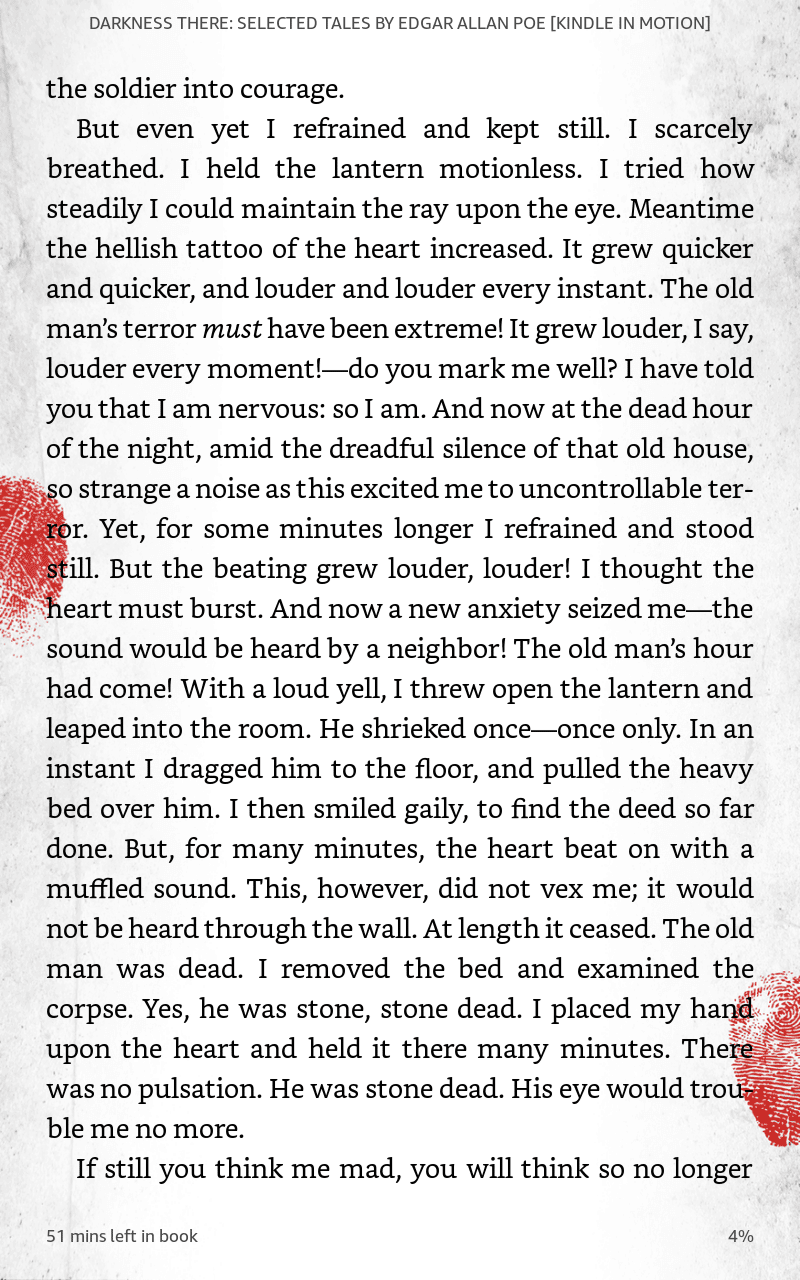
  • Six Kindle in Motion titles are available right now, all from Amazon’s publishing division. This includes four original romance titles and two new editions for an Edgar Allan Poe collection and The Secret Garden.
  • The ebooks sport various enhancements like animated covers, video clips, and page backgrounds which can be turned on or off if you don’t want to see them while reading.
  • The enhanced versions of the ebooks are limited to portrait mode only, and are quite large (200MB to 400MB).
  • There’s no known way for anyone to use KDP to produce this format.

I bought several Kindle in Motion titles. The romance titles had embedded videos, but the two public domain titles had animations.

I took a few screenshots to give you an idea of what they look like, but then I noticed that Amazon has video previews – so I downloaded those instead. I can’t find a way to limit the window size, sorry:

I could take or leave the animations, although I do admit that I like one snarky suggestion made on KBoards ("the bears are going to be shifting into billionaires on the covers"). Now that I would like to see.

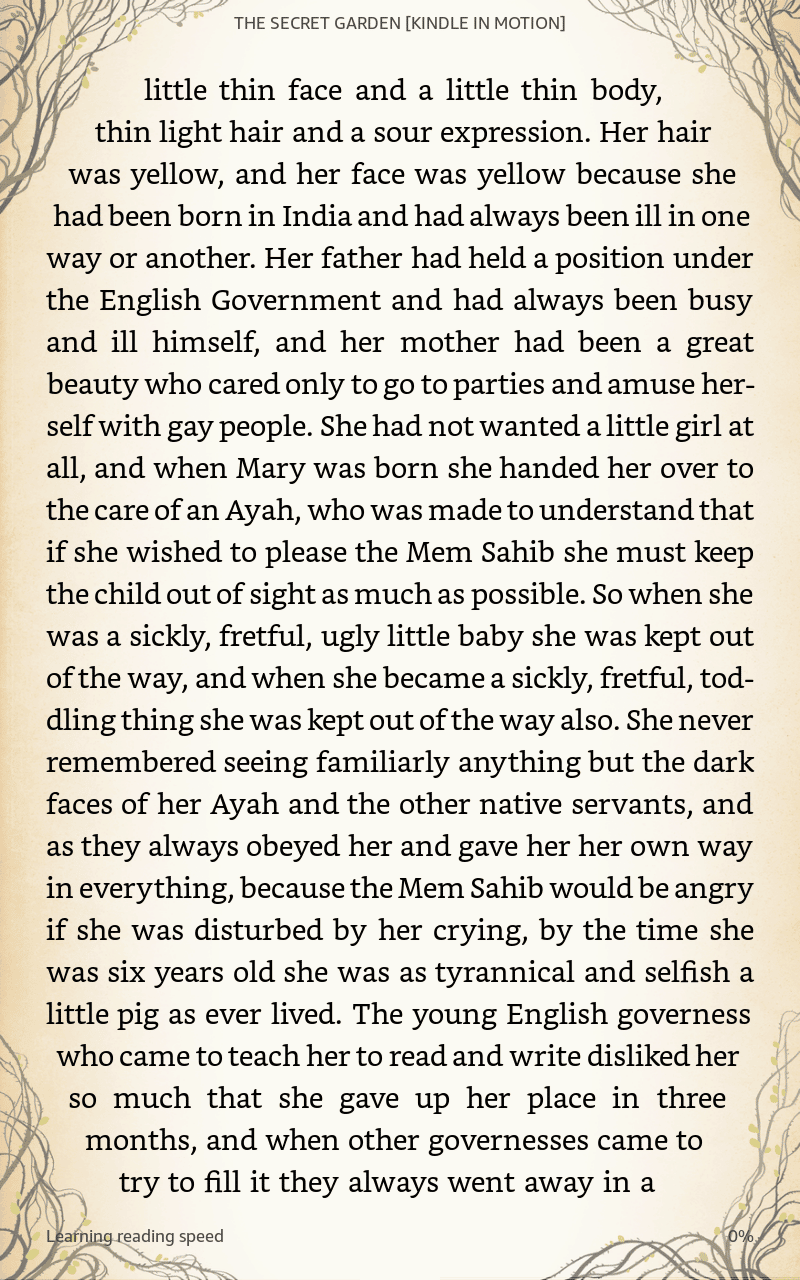
On a more serious note, the Kindle in Motion ebooks do have at least one feature which IMO enhances the reading experience. A couple of the ebooks showed the text of the story over a page background.

Yes, I know that we’ve seen this type of feature with fixed layout ebooks, but Kindle in Motion lets you resize the text and maintain the backgrounds.

Do you see the branches in the corners of the first screenshot? No matter how you change the font size, the text will not cover the branches.

I love this.

That is a small change but I think it could make for a great improvement to the reading experience.

Even if a background were used in several books, or if all Kindle ebooks were limited to (say) a dozen backgrounds, I would still like to see this in the ebooks I read in my Kindle app.

This page background feature is the kind of thing which print snobs point to in a paper book and cite as an example of why print is better, and adding it to the Kindle platform would really go a long way to making ebooks the equal of print books as an art form and not just as a reading material.

Hey Amazon, what would it take to make this a standard feature?

Visionect Debuts an ePaper Sign for Museum and Galleries

The ereader market may have peaked several years ago, but E-ink screens aren’t dead. A small Slovenian startup continues to find new uses and markets.

Visionect announced on Monday that it was adapting its Joan smart meeting room sign for use in museums.

The Amlabel digital gallery display offers museum curators a new alternative to static paper labels, one which can be changed remotely with a minimum of time and effort.

As Visionect explained, a recently surveyed group of museums reported that 66% of the respondents printed more than 200 labels per year while a third printed 500 plus labels per year. All reported an average cost of $70-$100 per label, with a single misprint or a change of text causing this cost to double.

The Amlabel cuts that cost by letting museums and galleries update a label digitally. Not only does this reduce reprint costs but it also lets curators change details, or even the language on the label, at the drop of a hat.

The Amlabel comes in 6″ and 9.7″ screen sizes, and connects to existing Wifi networks. Its battery is good for months.


You Can Now Share Your Kindle Notes and Highlights via Goodreads

Kindle users have long been able to share via Twitter and FB the annotations from the ebooks they’re reading, and now we have the option to share via one of Amazon’s social networks, Goodreads.

Goodreads just announced the launch of a beta feature where Kindle using Goodreads members can:

… access and share your Kindle notes and highlights right from the book pages on Goodreads.com (PC or laptop). You can even edit your notes directly on Goodreads, and your changes will sync back to your Kindle book. By default, your Kindle notes and highlights are only viewable by you—you’re always in control. You can choose to share them with friends by marking any (or all) of your notes and highlights as “Visible,” and your friends will be able to view, like, and comment on them. You can also share them by sending the URL of your Kindle Notes & Highlights page to anyone you like—for instance, a colleague, professor, or classmate.

We already had the option of organizing our Kindle notes and highlights via Kindle.Amazon.com (we could even share them) and now Amazon is adding that feature to Goodreads.

Before you can use it, you’ll need to tie your Kindle and Goodreads accounts, add the relevant books to your GR account, and start taking notes.

Coincidentally, if you don’t want notes from a particular book to show up on Goodreads then you can simply not shelve the books – or simply leave the notes for that book as private (it’s the default setting).

This sharing feature is currently available via the Goodreads website, but the announcement also mentions that Goodreads plans to add mobile support.

Kobo Aura One Leaks, Has a 300 PPI 7.8″ E-ink Screen for 229 Euros

For the past six weeks Kobo has been teasing us with hints about a new and larger ereader.  We first learned of it in an FCC filing, then Kobo CEO teased that it would launch this month, and now thanks to a leak I can finally show you what we’ve all been waiting for.

A Dutch retailer has inadvertently published the product listing for the Kobo Aura One, and it is just about everything we would want from a premium ereader.

We still don’t know the launch date, but according to the leak the Aura One will feature a 7.8″ Carta E-ink display. It has a flush-mounted frontlight and touchscreen, and sports a screen resolution of 1872 x 1404. That is a 300 ppi screen, which means it’s not only larger than most other ereaders on the market, it is also just as sharp.

But wait, there’s more.

Inside this ereader’s waterproof shell you will find Wifi, 8GB internal storage (but no card slot), and 512MB RAM. The listing doesn’t mention the CPU speed, but it does say that the Aura One wieghs 252 grams and measures 195 mm by 138.5mm by 6.9mm.

In comparison, The Aura H2O has a 6.8″ screen, weighs 233 grams, and is only slightly smaller than the  Aura One. But it’s not as pretty:

And how much is Kobo asking for this beauty?

According to our source, the retail price is 229 euros. That price is about 60 euros less than the European price for the Kindle Oasis, so not only has Kobo developed an ereader which is bigger and better than Amazon’s flagship, it’s also cheaper.

I can’t wait to get one, can you?

wehkamp.nl via MobileRead

Pocketbook Inkpad 2 8″ eReader – 199 Euros

Pocketbook has just announced an updated version of the Inkpad, its 8″ ereader.

Launched in 2014, the Inkpad was arguably the best premium ereader of the year (and still one of the better ereaders two years later). With a large 8″ screen and a one-handed design which Amazon later copied for the Kindle Oasis, the Inkpad was the closest digital equivalent to reading a hardback book.

And now Pocketbook has brought it back.

The Inkpad 2 keeps the one-handed design, screen size, and most of the other specs from its predecessor, only it weighs less and comes with a slightly improved screen.

This ereader runs Pocketbook’s proprietary OS on a 1GHz CPU with 512MB RAM and 4GB of internal storage, and it also has Wifi, a microSD card slot, and a headphone jack.

It’s running the same software as the original Inkpad, and comes with a number of apps and supports a wide variety of ebook formats. The Inkpad has more formatting options than you can shake a stick at, and also supports TTS as well as mp3 playback.

The 8″ Pearl E-ink display has a screen resolution of 1600 x 1200 with a capacitive touchscreen, just like the first InkPad, but Pocketbook says in the press release that the screen on the Inkpad 2 has improved optical properties (we’ll have to wait to see it in person before we know what that means).

In terms of battery life, the Inkpad has a 2.5Ah battery with a projected runtime of "up to a month without recharging". It weighs 305 grams, or about 45 grams less than the first model.

All in all, the new Inkpad doesn’t present a compelling argument in favor of upgrading from the original model, but at 199 euros this ereader is still worth a look.

The Inkpad 2 is cheaper than the Kindle Oasis, and its only real competitors in the plus-sized ereader category are the 6.8″ Kobo Aura H2O, the Onyx Boox i86, and the Icarus Illumina XL.

Of the four, I am torn between the Inkpad  and the Aura H2O. I like them both, for different reasons. The Inkpad is bigger, but frankly Kobo has the better software. My Inkpad keeps freezing and refusing to reset (and yet I still like it – go figure).

In any case, your buying decision will likely come down to which one you can buy. The press release says that the PocketBook InkPad 2 is now available online for a suggested retail price of 199 euros, from www.pocketbook.de.

Pocketbook, however, won’t let me visit that site to confirm the news, and so I can’t buy the Inkpad 2.

But you might have better luck.

Pocketbook via eBook-Fieber.de