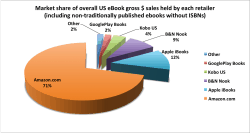
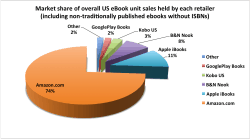
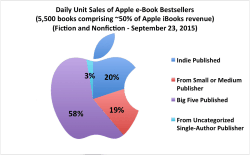
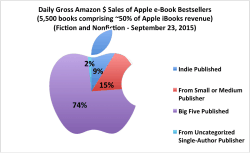
With Kindle Unlimited funding continuing to grow month after month and Amazon maintaining its dominance of the ebook market, authors are faced with a quandary:
Do they give up in the rest of the market and go exclusive with Amazon, or do they go wide and sell their ebooks in as many bookstores as possible?
Lindsay Buroker published a post today that asks this very question:
When I uploaded my first book, The Emperor’s Edge, in December of 2010, it was a foregone conclusion that I would put it out there everywhere I could, in the hope that new readers would stumble across it and give it a try. Then, a couple of years later, Amazon introduced KDP Select, a program for self-publishers that requires exclusivity.
Right off the bat, Amazon introduced a couple of promotional tactics that are still available to those who are enrolled. Eventually, Kindle Unlimited and the ability to be paid for borrows also came along.
…
Obviously, if you’re exclusive with Amazon, you can’t receive ebook income from the other stores. Let me emphasize that we’re only talking about ebook income, as you can still have audiobooks in iTunes and paperbacks in Barnes & Noble and elsewhere. But, as you probably already know, ebook income is huge for self-published authors. Even though I’m working on getting more audiobooks out there, and I’ve done paperbacks for most of my novels, ebooks easily account for 95% of my income.
Are you wide or in Select?
Before I go further, I should disclose that I am not in KDP Select with any of the books under my name, but that my pen name is currently “all in” with KDP Select. I started the pen name books there, to take advantage of the sales ranking/visibility boost from Kindle Unlimited, and I returned them to KDP Select this August, after not gaining much headway in the other stores and after Amazon switched to Kindle Unlimited 2.0, a system that rewards novelists by paying based on total pages read.
I won’t take a position either way on this topic (I stopped railing against Kindle Unlimited’s exclusivity requirement for the same reason I stopped yelling about authors signing their rights away to publishers), but I do have something to add.
Indie authors aren’t the only ones doing the maths and trying to decide whether going all-in on Kindle Unlimited is worth it. Publishers are also eyeing Amazon and asking whether they would earn more if they stopped selling elsewhere.
And some have found that the answer is yes.
And just to be clear, I’m not talking about publishers which are in Kindle Unlimited at Amazon’s whim and are being paid wholesale each time one of their books is loaned; there are also publishers who have decided to take Amazon up on the offer of being paid for each page read by a Kindle Unlimited subscriber (and all of the restrictions that entails).
There’s always been two classes of publishers in Kindle Unlimited (and before that, Kindle Owner’s Lending Library). Some were in Kindle Unlimited at the discretion of Amazon, while others joined the service under the same terms offered to indie authors.
Speaking of which, a story’s been going around these past few weeks that Amazon has been pulling traditionally publishing ebooks from Kindle Unlimited. All the versions of the story I’ve encountered led back to a comment Kensington CEO Steve Zacharius left on Mike Shatzkin’s blog.
I reached out to Zacharius by email, and he confirmed the comment. He said that Kensington titles had been removed from Kindle Unlimited by Amazon, and that he "can’t discuss terms but anything other than a full royalty for the authors was unacceptable for me and would also create an accounting nightmare".
I also have independent confirmation that Amazon is removing trad pub ebooks from Kindle Unlimited. For example, these titles from Skyhorse were some of the trad pub titles removed this year:
- A Hunter’s Fireside Book: Tales of Dogs, Ducks, Birds, & Guns
- The Reappearing Act: Coming Out as Gay on a College Basketball Team Led by Born-Again Christians
- Horses Never Lie: The Heart of Passive Leadership
- Ibn Saud: The Desert Warrior Who Created the Kingdom of Saudi Arabia
According to Skyhorse, Amazon both added and removed the ebooks at its discretion. “Amazon decides what to include in Kindle Unlimited. They pay us as the publisher per our agreement with them whether or not they sell the ebook or give it away," Bill Wolfsthal, the director of sales at Skyhorse, told me. "It’s their choice on what to charge their customers."
Amazon was paying Skyhorse under terms similar to the ones that Scholastic was being paid when Kindle Unlimited launched. The publishers get a full royalty each time one of their ebooks was read in Kindle Unlimited. The same goes for all the other ebooks Amazon has decided to add to Kindle Unlimited.
Speaking of adding trad pub titles, in the past 6 months Amazon has also added titles from traditional publishers to Kindle Unlimited. For example, I’ve got a long list of some five or six dozen titles from F+W Media which Amazon added to Kindle Unlimited some time this year.
I won’t list all the ebooks here, but I have checked and I can still find the ebooks in other stores. (I’ll explain how I know these ebooks were added to KU in a postscript.) So Amazon is removing titles, and they’re adding titles, but that’s not the most interesting story here.
While I was confirming that those Skyhorse titles and F+W Media titles were available elsewhere, I also identified several publishers that had titles in Kindle Unlimited which could not be found in other bookstores.
Two of the publishers, the UK-based Thistle Publishing and the US-based Limitless Publishing, did not respond to my queries but I am reasonably certain that these publishers have gone exclusive with Amazon in order to take advantage of Kindle Unlimited.
Edit: Just to be clear, I’m talking about an exclusive on digital titles. The publishers still distributed their print editions widely.
I spot-checked a half-dozen ebooks from each publisher (their catalogs number in the hundreds of titles), and cannot find their books in other ebookstores. The publishers also didn’t show up when I searched for them by name, but without explicit confirmation there’s a chance I could be wrong.
Fortunately, I am far more certain about the third publisher. Ed Renehan, the publisher at New Street Communications, confirmed that he’s gone exclusive with Amazon.
He’s told me that 56 of the 57 titles published by New Street are exclusive to Kindle Unlimited (the holdout is not exclusive at the request of the author). "For what it is worth, we at New Street have done VERY WELL thus far re: total compensation from per-page reads," Renehan said.
Renehan is seeing the benefit from exclusivity which Hugh Howey identified in August:
You can sometimes reach more readers by making your products available with fewer vendors. By concentrating sales in one location, sales rank gets a boost and more reader reviews are compiled in a single place. This means more visibility and more word-of-mouth sales. It can also mean more readers.
I know that runs counter to conventional wisdom (see John Scalzi for more on this), but Renehan had found that conventional methods just don’t work for him.
"We are not distributing anything on Kobo or Nook or any other platform. We’ve tried & it just does not pay," he told me. "Whereas KU has offered us results we’ve tracked and found to bring in increased ancillary revenue."
Obviously Renehan’s choice won’t be acceptable to all (see Zacharius, above) or even a workable option for some, but what does this says about the ebook market?
Here’s what I see:
For one thing, there are all sorts of assumptions about Kindle Unlimited which need to be discarded. It’s not as terrible for authors and publishers as its detractors say. Renehan has accepted the terms that DBW said treated some authors like second-class citizens, and he’s found that to be the more remunerative option that dealing with all the other bookstores.
What conclusions would you draw from this?
OOO
P.S. I know that some titles were removed or added to Kindle Unlimited because they were listed in the raw data for two or more Author Earnings Reports, and that status changed between one report and the next.
P.P.S. I would like to thank Data Guy, Steven Zacharius, Maria Schneider, Ed Renehan, and everyone else for helping with this post by answering my questions.
image by markus spiske