Axel Springer Sues Ad-Block Developer

German news publisher Axel Springer has always taken a hard line on advertising. It has sued ad block developers, barred ad block users from Bild.de, was the last German news publisher to let Google use snippets for free, and now it’s back in court again.

TechCrunch reports that Axel Springer is targeting the developers of the iOS9 ad-block app Blockr.

Specifically, explains the law firm representing Blockr, Axel Springer wanted to prohibit Blockr’s developers from being able to “offer, advertise, maintain and distribute the service” which can be used today to block ads on http://www.welt.de, including the website’s mobile version.

Blockr’s lawyers argued in a hearing on November 19 that its software is legal and should be allowed to continue, and that it’s the user’s choice to use an ad blocker.

In the hearing, the court seemed to agree with the startup, and pointed out that Axel Springer has other options for handling how it wants to deal with ad blockers. For example, it could re-use its prior tactics that involve locking out users from a website when it detects that the visitor is using ad blocking software.

The final ruling, however, is not until December 10.

Considering that two similar rulings have already been handed down in Germany this year, including one where Axel Springer was the plaintiff, the odds of the media giant winning this time around range from slim to a snowball’s chance in hell.

But legal precedence is not enough to discourage Axel Springer, although it has made them craftier. Rather than directly sue the developers of Blockr, Axel Springer first sought an injunction at the district court of Stuttgart. Arguing that the software was illegally obstructing its digital content, Axel Springer asked the court to ban the app from being used in Germany.

It was at the hearing on 19 November that Lampmann, Haberkamm, & Rosenbaum, the lawyers for Blockr’s developers, successfully argued that there was no immediate need for an injunction.

The case is still ongoing, but it doesn’t look good for Axel Springer.

Edit: But perhaps that doesn’t matter to the news publisher. What if this simply a bid to harass developers into avoiding this type of app? (Fighting a lawsuit like this can get expensive.)

In any case, the media giant has other means to continue the fight.

About a month ago Axel Springer ran a pilot test where it erected a barrier on Bild.de, one of its news sites, which banned ad-block users from visiting the site without either disabling their ad blocker or getting a subscription.

According to Financial Times, this pilot test succeeded in reducing the proportion of readers using ad blockers from 23% to a single digit. Axel Springer hasn’t revealed whether revenues increased, although FT did report that the site had shown an addition 3 million "marketable" page views to visitors in the first two weeks of the pilot.

"The results are beyond our expectations,” said Axel Springer CEO Mathias Döpfner at the time. “Over two-thirds of the users concerned switched off their adblocker."

He added: “Our experience makes us optimistic that adblockers will not develop into a game-changer for the sector.”

Axel Springer isn’t the only publisher to take a hostile approach to ad block users. The Washington Post started testing a similar block in September, and just last week Yahoo started blocking some users from checking their email.

TechCrunch

image by n0nick

Wattpad Now Lets Authors Trick Out Their Stories With GIFs, Youtube Embeds

Ever looking for new ways to help writers tell stories, Wattpad has released a cover-making app, and earlier this year they added background soundtracks as an option.

And now:

With the new feature,  storytellers can insert animated .GIFs, images, Vimeo, and YouTube videos to add visual elements to their stories.  The goal of this project is to make Wattpad a home for new forms of storytelling. With the multimedia feature, the global community can create and share comics, cookbooks, travel diaries, fashion blogs, and more.

Wattpad wants to deliver the best possible experience and evolve the story so it can be used for many different types of storytelling. Over 175 million original story uploads are already shared on Wattpad, we expect to see even more stories shared as a result of today’s launch.

As someone who has seen far more badly made GIFs than cute ones, I don’t exactly find myself excited by the announcement. I know that far too many people will embed one- and two-second GIFs just because they can.

The video embeds, on the other hand, could prove useful for non-fiction writing. On the other hand, if you’re writing non-fiction for free, why not just publish it on a site so the larger internet audience can read it?

images by vancouverfilmschool, Wattpad

Speed Readers, Rejoice: Kindle for Android Updated With Bookerly Font, Word Runner

A new version of the Kindle app for Android hit Google Play yesterday. The update only added a couple new features, but what the changelog lacks in volume it makes up for in value.

First up is Word Runner, the speed reading feature which Amazon launched with the new Fire tablets this fall. Readers can now use what is arguably the second-best speed reading tech on the market to zoom through their books at a rate of 300, 400, or 500 words per minute.

The tech gives me and some other users headaches, but I’m told we’re the exception and not the rule. You can find more info on Word Runner here.

The second half of the update is Bookerly, the serif font that Amazon launched earlier this year on the Fire tablets (it was added to the Kindle iOS app in the summer).

Edit: And the third half of the update is the new KFX typography that Amazon added to the iOS app this summer. Thanks, John!

Bookerly was developed just for Amazon. It is more correctly termed as a slab-serif font that looks a little like Georgia, only better. I didn’t think much of it when it was first released, but it has grown on me.

The app can be downloaded from the Amazon Appstore or Google Play.

Kindle Unlimited Payout Drops Below Half a Cent Per Page in October 2015

The Kindle Unlimited payout for October was 0.4809 cents per page, and as you can see from the chart to the right that is the lowest payment Amazon has offered since switching to the new model in July.

Amazon has deliberately allowed the payment to drop over the past 3 months by arbitrarily choosing just how much to boost the monthly payment pool.

Edit: a reader argues in the comments that this post is inaccurate. I disagree, but for the sake of completeness here is the counterpoint he made:

The KU payout per real book page (imaging a printed book) is about one cent per page. The KU payout of about half a cent is per KU KENP page, which is a constructed “page” to account for differences in paging in various ereader devices, phones, tablets, etc. KENP pages run about twice the count of real book pages. Also consider the following: a printed mass-market 300 page paperback book will produce a royalty in trade publishing of about 50 cents a copy–which is about 0.17 cents per page, much less than the 1.00 cents per page of KU for the same book.

Don’t forget: starting in November (this month), Amazon will adjust the payment based on the market where the subscriber is located. (I don’t know exactly what that means, either, and Amazon has declined to provide specific details.)

Here’s the running tally of monthly funding pools:

  • May 2014: $1.2 million
  • June 2014: $1.2 million
  • July: $2.5 million (Kindle Unlimited launches early in the month)
  • August: $4.7 million
  • September: $5 million
  • October: $5.5 million
  • November 2014: $6.5 million
  • December 2014: $7.25 million
  • January 2015 – $8.5 million
  • February 2015: $8 million
  • March 2015: $9.3 million
  • April 2015: $9.8 million
  • May 2015: $10.8 million
  • June 2015: $11.3 million
  • July 2015: $11.5 million
  • August 2015: $11.8 million
  • September 2015: $12 million
  • October 2015: $12.4 million

Thanks, Morris!

image  by 401(K) 2013

Sony DPT-S1 Hacked, Now Runs Android

With a price of nearly a thousand dollars and limited format support (PDF only), Sony’s 13.3″ E-ink writing is a tough sell for most users. While there are some business use cases, the average consumer has to work hard to justify the expense.

But after today’s news, that should get easier. News is breaking on MobileRead this morning that a seller on the Taobao marketplace in China is claiming that he can hack a DPT-S1 and expose the underlying Android OS.

Send that seller your device, and pay him 800 yuan, and he promises to send back a DPT-S1 that runs Android 2.2. which looks like:

So is this real, or a hoax?

I’m still looking for someone who has used this service to hack their DPT-S1, but at this point I have little reason to doubt the story.

Sony’s last three ereaders in the PRS line ran Android 2.2 (and could be hacked to access the OS), and Sony must have reused some of the code developed for those 6″ ereaders when they developed the software for the DPT-S1. (This could also explain why the DPT-S1 has the three iconic Android buttons below the screen.)

And so with time, a lot of money, and a little trust, you can turn Sony’s writing slate into an Android tablet.

That single act could double the DPT-S1’s usefulness – if not for the fact it runs such an old version of Android. If this were Android 3.0 Honeycomb, or Android 4.0 Ice Cream Sandwich, this project could be worth the time ans expense.

But Android 2.2 is over five years old, and that means you will have trouble installing Android apps.

Google Play Books Updated With Basic Comic Book Support

Google hasn’t seen fit to end the five months and running hiatus of its publisher portal, but that doesn’t mean they’ve abandoned plans for Google Play Books.

Earlier today comic book readers were gifted with an update that, while it doesn’t make for an awesome reading experience, does improve support for digital comics.

I tested the app both before and after the update, using the first volume of The Walking Dead. The update doesn’t add a guided viewing mode(*) like the one offered by Kobo, Kindle, or Comixology, but it does offer a new default zoom setting. When viewing in landscape mode, the app zooms until the page width matches the screen. Before, the app zoomed to fit both the width and height, and wasted screen space.

This update also adds a couple optional features. You can now tap to scroll the page, rather than swipe, and you can have the app remember your page zoom setting when you turn the page.

In related news, Google has also reorganized the comics section of Google Play books:

We’ve also made finding great comics and series really easy. Now we’re offering a new comics destination and a bunch of beautifully curated series pages on the Google Play Store that organize volumes, issues and other editions of the top comic series. You’ll also find new personalized recommendations for similar series to help you discover new stories and characters.

All in all, the updates are an improvement on the abysmal features provided before the update, but they’re still nothing to write home about. In all seriousness, they are on par with the features that Adobe Reader had on Windows CE a decade ago, or can be found in most PDF apps today.

But hey, any improvement is a plus.

The app can be found in Google Play.

P.S. Can anyone tell me if the app has a guided viewing mode? I didn’t want to buy comic books and go looking for it.

Google

Pocket Moves Into Twitter Territory?

The Verge has a story that has me stumped (I don’t see why it’s newsworthy).

Pocket, the service for saving articles and videos to view later, is starting to look a bit more like a social network. The company is now testing a way for you to share your favorite items to a public profile, which others can follow to see your picks in a feed of recommended items. Your saved items are still private by default, but you can now choose to broadcast favorite pieces with your followers. …

Still, Pocket won’t show you everything your friends share. "This feed isn’t Twitter or Flipboard," Weiner says. "It’s not time-ordered, and it doesn’t include every possible article from the sources that you follow. The goal with recommendations is to bring you the very best of the web without the noise."

Pocket already had sharing options for all the major social networks, and it offers RSS feeds for unread/all items/archived links. And through IFTTT you can micromanage the link sharing to your heart’s content (forex: only sharing links with a certain tag).

So what does this new option ad, besides an algorithmic filter that is intended to only show me the best?

One, that sounds more like Facebook than Twitter, but in any case thanks, but no thanks.

I don’t need or want software to second-guess what someone chooses to share. They chose to share it, so I want to see it. If I want a filter I will set one up.

The new more social sharing option is being rolling out today in a public beta on Android and iOS. To use the features, you’ll need to join Pocket’s beta testing program.

image by GotCredit

Publishers Are Unhappy Over Facebook Instant Articles

Facebook’s Instant Articles has been variously described as the next stage of media consumption or a great threat to news orgs survival. But based on early reports, there’s one thing that Instant Articles clearly are not: a money-maker.

Citing persons familiar with the matter, the WSJ reports:

The product is still in its infancy, but publishers including The Washington Post, New York Times and LittleThings.com are finding it difficult to extract as much revenue per article from Instant Articles as they do from pages on their own websites, according to people familiar with the situation.

That is because of the guidelines Facebook has laid down on the type and volume of ads publishers are allowed to sell. For example,only one “large banner” ad sized 320 x 250 pixels may be included for every 500 words of content. On their own mobile properties, publishers such as The Washington Post would typically include three or perhaps four of those ads alongside a 500-word article.

Facebook is also restricting the type of ads publishers may place in Instant Articles. It will not allow so-called “rich media” ads, the animated or interactive ads that appear across publishers’ sites.

To put it simply, publishers are upset because Facebook won’t let them slather their articles with adverts. (For the record, I have 5 adverts on this page, so I am almost as bad.) In particular, Facebook won’t allow the rich media adverts which are simultaneously the most annoying and the most remunerative. (Instead, Facebook wants to sell those rich media adverts themselves.)

But sadly, that is going to change. Michael Reckhow, Facebook’s Instant Articles product manager, told the WSJ that Facebook would allow more adverts per article andad types which were previously verboten. He hasn’t shared the specifics, but he did say that: "We’ve made numerous improvements to the advertising capabilities over the past few months and will continue to iterate based on publisher feedback to improve the product".

Officially launched for all users of the Facebook iPhone app last month, Instant Articles lets news publishers and media companies publish content directly to Facebook feeds rather than posting links on Facebook to attract users to their websites.

Twenty publishers are currently participating in the program, which lets them sell adverts against their articles and earn 100% of the revenues, or 70% of the revenues from adverts sold by Facebook.

image by Richard Masoner

B&N Launches Nook Audiobook Apps for iPhone, iPad

Remember the audiobook service Barnes & Noble launched last year? Me neither, but it’s back in the news again today.

After a year of waiting, B&N has released Nook Audiobooks apps for the iPhone and iPad. They’re also finally launching a website where you can buy the audiobooks: NookAudiobooks.com.

“We’re thrilled to expand our NOOK Audiobooks offering to further our commitment to creating an easy way for customers to find and access their next great listen on their favorite devices,” said Fred Argir, Chief Digital Officer at Barnes & Noble. “Customers can discover their newest audiobook anytime, anywhere and dive in immediately on any NOOK by Samsung, iPhone, iPad or Android device.”

The new apps, which can be found in iTunes, let you listen to the audiobooks bought through either the Nook Audiobooks Android app, or the new website.  (Apple being Apple, there are no in-app purchases in the iOS app.)

B&N offers a catalog of 60,000 audiobook titles through a service that was developed in partnership with Findaway (and who is actually running the service). It’s not a particularly well-designed service or website, and it lacks basics like letting you play other audiobooks in the Nook Audiobooks app, or the option to sort the store listings by price.

But if a token presence in a niche market counts for something, then B&N is ahead of the game.

Kobo Promises to Refund All Orders From the Kobo Mini Sale Fiasco

Kobo has proposed a very adequate solution to the mess resulting from last week’s bungled Kobo Mini sale.

As I reported yesterday, Kobo briefly ran a sale last week where they offered a new Kobo Mini with a Pearl screen and a gray knit sleepcover for $50.

Unfortunately for everyone, what Kobo had intended to sell (and all they ahd on hand) were old demo units with pink rubber shells. Since Kobo doesn’t have the units it listed on its website, it has instead decided to give everyone a refund.

Here is the official statement:

The Kobo Mini eReaders that were sold from November 3 to 7 in Canada and the US were devices produced for retail store demo environments. Although the eReaders were unused and in original, sealed packaging, the description onKobo.com should have explicitly stated that they were demo devices. This was an error and it was not Rakuten Kobo’s intention to mislead customers. As such, those who bought the Kobo Mini will automatically receive a full refund for the device and shipping costs, and are welcome to keep the device if they wish.  Rakuten Kobo apologizes for this unfortunate error and is working quickly to get booklovers back to reading.

If you bought a Kobo Mini in last week’s sale, contact customer service so you can get your refund. You might need to reference this post.

Publisher eBook Revenues Down in First 7 Months of 2015

Numerous press reports over the past few months have informed us that the major publishers are experiencing a decline in ebook revenues, and based on the latest statements from the Association of American Publishers, that trend is not going to stop any time soon.

The AAP released new stats today for the first seven months of the year.

Or rather, the AAP released statements about sales stats. Since the AAP is reserving all the actual figures for paying customers, I can’t report on them. And without that data, I might as well simply repost the email as rewrite it.

When you read it, do note that trade ebook revenues among the major publishers declined 11.2%. That of course does not reflect the entire market, but only the revenues of the major publishers.

O O O

Publishers’ book sales for trade (consumer) books from Jan. to July were up 0.3% compared to the same timeframe in 2014.  July was a strong month for trade books, with Adult Books, Children/Young Adult Books and Religious Presses all showing double-digit growth over July 2014.

Despite the bump from July’s trade sales, overall publisher revenue for the seven-month period was $8.37 billion, down 2.0%. These numbers include sales for all tracked categories (Trade – fiction/non-fiction/religious, K-12 Instructional Materials, Higher Education Course Materials, Professional Publishing, and University Presses). Publishers net revenue is tracked monthly by the Association of American Publishers (AAP) and includes sales data from more than 1,200 publishers (#AAPStats).

Trade:

July was a good month for all categories of trade books with sales growth in  Adult Books (10.9%), Children/YA Books (11.5%) and Religious Presses (14.6%), compared to July 2014.

The trade category for Jan. – July 2015 showed slight growth for the first time this year as a whole at 0.3%, at $3.67billion.

Trade Formats:

Downloaded audio remained the fastest growing format, increasing 31.2% in July, compared to July 2014. This brings the year-to-date growth for this format to 37.0%, compared to the same timeframe in 2014.

eBooks were down for the first seven months of the year at 11.2% compared to the same timeframe in 2014. The bulk of the decline comes from Children/YA Books, which has seen a 44.7% decline compared to the first seven months of 2014.

Hardback books had an upswing in sales this July, growing at 43.1% for Adult Books and 6.9% for Children/YA Books compared to July 2014. However, the year-to-date growth for this format is still down 6.6% overall for the year compared to the same timeframe in 2014.

Paperback books also had sales growth in July for Adult Books (18.4%) and Children/YA Books (23.6%), compared to July 2014. From Jan. – July, this category has grown 13.2% compared to the same timeframe in 2014.

Educational Materials:

Despite having a positive July, with growth of 1.4%, revenues for PreK-12 instructional materials were down by 6.4% the seven months of the year. Higher Education course materials were down 6.0%.

Professional and Scholarly Publishing:

Sales for Professional Publishing, which includes business, medical, law, scientific and technical books and journals, are up 33.8% in July and 23.4% for the year-to-date. University Presses were down slightly 0.7% year-over-year compared to the same seven months in 2014.

Amazon Books is All About the Data

Amazon’s new bookstore is only four days old but it has already inspired more opinions than your average political debate. Some see Amazon Books for what it is, a wholly unremarkable bookstore, while others see it as either a threat to indie bookselling or as a replacement for the public library.

Rob Salkowitz, on the other hand, sees Amazon Books as being all about the data.  Describing Amazon Books as not "the grandiose retail book palaces that Barnes and Noble and Borders built in the late 1990s", Salkowitz hones in on the shopping experience and points out that Amazon might be interested less in selling stuff than in tracking what shoppers are doing in the store.


Under the hood, the Amazon store has a few unusual features. Every book has a shelf tag that includes a capsule review from the website, a star rating, and a barcode. There are no prices listed.

To get the price, you scan the code with the camera of your smartphone and the Amazon app. If you don’t have a smartphone or the app installed, an associate can do it for you. This brings up the product page for the item you’re looking at, with full reviews, specs and pricing. Pretty slick, eh?

But here’s where it gets interesting. If you are signed into the app with your account – as is likely – Amazon is immediately able to associate its online customer records with you, the customer browsing the shelves in its physical location. It knows your preferences, your buying history, your status as an Amazon Prime and/or Amazon credit card member, and who knows what else. Armed with that data, it can feed you recommendations, offer coupons and incentives, and do whatever it needs to do to close the sale as you are holding an item in your hand that you are considering purchasing.

…

It seems clear that the shelf pricing model in the Amazon store isn’t a feature – it’s the product. By pushing pricing to the app, Amazon enables every offer, every recommendation and potentially every price to be personalized to each customer and timed to optimize every transaction.

I don’t have inside info from Amazon that proves he’s right, but it would make a lot of sense.

For one thing, it would explain why Amazon went with a shelf-label that didn’t mention the price:

Amazon didn’t leave the price off because it is a variable; if that were the issue then Amazon could have invested in electronic shelf labels. (E-ink has red/black/white and yellow/black/white labels which would look great.)

No, Amazon left the prices off so they could use the Amazon app to track which book caught your eye while you are in the store.

When I wrote earlier this week that the store felt like a field experiment, I wrote that "Amazon is closely studying the wildlife to see how it interacts with the the test equipment".

I thought that meant that Amazon would respond by changing the equipment around, but now I see another possibility; the whole point of the exercise, from Amazon’s viewpoint, is studying the wildlife (as opposed to selling stuff).

Salkowitz says that it’s all about the data, and I agree with him. Amazon’s focus on the data also explains why Stacy Claflin reported that Amazon Books did not accept cash; they want your credit card so they can track you better.

To be fair, none of this is new; retailers have been using loyalty cards to track your shopping for decades. It’s just that in the case of Amazon Books, we have a store that takes it to the next level.

Where most retailers track your in-store buying patterns, Amazon is equipped to track your in-store browsing habits (just like retailers do online).

If I were a competing bookseller, I would be more worried now than I was before. Amazon didn’t just open a store; they are adapting their data-centric business methods to brick-and-mortar retail.

Those methods are why Amazon is the single biggest online retailer, and now they’ve set their sights on b&m.

Be afraid. Be very afraid.


SNCF’s New eBook Subscription Service Validates the Kindle Unlimited Model

In September of last year the French Railway SNCF launched a free digital library where passengers could read short public domain works with reading times ranging from 15 minutes to an hour long.

Evidently pleased with that program, SNCF expanded the program last week with the launch of a paid service that offers access to a catalog of 100,000 titles – and they’re taking a leaf from Amazon’s play book when they do so.

The paid SNCF e-LIVRE service costs 10 euros per month, and lets subscribers download and read ebooks on their smartphones and tablets. The service will be free until mid-December (for the first 45 days) after which subscribers will be billed monthly.

It is a freemium service; it still offers the 5,000 public domain titles and excerpts for free, but it also offers a catalog of 100,000 titles which includes best-selling novelists like Marc Levy, Amélie Nothomb, and Guillaume Musso.

SNCF will also run a book of the month promotion and promote books which could help a reader discover a region’s heritage and history, its stories and legends, and its authors.

Selection is limited, however, because publishers are reportedly put off by the funding model. According to eFigaro.fr, SNCF e-LIVRE will pay publishers 65% of its revenues, and divide the payments based on the number of pages read.

That, folks, is more or less the same model that Amazon adopted for Kindle Unlimited in July 2015, only with a more explicit split and a more specific cap on funding.

Kindle Unlimited, on the other hand, is funded based on Amazon’s arcane calculations. According to Amazon, the KU funding pool will total $12 million in November 2015.

While some have complained that Amazon was paying indie authors less than trad publishers (even though this isn’t strictly true), in SNCF e-LIVRE we have service that competes with Kindle Unlimited and uses the same model.

And that makes perfect sense. What with Scribd cutting back its service, and Oyster selling out to Google, it’s clear that paying the wholesale price for a book each time it is borrowed is simply not a workable idea.

The Kindle Unlimited model is clearly the future of the subscription ebook market (assuming, that is, that this market has a future at all).

HuffPost.fr, leFigaro.fr, The Bookseller


How to View Epub, Kindle eBooks in OSX Quick Look

Calibre is a great tool for managing your ebook library. It has a lot of cool tricks, but sometimes one wants to use the file system in one’s PC to manage files.

Neither Windows nor OSX natively understand Epub or Kindle formats (and why is that, I wonder) and that makes it hard for us to search through files, but luckily I have a solution for Mac users. (I’m still looking for a Windows solution.)

QLMobi and ePub-quicklook are two plugins for the OSX Quick Look feature that add support for Kindle and Epub files. They were released by two different developers and work very differently, but both should be added to the toolbox of any ebook developer.

According to its developer, QLMobi generates previews in Quick Look based on ebook contents, similar to the actual look in the ebook reader (you can see a preview in the lead post). It looks like this:

The other plugin, ePub-quicklook, does a lot more. According to the GutHub listing (which hasn’t been updated in over a year), ePub-quicklook has two parts.

One is designed to extract the cover images from Epub files to use as the file icon, and present a nice overview of the Epub in QuickLook. The other is designed to extract information from Epub files (metadata as well as text content) and index it so that Spotlight can search it.

Obviously neither plugins can read the DRMed contents of a file, but they should be able to read the metadata from those files and help you identify what file you’re looking at so you don’t have to guess based on the file’s name or open the file in another app.

P.S. Does anyone know of a similar solution for Windows?

MobileRead


New 13.3″ Onyx Boox eReader Revealed, Will Sport Higher Resolution Screen

Wednesday is rapidly turning out to be the day for product teases. Only minutes after I hit the publish button on the Noteslate hero post, word of a new large-screen ereader crosses my inbox.

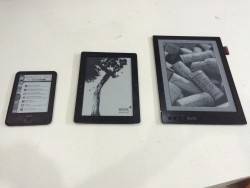
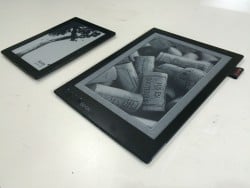
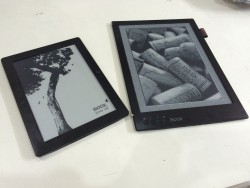
The Chinese ereader maker Onyx has been said to be working on a 13″ ereader, and today that rumor was confirmed by the release of the first public photos. Onyx’s retail partner in Germany posted a set of three photos on MobileRead. He also shared a few details on the specs, and revealed the projected ship date (spring 2016).

The new Onyx Boox ereader will feature an inductive touchscreen with stylus, rather than the capacitive or IR touchscreen found on many ereaders today. Or at least that is what Onyx is planning for the first model; that could change by the time it ships.

Edit: According to my source, Onyx will equip the first-gen model with a 1GHz Freescale imx6 CPU with 1GB RAM and 16GB internal storage. They’re also thinking about releasing an upgraded model 6 months later with a dual-core imx7 CPU, 2GB RAM, and either 16GB or 32GB internal storage.

Onyx is also planning to use a new higher resolution E-ink screen in their ereader. My source said that the new screen sports a resolution of  2200 x 1650 (207PPI). In comparison, the Sony DPT-S1 uses an E-ink screen with a resolution of 1600 x 1200, or 150ppi.

As a result, the new Onyx ereader is going to look considerably sharper if and when it hits the market. And since Onyx now uses Android for all of their ereaders, their device will also do more than just take notes on PDF files. You should be able to install your own apps, including for example the Kindle app, and use the new device as a multi-format ereader.

Or at least that is what we are hoping; we’ll have to wait for reports on the prototype before we know more. And given how long we’ve been waiting for the 13″ Pocketbook CAD Reader (whose prototype debuted two years ago), patience is very much in order.