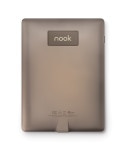
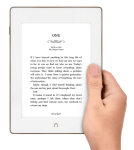
First Nook Glowlight Plus Update Rolls Out – Did You Know That It Runs Android 4.4?

Barnes & Noble’s newest ereader has been on the street for less than a day and it’s already gotten its first software update.

My first impressions post for the Nook Glowlight Plus was interrupted this evening when it abruptly turned itself on and started downloading an update.

According to the changelog that popped up after the Nook restarted, the update added Readouts, B&N’s new teaser service. There’s a new icon in the menu bar at the bottom of the home screen, and it leads to a menu that wasn’t accessible before.

I’m not interested in that feature, but I am hoping that the update also fixes some of the software flaws I’ve seen. I’m not to happy about the hardware design (the bare metal shell and sharp edges do not appeal) but the software is a serious issue.

If I had to pick one word to describe the new Nook, it would be senile.

Every so often the Nook would suddenly forget the ebooks it was carrying, flash to black/white/black, and then remember the ebooks in its library. There have also been times where it would get confused about the command I just gave it, flash to black/white/black, and then go back to whatever menu I was just looking at.

It’s a little frustrating, but I hope that B&N can fix it in a software update.

O O O

In related news, discussions over at MobileRead have turned up an interesting detail about the Glowlight Plus. According to the media fact sheet, this Nook model runs a much newer version of Android than its predecessor.

Under the bland Nook software runs Android 4.4 KitKat. That’s not the latest cutting edge version of the OS, but it is a lot newer than the Android 2.1 running on the last Nook, or what is running on many Android tablet.

The Android version, as well as the 2.8GB accessible storage (I’ve tested it), has already drawn the attention of a couple members of XDA Forums. No one has stepped forward to say they’ve started hacking it, but it’s only a matter of time.

Given the relatively new version of Android and the 300ppi screen, this could make an interesting E-ink Android tablet. But the Glowlight Plus lacks a card slot or Android, two features which can be found on other Android ereaders, so that would make it less than ideal.

Instead I would recommend another model. Perhaps one from Icarus, which recently updated their firmware to integrate Scribd. Thee’s also the Inkbook Onyx, or the Boyue T62 (which I did not find appealing).

They don’t have the Glowlight Plus’s 300ppi screen, but they do have an open version of Android, a dual-core CPU, and a card slot. No hacking will be required to turn them into Android ereaders because they already are Android ereaders.

Pearson Reports Non-Specific "Weak eBook Sales" at Penguin Random House

Pearson has released its first quarterly report following PRH signing an agency ebook deal with Amazon (and adopting agency pricing), and it does not sound good.

You can find the press release on the Pearson website. Here’s the relevant section for Penguin Random House:

Penguin Random House had a solid third quarter performance, with the benefit from number one bestsellers which included The Girl on the Train by Paula Hawkins; Harper Lee’s Go Set A Watchman; Grey by E L James; and Lee Child’s Make Me; partly offset by weaker ebook sales. The company continues to make progress with the integration of its businesses, and remains on track to realise benefits in 2016 and in the long term. The fourth quarter will benefit from new fiction, nonfiction, and movie tie-ins across all formats from bestselling and prize-winning authors.

There are no other details mentioned in the publicly available documents.

UK-based Pearson owns a 47% stake in Penguin Random House, which is the largest trade publisher in the US and one of the largest publishing conglomerates in the world.  The other 53% is owned by Germany’s Bertelsmann.


Nook Glowlight Plus Now Available – Waterproof, Dust-Proof, 300ppi Screen, and only $129

As I predicted last week, Barnes & Noble has launched its newest ereader, the Nook Glowlight Plus, and it’s a better device than I was expecting.

Barnes & Noble’s newest ereader may be hitting shelves about six months behind its competitors, but that doesn’t mean that B&N was letting the dust gather – in fact, just the opposite. The Nook Glowlight Plus can match the Kobo Glo HD and the new Kindle Paperwhite in many respects, and it can go one step better.

This $129 ereader features a 300ppi Carta E-ink screen (with frontlight and touchscreen), Wifi, a metal rear shell, and six weeks of battery life, but it does have one feature that its mid-market competitors lack.

B&N reports that this ereader meets the IP67 certification, meaning that it can be submerged in fresh water for up to 30 minutes at a maximum depth of 1 meter. It’s also dust-proof.

While the premium-priced Kobo Aura H2O can boast the IP67 certification, and Tolino’s new Vision can make a similar promise (albeit one without certification), the Nook Glowlight Plus is the only device at the $129 price point that goes above and beyond in guaranteeing that it can survive rough usage.

That said, I do think it’s a shame that B&N didn’t put similar effort into the storage capacity. The Glowlight Plus has no card slot and only limited storage. Of the 2.5GB internal storage, only 500MB is available to the user. The rest is reserved for B&N-sold content.

Update: While B&N’s website said that most of the storage was reserved, the Glowlight Plus I have in front of me says that I have access to 2.8GB of storage.

As I maintain my own ebook library, the storage problem is enough to turn me off of the  Glowlight Plus. But if it doesn’t bother you, this ereader is available in B&N stores today, and online at Nook.com.

Affordable Textbook Act Reintroduced in Congress

When it was first introduced in 2013, the Affordable College Textbook Act offered the promise of funding for universities that started open textbook pilots (like Virginia’s community colleges, or UMUC in Maryland).

Sadly, that bill died a quiet death, but The Cite reports that it has been revived. Congress is working on reauthorization of the Higher Education Act, and:

The act, sponsored by Dick Durbin (D-IL) and Al Franken (D-MN) in the U.S. Senate and Rubén Hinojosa (D-TX) in the House of Representatives, would encourage the use of open-access textbooks by providing grants to schools to make free or low-cost digital content available to professors, students, and researchers.

The grant process would allow schools to conduct pilots aimed at expanding the use of open educational resources as a way to lower college expenses to students. Applicants would have to provide estimates on the potential cost savings, with priority placed on programs that save students the most.

Publishers would be required to make all textbooks and educational materials available for sale as individual pieces of content, rather than as a bundle. It also requires the Government Accountability Office to provide updates on price trends of college textbooks.

That last detail is probably why the bill was killed before, and it will likely kill the bill this time around. Textbook publishers don’t want to stop exploiting students, so they’ll use some of their ill-gotten gains to hire lobbyists.

And that’s a shame, because we could use this bill now even more than in 2013. Textbook prices haven’t gone down any in the past couple years, and textbook publishers keep coming up with new ways to get schools to subscribe – and not buy – curricula.

Those are problems that open textbooks can fix, if only schools had the resources to experiment.

To be clear, you can already find free digital textbooks; organizations like the CK-12 Foundation fund support the development of CC-licensed textbooks and other open educational resources which can be customized to meet the specific  requirements of a school.

That gave the several states (including Calif., Wash., and more) with digital textbook archives a head start, and it also helps the efforts being led by the universities themselves, including the Open Source Textbook Initiative at the university of Illinois, or the two mentioned in the first paragraph of this post.

And if this bill passes, more schools will be able to launch open textbook programs, saving money both for the school and student.

images by Mike Licht, wecometolearn, gagilas


LibraryThing Launches an iPhone App

LibraryThing has long developed catalog apps for public libraries (including LibAnywhere), and now they’re making one for users.

Yesterday LibraryThing announced the beta launch of the official LibraryThing app:

We’re thrilled to announce the official LibraryThing iPhone App!

Free accounts. We’re giving away lifetime memberships to anyone who uses the app for the next month. Register for a new account using the LibraryThing App, or sign into the app with an existing account, and you’ll be automatically upgraded.

What it does. This is our first version, so we’ve limited it to doing the most basic functions you’ll need for cataloging on the go:

  • Browse and search your library.
  • Add books by scanning barcodes. Scanning to add is VERY FAST!
  • Add books by searching.
  • Browse and upload covers, using the iPhone camera.
  • Do minor editing, such as changing collections and ratings. Major editing sends you to LibraryThing.

The app is intended for the iPhone but you can install it on the iPad. (An Android app is in the pipeline).

iTunes

Authors, Nay, EVERYONE Will Get Screwed If The Authors Guild Wins the Google Books Lawsuit

The Authors Guild received a major setback in last Friday’s appeals court ruling over the decade old Google Books lawsuit, but they’re not giving up.

And that’s a shame, because if The Authors Guild wins then we’re all going to lose.

On Friday The Authors Guild announced that they were going to waste even more money by appealing the case to the US Supreme Court. You can read a fisking of TAG’s statement over on Konrath’s blog, or if you prefer the unfiltered version, you can find it at the end of this post.

That is, if you can stand the BS. The statement is chock full of ridiculous statements like "America owes its thriving literary culture to copyright protection."

That, my dear, is utter nonsense. Until the 1976 Copyright Act was passed, the US copyright law limited the copyright term to 56 years and required that a copyright be registered and renewed after 28 years, otherwise the work was in the public domain.

By modern standards, that would best be described as a lack of copyright protection, because it let publishers ignore foreign copyrights unless that copyright was also registered in the US, and it made every work more than 56 years old fair game.

The Authors Guild is wrong in almost everything they say in that statement, and they are also completely wrong to pursue this doomed effort to force Google to pay for the use of excerpts.

Speaking of which, The Authors Guild is also trying to do an end run around this case. Last April TAG went before Congress and proposed an ASCAP-like agency which would collect micro-fees from Google and other companies for the use of snippets (even though said use is completely legal).

That bit of lobbying hasn’t gone anywhere (yet), and that’s a good thing because that agency would be just as much of a fiasco for authors as if  The Authors Guild’s had won the Google Books case.

There are many reasons to argue against The Authors Guild’s position, but I have one which will trump every counter argument.

This is 2015, so one could argue that the book market is very different from the one in which TAG filed its lawsuit in in 2005, and thus the lawsuit no longer makes sense.

Or one could argue legal theory concerning fair use. One could also argue that authors and publishers benefit from the free advertising that stems from Google Play Books, and the way that it helps readers discover books that they’d never heard of before.

But never mind those arguments; here’s an argument that is irrefutable.

This lawsuit won’t succeed. Google will not pay the fees.

So far this story is being covered from the viewpoint of the book industry, but if we instead focus on the issue of Google then we are reminded that publishers have tried to force Google to pay for the use of snippets and/or links in the past.

And it was an utter failure. Every. Single. Time.

In Germany, for example, news publishers have been trying to get Google to pay for snippets since 2010. The publishers even went so far as to get a law passed which explicitly created a copyright over snippets.

Rather than pay, Google responded by changing its ToS, forcing German web publishers to agree to let Google use the snippets and links for free – otherwise Google would not list them in its search engine. (Those pubs even filed suit over that law, but the suit went nowhere.)

Google would not pay the German publishers.

In 2006, Belgian news publishers sued Google over its use of snippets and links in its search engines. The publishers won the copyright infringement suit, only to realize that they actually lost when Google complied with the ruling and removed those publishers from its search results.

The Belgian publishers ended up having to settle with Google and agree to let Google use their snippets and links for free – that is how much value it brought them.

Even a victory ultimately turned into a defeat.

And finally, in 2014, Spain passed a Google tax that made the payment of fees for the use of snippets compulsory. Google responded by shutting down Google News in Spain.

That closure has had a direct negative financial impact on Spanish news publishers. Furthermore, the shutdown disproportionately impacted smaller news publishers, forcing many to either close or curtail operations.

Google will not pay a fee for giving away free advertising – not to web publishers, nor to book publishers and authors.

If The Authors Guild gets what it wants then it will soon realize that it has still lost. And so will everyone else.

Mark my words: Google would rather shut down Google Books than pay authors and publishers.

And if that happens then we’re all going to be screwed. Authors and publishers will take a direct hit to the pocketbook, but the public will also lose a valuable tool for finding books.


Here’s The Authors Guild’s statement on the appeals court ruling:

Today, the Second Circuit Court of Appeals released its decision in Authors Guild v. Google. “The Authors Guild is disappointed that the Court has failed to reverse the District Court’s faulty interpretation of the fair use doctrine,” said Mary Rasenberger, Executive Director of the Authors Guild in New York. “America owes its thriving literary culture to copyright protection. It’s unfortunate that a Court as well-respected as the Second Circuit does not see the damaging effect that uses such as Google’s can have on authors’ potential income."

"Most full-time authors live on the perilous edge of being able to sustain themselves through writing as a profession, as our recent income survey showed, so even relatively small losses in income can make it unsustainable to continue writing for a living. We are disheartened that the court was unable to comprehend the grave impact that this decision, if left standing, could have on copyright incentives and, ultimately, our literary heritage. We trust that the Supreme Court will see fit to correct the Second Circuit’s reductive understanding of fair use, and to recognize Google’s seizure of property as a serious threat to writers and their livelihoods, one which will affect the depth, resilience and vitality of our intellectual culture.”

images  by Patrick Feller,

Patent Filing Reveals Smart Glasses from Amazon – Their Next eReading Device?

Between the Echo, Dash Button, and the Dash, Amazon is no stranger to novel gadgetry, and here’s one that could be turned into an ereading device.

Re/code has the scoop on a patent that describes Amazon’s take on augmented reality goggles like the Magic Leap or Sony Smart Glasses.

Originally filed in 2013,

The patent explains how the smart glasses might be wired or wirelessly connected to a device such as a tablet and display video or images from that device in front of the wearer’s eyes. Tapping on the tablet, it explains, transitions a surface in the display from opaque to transparent, making it possible to interact with the real world without taking the glasses off.

"On the one hand, a large screen is beneficial for watching movies, playing games and even reading email comfortably," reads the patent. It continues: "On the other hand, the larger the screen, the bigger the device, which may be less desirable for a light and portable product. Another problem consumers experience with portable devices, like tablet devices, is the lack of ability to immerse themselves in a tablet experience, such as watching a movie on an airplane."

Basically Amazon has a patent on a pair of glasses so smart that they can either block out the world around you or be transparent and let you see the display’s contents superimposed over the real world surroundings.

To be clear, the patent describes the glasses as a new form of display for video, but it also suggests that the same tech could be used as a HUD for displaying info (think Google Glass), or it might be used for augmented reality uses (like the Magic Leap or MS HoloLens).

But I wouldn’t expect to see it any time soon. Rather than release a commercial product, Amazon filed for the patent. That tells us that they’re interested in the tech and that they think it could be valuable one day – it’s just not ready yet.

And given the indefinite status of Magic Leap, the hottest player in this niche, that’s no surprise. This firm raised half a billion last fall to fund the development of cutting edge augmented reality tech very similar to the Amazon goggles mentioned above, but no one knows when it be on store shelves. According to the latest details shared earlier this week when the company announced it was shifting operations to CA,  Magic Leap isn’t saying when they will launch their first product (it is filing a lot of patents, however).

And so I wouldn’t expect to be reading your Kindle ebooks on the Amazon Embers any time soon.

Buck Rogers and the Copyright Trolls, Redux

With older stories and characters like Tarzan, Sherlock Holmes, Barsoom, and Buck Rogers increasingly protected by trademarks and not copyrights, it is becoming more and more important every day that anyone following digital publishing news understand the distinctions between these two parts of IP law, and how trademarks can be used to lock down works that have otherwise fallen into the public domain.

This is a nuance that Boing Boing missed yesterday when it covered the recent copyright lawsuit over Buck Rogers.

Earlier this year a filmmaker by the name of Don Murphy who had been hoping to make a movie based on the 87-year-old public domain story Armageddon 2419 AD filed a lawsuit against the Dille Family Trust, the legal entity that controls the IP of the author, Philip Francis Nowlan.

Murphy asked a judge to declare that the story was in the public domain (you can read more about this over at Boing Boing). Since you can find the story over at Project Gutenberg (it’s even appended to Murphy’s filing), he’s right.

But that’s not the whole story, and it’s also not the point I wanted to make. Instead, I want to point out an error in how Boing Boing framed the lawsuit:

Murphy responded by filing suit in court, asking for a judgment that the Nowlan novel is in the public domain. Furthermore, he asked (as Klinger did with Holmes) for a declaration stating that since the character of Buck Rogers has his origins in the public domain novel, the character itself is therefore in the public domain and all trademarks for it should be voided.

Yeah, that’s not what the Murphy lawsuit says, and that’s not what Klinger asked for when he sued the Conan Doyle estate over the Sherlock Holmes copyright.

The problem here is that Boing Boing has conflated copyrights with trademarks, and assumed that because the former is no longer valid then neither is the latter.

That is simply not true.

As I explained back in August, it is possible to hold a valid trademark on a work whose copyright has expired. For example, this is how the Burroughs estate maintains control over the Barsoom series.

Do you recall that terrible John Carter of Mars movie from 2012? After it bombed at the box office, the rights reverted from Disney to the Burroughs estate (or so the estate claimed; I am unconvinced that the IP claims are valid).

The trademark issue is important to this Buck Rogers lawsuit because while the copyrights may have expired, the trademarks might still be valid. A tv series based on Buck Rogers was produced in the 1970s, which means that there could be trademarks on elements from the stories.

This movie that Murphy wants to make might contain elements that violate the estate’s trademarks. We can’t know that for sure without seeing the movie, but we also can’t summarily discard the possibility.

As I pointed out earlier this year, there’s just too much we don’t know.

All I can say at this time is that when we hear of an author’s estate acting as a copyright troll, we can’t assume that only copyrights are involved. The trolls are now using trademarks to their advantage.

For example, in June 2015 Miramax settled a lawsuit over Mr Holmes, a movie based on Mitch Cullin’s book, A Slight Trick of The Mind. That lawsuit was brought by the Conan Doyle estate and alleged both copyright and trademark violations (this, even though the estate had never seen the movie in question nor sued over the book).

Similarly, The Dille Family Trust might also be able to exert control over Buck Rogers through trademarks. (This was mentioned in the BB post, but not given the emphasis it deserved.)

And for that reason, any reports which describe this type of lawsuit as an obviously bogus lawsuit should be taken with a grain of salt.

P.S. And to make things even more complicated, the copyright question is uncertain. Felix Torres has pointed out that "The original story has been adapted in newer novels that are still in copyright. There might be a valid claim on the basis of the newer stories." We won’t know for sure until and unless this case goes through discovery and a judge issues a ruling.

Amazon Files Suit Against a Thousand Fiverr Users for Selling Fake Reviews

In April of this year Amazon did something that it had never done before: it filed a lawsuit against four websites which had sold reviews to marketplace sellers on its site.

It was only the latest stage in Amazon’s years-long efforts to fight fake reviews, and today they’re going to court again. Geekwire reported on Friday that, following a months-long undercover investigation, Amazon has filed suit to unmask 1,114 anonymous Fiverr users who were selling their services as reviewers.

Fiverr is a marketplace where users can hire anonymous strangers to perform services which range from cover design, editing video, or crafting a business plan to the less palatable services like selling social media followers – or fake product reviews.

And yes, that includes Amazon reviews. There are around 680 people offering Amazon reviews on Fiverr at this time.  They’re so easy to find that you merely have to search and then scroll through the many listings promising five-star reviews.

There are so many review-sellers that you could wear out your keyboard just listing all the names, but Amazon doesn’t believe in half measures. Amazon didn’t just note the names of the sellers, it hired them:

Amazon has conducted an extensive investigation of the defendants’ activities on Fiverr, including purchasing “reviews” for products and communicating directly with some of the defendants. 

Many of the reviewers ask that the review text be added along with the payment, and some even promise a "verified review" where they faked buying the product in order to give the review more weight. Both of these tricks are ones we’ve seen before, and Amazon’s not happy.

"Defendants are misleading Amazon’s customers and tarnishing Amazon’s brand for their own profit and the profit of a handful of dishonest sellers and manufacturers. Amazon is bringing this action to protect its customers from this misconduct, by stopping defendants and uprooting the ecosystem in which they participate," Amazon wrote in the court filing. "Although Amazon has successfully requested removal of similar listings from Fiverr in the past, the removal of individual listings does not address the root cause of the issue or serve as a sufficient deterrent to the bad actors engaged in creating and purchasing fraudulent product reviews."

Amazon has been ratcheting up their fight against bogus reviews for several years, and in 2015 they got serious. In addition to that earlier lawsuit, in July Amazon radically changed their review policy to forbid any perceived relationship between reviewers and authors.

It might not look like it, but that policy change is the direct complement to this lawsuit.

That new policy is dependent on algorithms that track social media and other relationships, but the algorithms won’t help catch reviewers who launder their services through sites like Fiverr. And that means that if Amazon had changed the policy but not filed suit against Fiverr users, more of the disreputable reviewers would simply have shifted their activities to Fiverr.

Of course, this is as much a game of whack-a-mole as it is anything, so Amazon is probably already looking for the next site where the review sellers might take up residence.

Where do you think that will be?

image by robotchanter

Michigan’s Open Textbook Project Flunks Out With Critics

Advocates such as myself would like to believe that open educational resources are the panacea for the problem of ever rising textbook prices, but as we can see from Michigan’s open textbook project, publishing a textbook is harder than you might think.

Last year the Michigan Department of Education set aside a $600,000 grant to launch the Michigan Open Book Project. With half of the money spent, the first batch of textbooks commissioned under the grant were released in August and critics aren’t happy.

The critics contend that the four textbooks (history, economics, geography, and social studies) are rife with errors.

One Detroit school district reviewed the books and concluded that “all (the books) need significant editing and revision, if not complete re-writing", while the Oakland Intermediate Schools warned teachers in its social studies fall newsletter to avoid downloading the e-books.

"Despite the fact that these materials are free, Oakland Schools does not support the use of these materials with students,” the newsletter said, citing conceptual inaccuracies, poor grammar, factual errors, and other problems.

“It’s free, online, that’s awesome. But our kids deserve coherent, well-written materials,” says Darin Stockdill, a University of Michigan staff member and curriculum specialist, told the Detroit News. He said that the books he reviewed, on his own time, were "some of the most poorly designed social studies textbooks” he had ever seen.

And it’s not just the content; the textbooks are being distributed in a confusing manner.

The textbooks are available in PDF, Epub3, and in iBooks, but the supported platforms are not correctly or clearly identified.  The Epub3 format is described as the Chrome format (it requires Readium to function properly) while the PDF format is listed as the Windows format. Neither description is accurate, for obvious reasons.

And then there are the poor design choices. One of the textbooks I tried, for example, auto-played a tune each time I opened it. (Just imagine what that would be like in a classroom of 30 students.)

The textbooks' many problems stem from inexperience both on the part of the authors and the editors (assuming there were any).

Unlike other open textbook projects, the MOBP did not start with already available textbooks and then edit the books to suit its needs. Instead, the textbooks were written from scratch.

David A Johnson, a consultant with the Northern Michigan Learning Consortium, told me that the project "started with the Michigan Content Expectations and worked to build small introductory pieces to give students initial exposure to the state content".

He added that the writers are all social studies teachers from the grade levels that they represent with a history and background in the content. While that doesn’t sound bad, the Detroit News makes it clear that the teachers were under-trained and under-prepared:

The writers, who spent one day in a group training session, were selected from a large group of applicants, all of them Michigan social studies teachers. They were asked to design the materials “based on what they would want their dream resource to be,” Johnson said.

Creating the textbooks frm scratch isn’t necessarily a bad approach, but it is unnecessarily labor intensive  when compared to other projects. For example, I know of one elementary school teacher who developed his own textbooks based on the free and open textbooks published by the CK-12 Foundation.

Also, one Minnesota school district spent $15,000 paying three high school teachers to rework a stats textbook published by the CK-12 Foundation so they could use it in their classes.

To be fair to the  Michigan Open Book Project, many traditionally published textbooks have similar problems. That elementary school teach I mentioned above first got into rewriting the textbook because the books provided by his school district were written on a high school level.

And I am sure you recall the story from a few weeks back about the McGraw-Hill textbook that had a section on immigration that referred to slaves transported across the Atlantic Ocean as "workers".

So no, this is not a new issue, but it is a good reminder that when one commits to publishing a textbook, one can’t stop halfway.

When the Michigan Open Book Project set out to publish books from scratch, they should have gone through all the way and committed to a thorough editorial review, including beta readers.

Or better yet, the MOBP could have chosen the fiscally responsible shortcut and started with a previously published open textbook. The point of this project, after all, is to save the state money while providing the best quality textbooks to students. So far, this project has failed on both points.

image by mrpetersononline

E-ink Shows Off Smart Badges, 13.3″ Color Screens, and More (video)

Screen tech in the ereader market may have stalled after last year’s release of the Carta E-ink screen on the Kindle Voyage, but that doesn’t mean E-ink is standing still.

Charbax has posted a video of a recent booth tour where E-ink shows off its latest concepts. Watch carefully and you’ll see flexible smartwatch displays, a color 13.3″ E-ink screen, and an eBadge design that is powered by NFC.

There’s even a concept design for a dual-screen smartphone like the Yotaphone.

For the most part, what we see in the video are less products than they are potential products. I wouldn’t bet on seeing these devices hit the shelf any time soon, but this video does still give us a good idea on what E-ink could do if someone had the money.

Bots Learn How to Write Clickbait Headlines That Will Shock You!

Everyone from startups like Narrative Science to news orgs like the LATimes and the AP are using algorithms to automatically generate news articles, and pretty soon they’ll be able to get a bot that can write a clickbait headline.

The Stack reports that a Norwegian researcher and blogger by the name of Lars Eidnes has developed a clickbait generator by training a neural network to create sensationalist headlines.

As Eidnes explains in his blog post, he taught a recurrent neural network to create clickbait titles by feeding it a couple million headlines (scraped from Buzzfeed, Gawker, Jezebel, Huffington Post, and Upworthy) and asking it to guess the next word in the headline.

His bot got good enough that (once it also learned grammar) you could feed it a single word and have it generate multiple headlines.

The trick was in the recurrent nature of RNNs; each time the bot added a word to a headline, the new headline was fed back in to the bot as input, eventually resulting in a complete headline.

You can find the code on GitHub.

In addition to creating the bot, Eidnes has created a site as a proof of concept. Clickotron is perhaps the first "news" site where everything is written by a bot. It’s updated every 20 minutes with artificially-created news stories. Starting with the bot-generated title, the site finds a matching image by searching the Wikimedia API with the headline text, and selecting pictures that have the appropriate CC license.


The headlines are often nonsensical and the text is worse, but as a proof of concept it does work (mostly), and I think the complete lack of value may have been one of Eidnes goals.

As he explains at the end of his blog post: “In total, this gives us an infinite source of useless journalism, available at no cost. If I remember correctly from economics class, this should drive the market value of useless journalism down to zero, forcing other producers of useless journalism to produce something else."

Joking aside, Eidnes has shown us that it’s possible to teach a bot to write particular types of headlines. And since many news sites have their own pattern for headlines, it should be possible to adapt the idea Eidnes developed for his clickbait bot and use them to suggest headlines for other less evil purposes.

image by peyri

Kindle Unlimited Payment Dips Slightly in September 2015

Amazon has released the monthly stats for Kindle Unlimited, its access-based ebook service.

The total funding for September 2015 was $12 million, up slightly from August 2015. The average per-page payment was $0.00507, down ever so slightly from August 2015 ($0.0051). A total of 2.366 billion pages were read, worldwide.

Here’s the running tally of monthly funding pools:

  • May 2014: $1.2 million
  • June 2014: $1.2 million
  • July: $2.5 million (Kindle Unlimited launches early in the month)
  • August: $4.7 million
  • September: $5 million
  • October: $5.5 million
  • November 2014: $6.5 million
  • December 2014: $7.25 million
  • January 2015 – $8.5 million
  • February 2015: $8 million
  • March 2015: $9.3 million
  • April 2015: $9.8 million
  • May 2015: $10.8 million
  • June 2015: $11.3 million
  • July 2015: $11.5 million
  • August 2015: $11.8 million
  • September 2015: $12 million

Thanks, Morris!

Lufthansa Partners With Sobooks, Opens eBookstore at 30,000 FT

With Southwest, JetBlue, and many other airlines making ebooks available in-flight, 30,000 feet is the next-gold rush for ebook marketing, and now Lufthansa is getting involved.

Lesen.net has the scoop that the German national airline Lufthansa has partnered with the Hamburg-based social reading startup Sobooks to open an in-flight ebookstore.

Starting in 2016, readers on Lufthansa’s long-haul flights will be able to buy ebooks on their smartphones and tablets. Passengers will get destination-based recommendations, be able to read samples, and share and discuss passages online.

Passengers will be offered deals based on their destination (NYC guidebooks on a New York bound flight, for example). If a reader finds a book they like they can buy it mid-flight, but I’m not sure why they would want to. According to the press release, Sobooks platform is online-only, with the ebook readable on any Internet-enabled device (the FAQ confirms this detail).

The Sobooks platform has the convenience of working in any web browser but it also has the defect of not working offline. As a result, Sobooks and Lufthansa  customers are not only stuck with an ebook trapped in a niche platform, they’ll also have to pay for a data plan if they want to access the ebook on their trip.

Sobooks has said that they plan to release an offline reader in November, which means it should be available before the Lufthansa partnership kicks off next year. But even so, I think Lufthansa  should have found a different partner for this deal.

One of the things I like the most about Germany is that the major publishers have all opted for digital watermark DRM and thus removed one of the technical issues that sometimes trips up ebook sales.

It’s now easier than ever to sell and deliver ebooks, and Lufthansa should have found a partner who can do that in-flight, and not this half-assed online-only nonsense. A real ebook service would have been very useful to Lufthansa passengers, but instead they’ll be getting one that is recycling all the best ideas from 2012.

Oh, well. There’s always next year.

image by BriYYZ

Audible Brings a Graphic Novel to (a Very, Very Brief) Life With Virtual Reality

In addition to being an audiobook distributor, Audible is also a publisher. Its burgeoning original content dept has been producing podcasts, and Audible has also produced audiobooks with radio show quality sound effects, but nothing compares to the half-hearted attempt at a virtual reality experience which was developed for Joe Hill and Gabriel Rodriguez’s Locke & Key.

Originally published as a graphic novel series, Locke & Key is by its very nature not your average audiobook source material. In fact, one would assume that it’s impossible to turn a graphic novel into an audiobook. You would be wrong, but Audible did have its work cut out for it.

And that is why Audible partnered with digital creative agency Firstborn to create an immersive Locke & Key virtual reality experience which, according to Fast Company, was released last week during NY ComicCon and uploaded to Youtube as a 360-degree video.

Or at least that is what FC is saying; the 83-second video on Youtube doesn’t actually show much of a story. But from what I read on Techtimes, this video is exactly what was shown to the NY ComicCon attendees.

https://www.youtube.com/watch?v=ELF-dK8z5Dc

You can find Locke & Key as a more traditional audiobook production on Audible, where it’s free until 4 November. The audiobook is thirteen hours long.

The virtual reality experience requires an Oculus Rift or some other most of us don’t have. That pretty much torpedoed any chance Audible had of turning a profit on this project, but that hasn’t stopped them from touting the tech.

"From the beginning, Locke & Key was conceived to truly immerse listeners in the terrifying world created in the graphic novels, thanks to a cast of highly skilled actors, a soundscape that envelops you from all sides, and an original musical score, the audio drama succeeds in doing just that," Audible SVP Barbara Ward Thall told Fast Company. "Given the 360-degree sound design, we thought it only made sense to bring a scene from Locke & Key to life in VR. The fact that the audio drama was scheduled to launch the same week as NY Comic Con gave us the perfect opportunity to share this ambitious and exciting creation with some of its most ardent fans."

It doesn’t sound like Audible plans to complete the work, making this little more than a gimmick.

That is disappointing, but hey, the audiobook is free, and from the description this is one of those titles you should grab just because of the cast:

Featuring performances by Haley Joel Osment (Entourage, The Sixth Sense), Tatiana Maslany (Orphan Black), Kate Mulgrew (Orange Is the New Black, Star Trek: Voyager), Joe Hill, Gabriel Rodriguez, and Stephen King (The Stand, 11-22-63), as well as a cast of more than 50 voice actors, this audio production preserves the heart-stopping impact of the graphic novel’s astounding artwork through the use of richly imagined sound design and a powerful original score.