Amazon Comments on TOC Crackdown, Inadvertently Confirms Kindle Unlimited Page Count Scam

News broke on Friday that Amazon was cracking down on authors and publishers who had put their TOCs at the end of the Kindle ebook, rather than at the beginning.

On Monday Amazon confirmed the report in a statement on the KDP support forums, while at the same time also confirming that the crackdown was indeed a response to a much larger problem.

But first, Amazon’s statement:

We have recently received a number of questions on topics such as TOC formatting and our policing of abuse and fraud among KDP publishers.

In many cases, putting a book’s Table of Contents (TOC) at the end of a book can create a poor experience for readers, and in general we suggest authors locate TOCs to the beginning of a book. If the formatting of a book results in a poor experience or genuine reader confusion, or is designed to unnaturally inflate sales or pages read, we will take action to remove titles and protect readers. That said, absent any other issues of quality, locating the TOC at the end of a book is not in itself outside of our guidelines.

Relatedly, some in the community have contacted us about the activities of a small minority of publishers who may attempt to inflate sales or pages read through the use of various techniques, such as adding unnecessary or confusing hyperlinks, misplacing the TOC or adding distracting content. We both actively police for this type of activity on our own as well as investigate when the community points out such abuse (thank you to those of you who have helped us in this regard). Any abuse we find results in the immediate suspension of a title. Some circumstances, including repeat offenses, will result in KDP account suspension. In any abuse cases, we will also remove related pages read from the allocation of the monthly KDP Select Global Fund.

When I covered the story on Friday, I reported on the crackdown but not the speculation that authors were getting caught up in a response to scammers who were using various means to artificially inflate their page counts in Kindle Unlimited.

As David Gaughran explained, and as was laid out in detail over on KBoards, scammers were using tricks "such as adding unnecessary or confusing hyperlinks, misplacing the TOC, or adding distracting content" to artificially  inflate the number of pages read by Kindle Unlimited subscribers.

This details matters because in July of last year Amazon started paying authors and publishers with ebooks in Kindle Unlimited by the number of pages read, rather than the number of times an ebook is borrowed. This was generally viewed as a response to authors who were cheating the system by uploading really short works and getting paid each time one was borrowed, and it was supposed to level the playing field by making sure that longer works are valued the same as a short story.

That’s the way things were supposed to work, but alas, the scammers are smarter than that.

As the theory goes, scammers had figured out that Amazon wasn’t counting the pages a KU subscriber had read in an ebook; instead Amazon was only measuring how far into a book the reader gets.  So if the scammer can trick a reader to jump to a point 90% of the way into a ebook, that scammer gets paid for that 90% of the ebook no matter whether it was actually read or not.

I have yet to confirm the accuracy of that theory, but it is the consensus opinion over at KBoards. David Gaughran also thinks that’s what’s going on:

The latest wheeze from this shady crew was to place a message at the start of their KU titles encouraging readers to click through to the end – because this fools Amazon’s system into thinking the entire book has been read, the author of that title then receives an inflated payout from the KU pot, and then honest, hard-working writers who aren’t pulling these cheap tricks on readers have less money to share. It’s a mess. These guys are peeing in the KU pool and Amazon is paying them by the gallon.

And it seems this is what triggered the TOC crackdown.

You can find one such book over here. The scammer’s notice is visible when you read the sample on the Amazon website, and it looks like this:

I have yet to confirm first-hand that this theory is true, but I do believe that Gaughran was right all along.

Amazon’s announcement this morning, as well as the spammy/scammy screensnap above, would only make sense if scammers had found a way to trick Amazon into paying for pages that weren’t read.

And that is frankly shocking. Who would believe that Amazon would decide to charge by the pages read and then not bother to count the pages correctly?

That just doesn’t make any sense, and yet it is what is happening here.

Clearly Amazon is going to have to come up with a more permanent solution. They could start by defining an algorithmic filter to catch the more obvious scams, but in the long run Amazon is going to have to change how they track what is read by Kindle Unlimited subscribers.

image by Matt From London
Infographic: Old World Language Families

For reasons both poetic and pragmatic, the tree has historically been the designer’s go-to inspiration for mapping relationships. In the infographic below, Finish-Swedish illustrator Minna Sundberg artfully uses this format to trace the world’s largest language families.

All of the languages illustrated here stem from subcategories of either Indo-European or Uralic origin, and on closer examination many fascinating links are revealed. Finnish, for example, is more closely related to Hungarian than its geographic neighbors, Russian and Swedish.

Coincidentally, the one language I can’t find on this graphic is Basque, which makes sense. According to Wikipedia, Basque is not an Indo-European language at all but instead is the descendant of a language which predates the rise of Indo-European languages.

Click to enlarge:

Stand Still Stay Silent via eBookPorn

Amazon Now Resetting Some Account Passwords?

Remember about four months ago when Amazon was resetting account passwords for some users in the US and UK?

They’ve started doing it again. Over the weekend a member of MobileRead Forums reported that they received this email from Amazon:

Hello,

At Amazon we take your security and privacy very seriously. As part of our routine monitoring, we discovered a list of email address and password sets posted online. While the list was not Amazon-related, we know that many customers reuse their passwords on several websites. We believe your email address and password set was on that list. For your security, we have assigned a temporary password to your account.

You will need to reset your password when you return to the Amazon.com site. To reset your password, click "Your Account" at the top of any page on Amazon.com. On the Sign In page, click the "Forgot your password?" link to reach the Amazon.com Password Assistance page. After you enter your email or mobile phone number, you will receive an email containing a personalized link. Click the link from the email and follow the directions provided.

Your new password will be effective immediately. We recommend that you choose a password that you have never used with any website.

Sincerely,
Amazon.com

That email is similar to the one Amazon back in November 2015, and in fact similar emails date back as far as June 2011. I found a copy of that earlier email in a four-month-old Reddit thread, and both emails say basically the same thing.

It’s not clear whether Amazon found another security issue, the same one cropped up again, if Amazon is simply recycling the email text whenever they want you to reset your password, or if some scammer copied that earlier email for a new phishing attempt.

In any case, if you get one of these emails you should take it seriously, and follow the appropriate steps:

  1. Do not respond to the email, and do not click any links in the email.
  2. Instead, open a new browser tab and visit Amazon.com to reset your password.

Scammers sometimes use this type of email to trick the unwary into handing over their login info, which is why you shouldn’t click a link in or respond to the email itself.

In fact, that’s exactly what might be happening here. This email was reportedly sent to an address not associated with an Amazon account, which suggests that this email did not come from Amazon.

But the email did not have any outbound links, so it’s not clear what a scammer would gain.

I haven’t gotten the email, so I can’t comment first hand, but if I had would indeed take the steps to change my password from "Passw0rd" to "Pa55w0rd".

Better safe than sorry.

image by christiaan_008

Andrew Savikas Departs Safari Books Online Amidst "Massive" Layoffs

There was a quiet uproar at O’Reilly Media’s subscription ebook service this week  as a result of "massive layoffs".

A confidential source has tipped me to the news (and LinkedIn confirms) that Andrew Savikas, formerly of O’Reilly Books, has left his position as CEO of Safari Books Online.

Savikas had been the CEO since December 2010, and his departure was described by O’Reilly spokesperson Sarah Winge as part of a period of restructuring, "O’Reilly acquired full ownership of Safari in 2014, and as of January 2016, we are integrating the two businesses. They are quite complementary, and we see lots of opportunity ahead," she told me by email. "Today’s restructuring announcements are about aligning O’Reilly’s resources with its strategy, now that O’Reilly and Safari are one company. That company is in great shape, and we’re excited about the future."

Winge would not say how many people were laid off this week, however.

Update: Savikas confirmed his departure on his blog on Medium. "As some of you already know, I’ve left my role after 5 years as CEO at Safari Books Online, which is now part of O’Reilly Media. As O’Reilly works to fully integrate Safari with the rest of their operations, Tim O’Reilly and I agreed this was the right time for me to step away," he writes. "Anyone paying attention to technology, publishing, or education (and especially the places they intersect) knows that a lot can change in 5 years.That is true for companies like O’Reilly and Safari, and it’s also true for people."

Launched in 2000, Safari Books Online was the original subscription ebook service. Originally starting with just the technical titles published by O’Reilly, it now offers a catalog of 30,000 videos, books, and training courses for a monthly subscription cost of $40 (individual) and up.

This is the service which proved that the ebook subscription concept could work with the right model and in the right market niche.

The only wonder is that it took trade book publishers thirteen years to be willing to try to replicate the idea with consumer titles. Both Scribd and Oyster failed to follow in Safari’s footsteps, of course, but that stemmed less from any flaw in the basic idea than from a doomed plan to pay retail rates while charging for subscription access.

image by magerleagues

How to Downgrade Your Fire HD 7, HD 6 Tablet from Fire OS 5 Bellini to OS 4 Sangria

Not everyone is happy about the most recent update which added Fire OS Bellini to the Fire HD 7, Fire HDX 8.9, and Fire HD 6 tablets.

Users are complaining on Amazon’s support forums, the comment section of this blog, and elsewhere about the missing carousel, radical changes to the interface, the font size, and oh yes, the removal of device-level encryption.

I find myself indifferent to the change (although I would agree that the new interface is not an improvement) but I can appreciate that Bellini is such a major change from Fire OS 4 Sangria that I can see why some people would hate it.

Bellini replaces the carousel with a more complicated multi-page, multi-directional home page that is frankly less useful at helping you find and use your content (but I’m sure it’s going to do wonders for pitching you content Amazon wants you to buy).

Luckily, there’s a way to downgrade certain Fire tablet models, to go back to the older version of Fire OS.

Amazon has published a new help page which informs us that owners of Fire HD 7, Fire HD 6, and Fire HDX 8.9 can reset their tablets and reinstall the older OS, Sangria.

The option can be found on the "manage your content and devices" page on the Amazon website:

The process involves a complete hardware wipe and re-installation of the older OS, according to Amazon:

Downgrading to Fire OS 4 requires a factory reset and will remove all of your personal information, Amazon account information, downloaded content and application from internal storage.

Fire OS 4 will be available from the cloud within 72 hours and requires that your device be powered on, connected to Wi-Fi and with battery level at least 50% to downgrade. Fire OS 4 will download in the background and the device will reset and downgrade when the download completes and the device is idle. It is not possible to cancel the rollback process once the request has been made.

If you want to go through with it, go to the manage your content and devices page, select the "devices" tab, and then choose the specific tablet. You can find the downgrade option in the dropdown menu (see the above screensnap).

This process will wipe everything from your tablet, so make sure that all of your personal files are backed up before you begin. In fact, you might want to have two backups, just in case.

image by darinmarshall


Amazon Now Freaking Out Over TOC Location in Kindle eBooks?

Every so often Amazon decides to crack down on violations of some rule in its voluminous ToS or Kindle publishing guidelines, or even just because readers are complaining.

In the past Amazon has gotten serious about on keyword stuffing in titles; public domain, GPL-licensed, and other works found freely available on the web; and now David Gaughran tells us that Amazon is getting serious about the location of the table of contents in Kindle ebooks.

Apparently the logical location, putting the TOC at the end of the ebook, is not the Amazon-approved location:

We’ll get to what might be the root cause of this crackdown in a moment, but Amazon is claiming that having a TOC in the end-matter instead of the front-matter is a breach of the (ever-changing, 100+ pages) Kindle Publishing Guidelines (PDF). Amazon says that rear TOCs result in a poor reader experience, and it has very suddenly decided to clamp down heavily on this practice, without notifying the community-at-large, even though moving extraneous front-matter to the end of the text has been fairly standard practice for years.

Some individual authors are receiving Quality Notices warning them that their title will be removed from sale unless the TOC is moved to the front. Normally these notices – which appear to be generated by bots – give us just five days to comply. Other writers are having their buy buttons removed without receiving these notices.

To give you an idea of how disruptive this can be, read the story of author Walter Jon Williams – who had his Nebula-nominated SF novel Metropolitan removed from saleduring a BookBub promotion. Can you imagine?

His buy button was eventually restored around a week later, but Amazon wasn’t finished. After he moved his TOC to the front of the book and uploaded the new version, Amazon then sent an email to all previous purchasers of the book saying that the author had now corrected serious formatting and editorial issues. Walter Jon Williams said that there were no such issues with this book – which has been on sale in one form or another since 2005 when it was originally published by HarperCollins – and the sole change he made was to move the TOC, as requested.

I can’t confirm that Amazon is cracking down, but I can tell you that section 5.1 of the publishing guidelines does recommend that you put the TOC at the beginning of the book.

Amazon has some sound technical reasons for that recommendation, but a lot of authors and publishers have tended to ignore those technical reasons in favor of good design principles. A ToC is largely redundant in fiction, so there’s no need to waste a reader’s time by making them page through it at the beginning of an ebook.

That’s how Baen Books has been formatting their ebooks since before I started buying them over a decade ago, and it makes as much sense now as it did then.

In fact, putting the TOC in the back makes more sense in 2015 than it did in 2005.  Now Kindle ebooks have an external TOC which arguably makes the internal one redundant, so one could argue that you don’t need to put a TOC in the ebook any more.

But apparently Amazon thinks it’s still important – so much so that they’re threatening authors over the matter.

Weird.

image by Jason Hargrove

Four Reasons PDFs Are Better Than Epub

Epub, Epub, Epub.

Ask anyone in digital publishing today and they will tell you that Epub is the be-all and end-all of document formats. This ones-size-fits-all format can do anything (just ask Bill McCoy).

Or, you could look past the propaganda and realize that there are better formats. PDF, for example, is better than Epub in many ways.

Here are four (out of dozens, so if you know of other reasons please  feel free to leave a comment).

#1 PDFs can be read on any platform

Pull a computer out of the box for the first time, and try to read an Epub on it, I dare you.  When that fails, search for the user manuals on the hard disk. Guess what format they’re in?

If you said anything other than PDF, you’d be wrong.

Name any device, beit a cellphone, smart fridge, pez dispenser, , and odds are good it can read a PDF. (And if it can’t, it won’t be able to read an Epub either.)

#2 PDFs can be made with just about anything

Not only can you make PDF as a print/export option for office suites, cloud office services, note-taking apps, it’s now a standard printer option on Windows 7. Tools to make PDFS are literally everywhere, embedded in every type of app.

Got a Touchpad, a Twinkie, and a tissue? You can make a PDF.

Got an old Psion handheld and a couple of Q-Tips? You can make a PDF.

#3 Epub 3

'Nuff said.

#4 Compatability & Accessibility

Have you ever tried to take an Epub from say, Apple’s proprietary Epub format and convert it to say, Kobo’s proprietary Epub format? Ever try to extract the content from a fixed-layout Epub?

It goes something like this:

images by jurvetson,  ralphbijker, wheany,  Adam Greig

Kindle for iPad, iPhone v4.18 Adds OpenDyslexic Font, New Author Follow Option

Amazon rolled out a new update for the Kindle iOS app earlier this week.

Kindle for iPad, iPhone v4.18 adds new Audible audiobook integration which enables you to listen while the app highlights each word, and it also has a new "Follow the Author" feature (it sounds like this is "Amazon Follow").

The iOS app also now offers the OpenDyslexic font choice which Amazon added to the Kindle Paperwhite last month (OverDrive, Pocket, and other companies also offer similar font options).

The font is supposed to help those with reading disabilities. As the thinking goes, it makes characters easier to recognize by emphasizing certain parts of each character.

Experts dispute whether it is effective, but as you can see in the screen shot it is distinctive.

Thanks to Jiminy Panoz for the screenshot; I have somehow misplaced my iPad (it’s chaos here due to a family emergency).

You can find the app in iTunes.

Nielsen: Kids/YA Category Immune to Digital Cannibalization

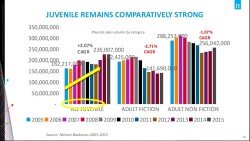
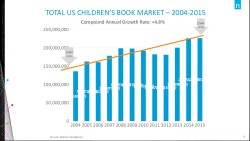
Kristin McLean of Nielsen Book revealed in her session at DBW 2016 Launch Kids conference (*) that the Kids/YA segment continues to be overwhelmingly print-focused.

According to Nielsen’s consumer surveys, this segment has been trending upwards for the past ten years, and growing by an average of 4.8%. eBooks do appear to have trimmed print sales for a couple years, but in recent years print has made a resurgence while ebook revenues have continued to grow:

It’s not all good news, however; Nielsen’s surveys showed that ebooks still make up a small fraction of the juvenile segment, even though ebooks accounted for half of the adult fiction market in 2014.

Depending on your viewpoint, that could be good news. It’s a sign that digital still has a lot of room to grow, but I wouldn’t bet on it.

One detail that has been reiterated over and over at DBW today was that surveys have shown that teens and the younger crowd are committed to paper. Even though kids are heavy users of digital services and social networks, they still prefer paper books over ebooks.

It’s not that they dislike ebooks so much as they like to share their books with friends, and that’s something which you just can’t do yet with ebooks. (And given that kids tend to borrow more titles than they buy, I’d say cost is another factor.)

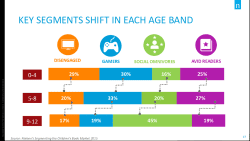
The surveys have also shown that avid readers and social onmivores, two groups that make up most of the juvenile book reading population, account for almost two-thirds of the 9-12 age cohort.

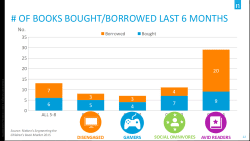
These two groups tend to buy more ebooks than gamers or the disengaged, but they also tend to borrow a lot more books than the other groups:

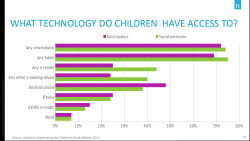
As you can see in the last slide, both avid readers and social omnivores are far more likely to have access to a smartphone or tablet. And contrary to what one might expect, avid readers were less likely than social omnivores to have access to an ereader (I would have expected that to go the other way, for obvious reasons).

So while there’s potential to sell more kids' ebooks to this market, it looks like authors and publishers would have more luck if they focused on digital content which is both easily sharable, and free.

P.S. While they are often referred to collectively as DBW, there are several conferences running concurrently this week in NYC. The session I attended was Launch Kids.

image by Julian Partridge

German Court Rules that Amazon Can’t Cut You Off From Your Kindle eBooks

Amazon has gotten a lot of bad press each time they banned a former customer and in doing so cut them off from the purchased ebooks, and now a German court is slapping the retailer on the wrist.

Lesen.net reports that a former Amazon customer in the German state of North Rhine-Westphalia sued the retailer in Köln over the following clause in its ToS:

We reserve the right to withhold your services on the website, to close member accounts or remove or edit content, if you violate any applicable laws, these Terms or any other applicable rules or guidelines.

The Oberlandesgericht Köln has now ruled that this passage is illegal under German law. It’s described in the announcement as putting customers at an unreasonable disadvantage, and the court also criticizes the clause for being too broad and lacking specifics that define when an account will be closed. The ruling, which has yet to take effect, can be downloaded as a PDF.

There’s no word yet on whether this ruling will affect all customers world wide, but I would hope it does (especially the point about specifics). Consumers have frequently been at a loss to explain why Amazon will close an account.

This is Amazon’s usual response should they decide a customer has made too many returns, but sometimes the retailer has closed an account for mysterious reasons and then refused to explain why (or so the complaining consumer has stated).

I have contacted Amazon, and asked about how this ruling might affect Kindle owners in Germany and around the world. I’ll update this post with Amazon’s response.

image by John Pastor

Middle-School Novels Are About Three Times the Size They Were Forty Years Ago

Remember a few months back when The Guardian told us that books were getting longer? That report eventually proved to be unsubstantiated after I showed that the source had an ulterior motive, but it turns out that the hypothesis was correct.

Books are getting larger (also longer, and that’s not the same thing).

Writing over at The Booklist Reader, Brianna Shemroske writes that she sampled The Booklist’s archives to put together a survey of book page counts over the past 40 years.

Luckily for me, Booklist—being the 111-year old review journal that it is—is a rich source of records. …

I collected data from seven issues of Booklist: the January 1 and 15 issues of 1976, the January 1 and 15 issues of 1986, and the double issues from 1996, 2006, and 2016. In each issue, I focused solely on reviews of middle-grade fiction. Because intended grade ranges often fluctuated by decade, I decided to allow a handful of varying combinations—so long as they fell somewhere between grades 3 and 8. Common grade ranges included 3–5, 4–7, and 5–8. Though the 6–8 range was ambiguous, I ultimately excluded it from my data because it’s commonly categorized as YA here at Booklist.

Shemroske found that middle-grade books have gotten considerably larger and longer over the past forty years, with the books reviewed in 2016 averaging almost three times the size of the books reviewed in 1976:

Year Average Page Length Average Increase in Page Length
1976 106.25 n/a
1986 137.08 + 30.83
1996 137.13 + 0.05
2006 174.5 + 37.38
2016 290 + 115.5

Noe that  this doesn’t show that the books are getting longer so much as they are getting larger. We’re tracking page count here, not word count, so what we see here is that the books are taking up more space on the shelf.

That said, a book with 290 pages had gotta be longer than one with 106 pages, so yes they are also getting longer. (Although, I would judge a book’s length by what happens, rather than word count. Excess description doesn’t make a book longer so much as more tedious.)

As we can see in the chart, most of the increase happened after 2006, and I bet you can guess which series gets the blame for inspiring longer YA novels:

Harry Potter

The adventures of the boy who lived started at a reasonable 77,000 words in The Philosopher’s Stone, tripled in size by the time of The Goblet of Fire, and reached its peak in The Order of the Phoenix (257 thousand words). The last two books were long, but still shorter than Phoenix. (You can find the page counts over at Quora.)

According to the reviewers over at The Booklist, the fantasy genre also skews the survey group. “Fantasies tend to be really long,” one explained. “Authors are building another world. Readers of fantasy want to get lost in those worlds.”

I don’t know that a reader’s desire to get lost in a novel necessarily translates into longer books; some of the mega novels I’ve read, including George RR Martin’s, owe their length to a cowardly editor who didn’t have the guts to trim the excess.

That said, the epic mega fantasy novel series has arrived, and Harry Potter gets most of the creditfor the YA aspect of the phenomenon. It made all the subsequent epic novels possible.

images by Horia Varlan,

B&N is Shutting Down One of Its Top Three Digital Blunders on 15 March

Barnes & Noble announced a slew of of closures on Thursday, including Nook Video, the UK Nook Store, and what had to have been one of B&N’s greatest digital mistakes.

B&N sent out an email on Thursday which informed users that the Nook’s own branded app store was going away:

Effective March 15, 2016, NOOK will no longer offer third party applications (Apps) for sale from the NOOK Store™. All of your existing Apps previously purchased from the NOOK Store will remain in your NOOK Library™ and will continue to be accessible on compatible NOOK devices. This means that you will still be able to download and install previously purchased Apps from the NOOK Library on your device.

The Nook App Store earned itself a eulogy because it is one of the reasons that the Nook platform failed.

I don’t really have time to explain this in depth, so here’s the short version.

During the early years of the Nook platform, before B&N sold rebranded Samsung tablets, its hardware strategy was built around custom Nook Android tablets.

Starting with the release of the Nook Color in 2010 and ending with the release of the Nook HD in 2012, B&N was building its own tablets and then trying to support them with an ebookstore and an app store.

Here’s the catch: You could load ebooks on to the Nook tablets from many ebookstores, but thanks to how B&N locked down the hardware you could only get apps from B&N.

That’s not a terrible idea on the face of it, but B&N could never make it work. They never had more than a couple hundred apps in the Nook App Store during that period, virtually guaranteeing that you would not be able to find the 4 or 5 apps you absolutely needed (I wanted OverDrive and Adobe Reader, and could get neither).

That is still a workable idea, if a user’s requirements are low enough, or if the locked down device costs a lot less than another tablet which perhaps shipped with Google Play.

Unfortunately, Barnes & Noble was charging about the same price for their ereaders cum Android tablets as Samsung and other tablet makers were charging for the Android tablets that shipped with Google Play.

If we look back to 2011, we recall that the original Kindle Fire, for example, torpedoed B&N’s plans to sell the Nook Tablet for $349 in late 2011 when the KF launched with a price tag of $199. (Even though the KF lacked Google Play, you could still do more with that tablet than you could with the Nook Tablet.)

$349 was the price of a premium tablet then, and it is still a premium price. And B&N thought they could sell what would best be described as an ereader at that price and that everyone would be satisfied with an anemic app store.

I wasn’t, and most people weren’t happy about it either.

This, folks, was one of the reasons why the Nook failed. B&N underestimated consumers who were savvy enough to figure out that they could read Nook ebooks on other hardware, but they couldn’t do jack with B&N’s tablets because of the sparse app store.

And so the only people who bought B&N’s tablets were B&N loyalists, the less tech savvy, and those with fewer needs.

Everyone else bought a gadget elsewhere, leaving B&N on the hook to sell millions of devices no one wanted to buy (hence the increasing number of two-for-one sales, refurb deals, and bundle offer in 2012 and 2013).

I don’t know that the Nook would have survived if B&N had never opened the Nook App Store; B&N made so many stupid mistakes that the platform was arguably doomed.

But I do know that the Nook App Store is one of the reasons that the Nook platform is dead today.

Amazon Decrypts Fire Tablets in Latest Update, Invites the FBI and NSA to Come On In

While Apple continues to fight the court order requiring it to develop a new firmware so that the FBI can more easily hack a terrorist’s phone, another major tech company has taken a surprise step back from protecting its customers privacy through encryption.

In the latest Fire OS Bellini 5.1.1 update, Amazon has removed device encryption from the OS.

Update: And as of Friday night, Amazon promised to bring encryption back. "We will return the option for full disk encryption with a Fire OS update coming this spring," I was told.

The change won’t impact Kindle or Fire phone owners, but it will impact millions of owners of Fire tablets running the latest version of Amazon’s OS, including the models launched last year as well as the Fire HD6 and Fire HD7. Both tablets are due to receive updates to Fire OS 5.1.1.

Device-level encryption, or full disk encryption, is the process of protecting all user data on an Android device using an encryption key. This is a core feature of Android 5.0 Lollipop, and once this option is enabled user-created data is automatically encrypted before being saved to a disk (it is disabled by default).

The change was first noticed by Rick Dillon, who wrote last week:

Even as the debate about whether the All Writs Act of 1789 can be used to compel a company to write new software that compromises the security of its own devices continues, Amazon has quietly removed all support for full disk encryption in their latest version of Fire OS, based on Android 5.0 ‘Lollipop’ (which has native encryption support). I discovered this while attempting to upgrade my 4th generation Kindle Fire, but got an error message indicating that I needed to backup all my data, do a factory reset on my device to remove encryption, and then install the update, since Fire OS 5 does not have support for encryption. Amazon did link to a page on their site explaining this, but it appears to not be indexed and I haven’t been able to find it again. Amazon’s removal of such a core privacy feature is somewhat surprising, since it represents a bit of a break from other high-tech firms like Google, Facebook and Twitter who have publicly expressed support forApple’s stance that it will not subjugate the privacy of its users to government whims.

The change has been subsequently confirmed on Twitter and Amazon’s support forums.

This is a shocking move for Amazon; the retailer has always put its customers first, so you would think that Amazon would at least give us the option of device-level encryption.

Both Apple and Google adopted device-level encryption in the wake of revelations of wide-spread illegal spying by the US government, and Apple even took the next step of making the encryption mandatory (it is still optional on Android).

And now Amazon is taking a step in the wrong direction, a move which makes no sense given that it follows only days after Amazon CTO Werner Vogels gave an impassioned speech at MWC in Barcelona where he said:

We have a very strong opinion on this. We believe that you cannot have a connected business, or an Internet-connected business and not make security and protection of your customers your number one priority.

Encryption plays a very, very important role in that. To be honest, it is one of the few really strong tools we have so customers know that only they have access to their data and nobody else.

I have reached out to Amazon for more information, and I will update this post with their response.

Update: Here’s Amazon’s response:

"In the fall when we released Fire OS 5, we removed some enterprise features that we found customers weren’t using," Amazon said in a statement. "All Fire tablets’ communication with Amazon’s cloud meet our high standards for privacy and security including appropriate use of encryption."

So Amazon is saying Fire OS 5 never had device-level encryption. It’s funny how no one notices that before now, but I suppose it is possible.

DailyDot

B&N to Close Nook UK Store on 15 March, Will Hand Customers Off to Sainsbury’s

After shutting down its international Nook Store in July 2015, B&N was left with just the Nook Stores in the US and UK. And now it appears the latter is about to go away.

There’s a belated announcement from B&N, but I learned of this story via a leak by the British supermarket chain Sainsbury’s. It posted a new webpage which welcomes Nook users:

Hello NOOK customers!

We are looking forward to welcoming you to Sainsbury’s Entertainment on Demand very shortly.

We are just putting the finishing touches to the process to allow us to transfer your eBooks and NOOK account to Sainsbury’s Entertainment. NOOK will send you an email with more information very soon.

In the meantime, if you have any questions read our FAQ or watch introductory video.

A quick check of the Nook.co.uk website confirms that there are "big changes ahead". The actual notice about the Nook UK closure was only just published while I was writing this post (the relevant page was blank just minutes ago), and it confirms the Sainsbury’s welcome message.

B&N tells its customers that the Nook apps will soon stop working in the UK, the ereaders will no longer have a bookstore built-in, and:

To meet your digital reading needs going forward, NOOK has partnered with award-winning Sainsbury’s Entertainment on Demand to ensure that you have continued access to the vast majority of your purchased NOOK Books at no new cost to you. Further instructions on how to transfer your NOOK Books to a new or existing Sainsbury’s Entertainment on Demand account will be sent to you by email over the coming weeks. Please ensure that you look out for these emails as they will contain important information on what to do next.

B&N also links to an FAQ.

Far from being "committed to providing a great digital reading experience to our customers", as B&N claimed in its financial report this morning, the retailer is retreating from yet another digital market. (This reversal also makes me doubt the announcement that B&N has a prototype digital store opening this year).

Edit: The WSJ said that B&N plans to open four prototype stores by April 2017.

At its peak the Nook Store was available in 40 countries, including Canada, the UK, Australia, much of Europe, and the US. In the not too distant future it will only be available to readers in the US.

Would anyone care to lay odds on when the US Nook Store gets shut down?

I would put the over-under at 7 months. That may seem like a short time frame, but then again I am a realist.

After having shut down its office in Luxembourg and later abandoning its international customers, dropping support for Windows 8 users in the UK, and now pulling back from the UK entirely, it’s clear that B&N is shutting down the Nook Store one component at a time.

Edit: B&N is also shutting down Nook Video.

The only part left is the Nook Store in the US, and that is bound to be on its way out.

Your guess is as good as mine as to when, but I would keep an eye out for a sudden exodus of staffers from the Nook offices. Once they get their pink slips, it will mark the death of the division and the servers are bound to be shut off a short while later.

MobileRead

image by James Cridland

B&N Reports Store Revenues down, Nook Revenues Down 33% Last Quarter

Barnes & Noble released its fiscal quarterly report today for the period ending on 30 January, and it looks like B&N’s plan to turn things around by selling pasta and tchotchkes still hasn’t worked.

Sales for the 3rd quarter decreased 1.8%, to $1.4 billion, compared to a year ago. Third quarter EBITDA was $169.0 million, up 1.6% as compared to EBITDA of $166.4 million a year ago, and consolidated third quarter net earnings from continuing operations were $80.3 million or $1.04 per share, or about double that of the third quarter 2014.

Retail accounted for most of the decline, and was down 1.2% over all, but the Nook platform’s ongoing spiral to oblivion also hurt B&N’s bottom line:

NOOK sales of $51.7 million decreased 33.3% due primarily to lower device and content sales. NOOK EBITDA losses of $11.2 million declined $17.9 million versus the prior year as the company continues to focus on cost rationalization efforts.

Barnes & Noble is no longer breaking out the content vs hardware sales anymore for the Nook division, so it is difficult to say with any certainty that the Nook Store continues to be smaller than Kindle Unlimited.

But with Nook revenues continuing to decline, and Amazon continuing to pay out more each month to publishers and authors in Kindle Unlimited ($15 million in January 2016), we have every reason to conclude that Nook is a smaller piece of the ebook pie than Kindle Unlimited.

Nevertheless, B&N is still pleased with the Nook results.

"We are pleased with our bookstore sales performance and the reduction of NOOK losses during the fiscal third quarter,” said Ron Boire, CEO of Barnes & Noble. “I am also pleased with the progress that has been made to reduce NOOK losses. We remain committed to providing a great digital reading experience to our customers, while exploring all opportunities to further reduce losses. Moving forward, our top priorities are growing bookstore and online sales, reducing Retail and NOOK expenses and growing our membership base."

Did you catch the bit about keeping the Nook? I had been wondering whether B&N would close the division, or perhaps sell it give it away, but apparently B&N is planning to keep the corpse in its parlor.

Edit: Or maybe not. The Nook UK store is closing on 15 March 2016.

Given how the Nook revenues have declined, that’s no big loss, but it is also a sign that B&N is still standing around, trying to decide what to do next with digital. We’ve been waiting three years for B&N to figure that out, and in that time revenues have declined by over 90%, and the Nook division has been reduced to a fraction of what it was once worth.

B&N almost spun off the division in 2014, before deciding to keep it and spin the B&N college stores off by themselves. Given the decline that followed, that proved to be a bad choice for B&N but potentially a good move for the remaining Nook users.

With the Nook worth so little, it would now be possible for either Kobo or Google to pick it up for chump change and fold the tech into their existing platforms.

It almost makes you wonder why Kobo hasn’t bought them yet, doesn’t it?

images by Todd Barnard,  wizardjournal