You Shouldn’t Read Too Much Into the Legal Threats Over Brave’s Ad-Blocking Browser

Brave put itself on a collision course with web publishers when it announced its ad-filtering web browser in January, so it should come as no surprise that a bevy of media companies have responded to last week’s launch with legal threats.

No fewer that seventeen web publishers, including the Washington Post, Gannett, and the Tribune company, have signed off on a letter which calls the browser’s built-in ad-blocking features ”blatantly illegal.”

Users have been blocking adverts in web browsers since long before Apple made content-filtering a core feature in iOS 9 last year, and there are even web browsers which offer ad-blocking as a built-in feature, but Brave takes the idea one step further.

This browser blocks adverts and replaces them with less-toxic ads sourced through a trusted ad network. The revenue generated by the ads is then split between the web publisher, Brave, and users, with the final group getting paid in Bitcoin.

Yesterday the media companies sent a letter to Brave, calling its browser illegal and describing the business model as copyright infringement. Brave responded with a public statement.

From Business Insider:

With Brave, publishers get around 55% of revenues: 15% go to Brave, 15% go to the partner that serves the ads, and 10% to 15% goes back to the user, who can choose to make bitcoin donations to their favorite publishers in order to get an ad-free experience on their websites, Eich told Business Insider in January.

But the 17 newspaper-publishing companies that cosigned the cease and desist letter sent to Eich on Thursday say that this business model is "blatantly illegal" because they claim Brave is profiting from the "$5 billion" a year the industry spends on funding journalism.

The publishers argue that Brave’s advertising-replacement plan would constitute copyright infringement, a violation of the publishers' terms of use, unfair competition, unauthorized access to their sites, and a breach of contract.

You can read more over on WSJ or Business Insider, and I have included both of the letters below.

But I wouldn’t read too much into the letter from the newspapers. It is less a threat of legal action than it is the first round of negotiations.

Or at least that is how things played out before. This whole incident is basically a repeat of the launch of Flipboard. That news aggregator app faced similar questions when it launched in July 2010, and so did its smaller competitor Zite.

Both Flipboard and the now-deceased Zite got their content by scraping websites and republishing the articles. That’s arguably copyright infringement, and in fact, Zite received a cease-and-desist letter in March 2011 over its site scraping because it was posting whole articles. According to coverage at the time, Flipboard managed to avoid the public nastygram by only showing excerpts, but some publishers still complained.

And yet, both Zite and Flipboard continued to operate right up until one was acquired by the other.

And Flipboard is still around today, so don’t count Brave out just yet.

O O O

Here’s the cease-and-desist letter sent to Brave:

Dear Mr. Eich:

Brave Software, Inc. (“Brave”), a company you founded, has announced that it intends to launch a browser and mobile applications that will display publishers’ content but replace publishers’ advertising with advertising that Brave sells for its own profit. You are hereby notified that Brave’s plan to replace our clients’ paid advertising content with its own advertising violates the law, and the undersigned publishers intend to fully enforce their rights.

Your plan to use our content to sell your advertising is indistinguishable from a plan to steal our content to publish on your own website. Your public statements demonstrate clearly that you intend to harness and exploit the content of all the publishers on the Web to sell your own advertising. “We can provide access to all of the top publishers through a single channel with guaranteed ‘share of voice,’” Brave’s website claims. “This combination of better targeting and first-look access to all of the premium placements our users browse is something that no one else can provide.” There’s a simple reason “no one else” is purporting to “provide” all the content on the Web in one place for its own profit, without investing a penny in creating that content: everyone else has recognized that it would be blatantly illegal for one company to hijack all the content on the Web for its own benefit.

We publish some of the most highly valued and widely read sites on the Web. Our sites and mobile applications provide news reporting, photojournalism, video content and feature writing that is researched, reported, edited, and produced at extraordinary cost. Our industry spends more than $5 billion per year on reporting in the United States alone. We distribute that reporting online for free or at highly subsidized rates, in no small part due to revenue from online ads.

Your apparent plan to permit your customers to make Bitcoin “donations” to us, and for you to donate to us some unspecified percentage of revenue you receive from the sale of your ads on our sites, cannot begin to compensate us for the loss of our ability to fund our work by displaying our own advertising. We expressly decline to participate in any way in Brave’s supposed business model. We explicitly reject any compensation or consideration Brave plans to offer to us as part of its ad-blocking and ad-replacing scheme, and we refuse to accept any “site wallet” that you propose to create for our supposed benefit. In addition, you are not authorized to use our names, trademarks and logos in any way in connection with the promotion or operation of your business.

We stand ready to enforce all legal rights to protect our trademarks and copyrighted content and to prevent you from deceiving consumers and unlawfully appropriating our work in the service of your business. Unauthorized republication of our copyrighted content to support Brave’s illegal advertising model violates protected rights of publishers under the Copyright Act and other laws. We reserve the right to seek all remedies for this infringement, including but not limited to statutory damages of up to $150,000 per work pursuant to 17 U.S.C. § 504. Brave’s use of publishers’ trademarks to sell its own advertising will confuse consumers, infringe upon publishers’ exclusive rights in their brands, and dilute our highly distinctive marks. We believe your planned activities will also constitute unfair competition and misappropriation under relevant federal, state and common law. Brave’s unauthorized activities involving our content and websites also violates our terms of use. By engaging in Brave’s plan of advertising replacement, Brave is liable for breach of contract, unauthorized access to our websites, unfair competition, and other causes of action.

Very truly yours,

O O O

And here’s is Brave’s response:

The NAA sent a letter to Brave Software that is filled with false assertions. The NAA has fundamentally misunderstood Brave. Brave is the solution, not the enemy.

The NAA’s letter to Brave Software asserts that any browser that blocks and replaces ads on the browser user’s device performs "unauthorized republication" of Web content. This is false on its face, since browsers do not "republish", serve, syndicate, or distribute content across the Internet or to any computer other than the one on which they run.

Browsers are the end-point for secure connections, the user agent that actually mediates and combines all the pieces of content, including third-party ads and first-party publisher news stories. Browsers can block, rearrange, mash-up and otherwise make use of any content from any source. If it were the case that Brave’s browsers perform "republication", then so too does Safari’s Reader mode, and the same goes for any ad-blocker-equipped browser, or the Links text-only browser, or screen readers for the visually impaired.

The NAA letter also falsely asserts that Brave will share an "unspecified percentage of revenue", when our revenue share pie chart has been public and fixed from our first preview release in January. We give the lion’s share (pun intended), up to 70% of ad revenue, to websites, keeping only 15% for ourselves and paying 15% to our users.

We sympathize with publishers concerned about the damage that pure ad blockers do to their ability to pay their bills via advertising revenue. However, this problem long pre-dates Brave. We categorically reject the claim that browsers perform "republication", and we repeat that Brave has a sound and systematic plan to financially reward publishers. We aim to outperform the invasive third-party ads that we block, with our better, fewer, and privacy-preserving ads.

Finally, we note that malvertisement has gotten onto the websites of the New York Times and the BBC recently through the ill-designed, unregulated, and poorly-delegated third-party advertising technology ecosystem. Truly, this tracker-based ad-tech ecosystem is what is damaging the brand value of content publishers and driving users to adopt ad-blocking software. Brave blocks and replaces only third-party ads and trackers. Our system thus actually repairs the damage that publishers have carelessly allowed their ad partners (and partners' partners, to the seventh degree of separation) do to their trademarked brands and names.

Make no mistake: this NAA letter is the first shot in a war on all ad-blockers, not just on Brave. Though the NAA never reached out to us, we would be happy to sit down with them for an opportunity to discuss how the Brave solution can be a win win. We will fight alongside all citizens of the Internet who deserve and demand a better deal than they are getting from today’s increasingly abusive approach to Web advertising.

image by finalcut

B&N Outsources Nook Functions to Indian Tech Company

When Barnes & Noble shut down the UK Nook Store as well as the Nook App Store last month, we took it as a sign that B&N was going to kill off the Nook platform quickly. Now it seems B&N is going to let the Nook wither on the vine.

B&N announced on Thursday that it had inked a deal with Bahwan CyberTek, an Indian outsourcing firm, for BT to take over certain Nook tech services. To be more exact, B&N said that the firm would be responsible for cloud management, development support for Nook software, and other services.

“Over the last two years, the Company has done a significant amount of work to improve NOOK’s overall performance,” said Fred Argir, Chief Digital Officer at Barnes & Noble. “While we have been able to reduce costs, we still have a lot more work to do to rationalize the business. We believe that by outsourcing certain technology functions of our Nook business we will further improve Nook’s performance.”

B&N also took the time to reaffirm its commitment to the Nook platform, and add that as a result of the deal it is closing both its Taiwan and Santa Clara, Calif. offices by July 2016.

The Nook platform, however, will remain open as B&N adopts benign neglect as its digital business model.

And yes, benign neglect is the best term for today’s news; had B&N really been interested in rebuilding Nook then they would have invested capital rather than outsourcing key functions.

That’s what Amazon would do; remember, Amazon has a habit of buying companies with tech it needs (Kiva Systems, Mobipocket, Liquavista, etc).

That B&N is choosing not to invest tells us all we need to know about their plans for the Nook platform.

Now would be a good time to get your ebooks out, if you can.

image by Kansas Poetry

Goodreads Reaches New Milestone: Fifty Million Reviews

Goodreads secured its position as the world’s largest book-focused social network this week. The Amazon subsidiary announced yesterday that users had posted an aggregate 50 million reviews. 

"Many of our reviewers have developed their own distinctive style and won an audience that loves their creativity as much as their recommendations," Goodreads founder Otis Chandler wrote on the Goodreads blog on Wednesday. "The amazing diversity of reactions and approaches is what makes Goodreads reviews so unique and enjoyable. And now, just over nine years later, we’ve reached a new milestone: 50 million reviews! "

Chandler didn’t share how many reviews had been removed during one of Goodreads infamous purges, but he did thank members for the reviews which made it through the culling. "On behalf of the Goodreads team, I wanted to give a huge thank you to all of you who’ve written such amazing reviews over the years. I hope you’ve found it as rewarding as I do to look back at your reviews."

Amazon bought Goodreads in early 2013, and clearly the site has thrived under Amazon’s influence.

image by deeps.adhi

New Kindle to Have Rechargeable Case, New Basic Kindle "Woody" On the Way

Jeff Bezos has promised that we would hear more about the new Kindle next week, but thanks to a new leak we do not have to wait.

The WSJ confirmed my report from yesterday that the new Kindle had a battery-powered case, and added that we might not see it any time soon:

Also under development is a separate Kindle case with a battery that can be charged using solar power. It is unlikely this case will be released in the immediate future, another person familiar with the matter said.

…

The new Kindle and case are code-named "Whiskey" and "Soda," respectively, and the solar-powered case is known internally as "Sunkiss" among engineers at Lab126, Amazon’s Silicon Valley hardware development unit, one of the people said. The division is responsible for other Amazon devices including its Echo virtual assistant, Fire tablets and Fire TV set-top box.

So it’s a solar-powered case? Interesting, but not ground-breaking. There were third-party solar-powered battery cases for the Kindle Touch and the Kindle (no-touch). They were released in early 2012, and the quietly vanished as the stock was sold off. (You can see one of the cases in the lead photo.)

I have one of those cases, and I never thought it was worth the extra mass. It just wasn’t useful enough to justify the nuisance, so I rarely used it.

It’s not clear why Amazon is reviving that old idea, but one does hope that it points to a Kindle which needs the extra battery life (Liquavista …). But that’s for the future; what matters now is the Kindle to be announced next week.

While I don’t have any details about the case codenamed "Soda", I can independently confirm that the codename "Whiskey", or rather "Whisky", has been found in the recent Kindle Firmware update.

Edit 1: And now we know the name is the Kindle Oasis.

Edit 2: Another leak confirms the battery-case, and that the Oasis has page turn buttons.

Edit 3: And Amazon has put the cherry on top with a leak on Amazon.ca.

A hacker has taken apart the update and found references to a new basic Kindle codenamed "Woody" as well as the Kindle "Whisky". He said that the new Kindle we’re going to hear about next week lacks the haptic feedback found on the Voyage (yay!) but may have page turn buttons (double yay!) and accelerometers.

He called it a "hybrid between a PW and a Voyage", one which could run on the Paperwhite’s firmware, and added that both the new  models "would run on a new storage solution at the HW level". Also, the "Whisky" model and the new "Woody" Kindle are going to use a new mainboard codenamed "Duet".

So there you have it, folks; we have not one but two Kindles in the pipeline.

And you read it here first.

Jeff Bezos Says a New Kindle is Coming

My one and only April Fools joke last week involved a new Kindle launching this month, and now it appears my joke may be closer to the target than you might have expected.

Jeff Bezos tweeted the following about an hour ago:

While we don’t have any specific details on the next Kindle, I have heard from Dave Zatz that it will have Wifi, BT, and 3G. I can also add that you’ll find this in the product description:

Product supplied with cover in leather. The cover has internal battery recharged via the tablet itself.

That’s all we know until Amazon either drops the embargo or leaks more info. (And just to be clear, I had that info from Dave before I posted the 1 April joke. I think it’s legit.)

Edit 1: And now we know the name is the Kindle Oasis.

Edit 2: And new info has leaked. The battery case is confirmed, and there are two Kindles in the pipeline.

Edit 3: Another leak confirms the battery-case, and that the Oasis has page turn buttons.

Edit 4: And now Amazon has confirmed the name and specs with a leak on its Canadian site.

I for one am hoping that it has a Liquavista screen, and Twitter users have responded to Bezos' tweet and asked for their most-wished for features. "Please let it have proper clicking page-turn buttons! Touch screens and sensors are terrible replacements," one writes.

Another one wished Amazon would release an upscale white Kindle: "Future wish: white bezels, allowing text to go up to the edge of the display, while still looking good," while a third asked for the return of Text to Speech: "Have text-to-speech or go away forever. The Keyboard is the ONLY good Kindle."

Both a Liquavista screen and text-to-speech would fit with Bezos’s calling the next Kindle "top of the line", but of course this is purw speculation at this point.

What would you like to see in the new Kindle?

Kindle Flame to Ship This Month, Has Liquavista Screen

When Amazon bought the Liquavista in early 2013, I hoped that it meant that we would one day see Liquavista’s electrowetting screen tech in the Kindle.

Now it’s finally happening. Meet the Kindle Flame (at right).

Edit: This post was and is a 1 April joke, but it has rapidly become less a joke than a prediction. Here’s the latest info on the new Kindle (one, two, three, four, five).

An inside source at Amazon shared the above photo with me, and they also told me that later this month the retailer will be launching the Kindle Flame, its next and best Kindle. Equipped with Wifi, Bluetooth, and 3G, the Kindle Flame will combine the best aspects of Amazon’s Kindle ereaders and the Fire tablets.

I’m told the Kindle Flame will run Android, and ship with a case which has its own battery (no word on whether there’s a light, or a keyboard built-in). I have no info on price, but I can report that when it goes live you will find it at www.kindleflame.com.

And most importantly, the Kindle Flame will have a Liquavista screen. This screen won’t be nearly as pretty as the screens on the Fire tablets, but it will be in color, and it will refresh at a rate faster than one of the E-ink screens found on the other Kindle models.

The Kindle Flame’s screen will also be relatively low-powered, compared to your average LCD screen, which means it should have battery life on par with the Kindle Voyage (here’s hoping, anyway).

But in all honesty, we won’t know that for certain until the Kindle Flame launches later this month.

Stay tuned.

P.S. April Fools.

Bexar County to Open Its Third All-Digital BiblioTech Library Branch in 2017

Bexar County made headlines in 2013 when it became one of the many libraries to open a book-free, all-digital library, but it didn’t stop there. Its second all-digital branch opened last year, and now the San Antonio Express-News reports that construction is underway on a third branch.

Located in the Wheatley Heights Choice Neighborhood development at 1203 N. Walters Street, the new branch will occupy 4,200 square feet, or about the size of a RadioShack.

According to my source, it will have a digital reading room, community room, children’s area, and study rooms. That’s a lot of activity rooms for such a small space, more than you would expect in a regular library, but Bexar County has a unique advantage. Its BiblioTech library system follows the trend seen in college libraries in that paper books have been displaced in favor of digital.

The all-digital collection lets the library system economize on space, so they can open smaller and cheaper branches, and extend to support more parts of the community. In addition to the BiblioTech branches in a housing complex and a county building on Pleasanton Road, the library system also supports ebook kiosks at local military installations and a hole-in-the-wall branch at the county’s Central Jury Room.

In an earlier age, those secondary locations would be served by bookmobiles, but now they have a permanent digital presence.

But is that an improvement? That remains to be seen.

The all-digital branches may have lower physical operating costs, but they also have much higher digital costs. Library ebooks costs four to six times as much as print books, are sold under expiring licenses, and require annual maintenance fees. Libraries also have to invest in additional hardware so the ebooks can be read, so it is far from clear whether the new idea is a net positive or a negative.

In any case, the third branch is expected to open early next year. Patrons will be able to access BiblioTech’s ebook catalog through Cloud Library, as well as other digital services like Hoopla and Zinio. That ebook catalog will be augmented by an additional 4,000 titles purchased with a generous $100,000 grant from the Kronkosky Foundation.

“Because BiblioTech is the first all-digital public library in Bexar County and our nation, children county-wide will be able to enjoy the marvelous new collection, and learn more about their heritage and heroes,” said Hidalgo Foundation president Tracy Wolff.

The Hidalgo Foundation is a local non-profit which supports the BiblioTech library system, as well as other endeavors in Bexar County. eBooks acquired with the grant will include titles for school-age children, adolescents and adults, Wolff said.

Onyx Boox Max is Not Your Typical eReader

Thirteen inch ereaders are few and far between and far outside my budget, so when the Onyx Boox Max went up for pre-order a couple weeks back, I immediately begged to borrow a review unit.

This 13″ ereader retails for $650 plus shipping and VAT, putting it far outside my budget.

I got the Max on Tuesday, and started thinking about the review on Saturday night. Five days is not nearly long enough to really plumb the depths of a device as complex as the Max, but I have a good excuse for writing the review this early.

The review unit died Friday night. We think it’s just a loose cable, but since I can’t use the Max right now I decided to take a few minutes and share my thoughts.

This is going to be a difficult review to write. The Max is not an ereader, not in the way you think of an ereader or use one, and I don’t think it fits into any predefined category.

I haven’t had such a category-breaking device since the Entourage Edge, that dual-screen textbook reader from early 2010.

The Edge was a well-conceived device with solid hardware and software, but it flunked out with a lot of reviewers because they couldn’t grasp its purpose or function. They approached it as an ereader, and tried to compare it to a Kindle, when in fact the Edge was a niche product designed to serve just one market.

If you are looking to buy a Max, I suggest that you avoid the mistakes those reviewers made, and set aside any preconceptions that the Max was made for reading ebooks. Based on my time with it, I would say that it is more of a document viewer than an ereader. Its sheer size precluded me from using it as an ereader.

This is more of a device that you would hold up and use for showing off blueprints, or one which you would use to proof a document a page at a time. You might also lay it on a table, and have several people looking at the screen at one time.

Now that I have used the Max, I can understand why Pocketbook has branded their large ereader as a blueprint reader for the construction market, and why the Sony DPT-S1 only supports PDF and is targeted at the business market. I think both Sony and Pocketbook built a prototype, started using it, and realized that they would have more success if they focused on a limited number of use cases. That’s why they refined their software to better support those use cases (the Pocketbook CAD Reader has yet to be released, but still).

A device built around a 13″ E-ink screen is not a product for the broader ereader market, so it made sense for Sony and Pocketbook to focus on niche markets with specific uses.

And luckily for Max owners, they can define their own niche uses (including ones I have’t thought of).

The Onyx Boox Max is an open Android device. It runs Android 4.0 on a 1GHz CPU. You can install third-party apps, and it also comes with Google Play.

I didn’t get a chance to test app compatibility with the review unit, but I do want to point out that potential owners should think about the apps they might install, and the abilities and features those apps would add to the Max.

Max owners can define their own niche uses for the Max, and so while I might declare what the Max is not, I can’t tell you exactly what it is.

We really don’t know yet.

Boyue T63 Shine Android eReader to launch in China as the JDRead

The Chinese ereader OEM Boyue updated its website this week and has taken down the page for the long awaited T63 Shine. In its place is a new page for a new ereader called the JDRead, which has essentially the same hardware, only now with a new brand.

China’s second largest online retailer (after Alibaba) Jingdong is getting into the ereader biz. The retailer is in the middle of a crowd-funding campaign to raise interest in the JDRead, its first ereader.

The JDRead features a 6″ Carta E-ink screen with frontlight and touchscreen, and like the earlier and related ereader Ridibook Paper, the JDRead runs Android an an dual-core 1GHz CPU with 512MB RAM and 8GB internal storage. It’s not known, however, whether the JDRead lets you access the Android and install apps (the Ridibook Paper does not).

Weighing in at 190 grams, the JDRead is a little heavier than the Kindle Voyage. It has a 1440 x 1072 resolution display, a 2.8Ah battery, Wifi, and a microSD card slot. It also has page turn buttons, and according to one source the JDRead has a haptic feedback system (it vibrates when you touch the screen). My Ridibook Paper doesn’t appear to have that option, so I can’t confirm this detail.

According to Boyue, the JDRead is going to launch/ship in May. Jingdong is charging 799 yuan for the ereader, or about $123.

Based on what I’ve seen with my Ridibook Paper, that’s not a bad price, although an English speaker is probably going to have trouble with the Chinese-language menus.

The language conflict is the single biggest issue for my Ridibook Paper, which I got in late December. It has been available in Korea from the bookseller Ridibook since last fall, but it’s not available internationally and even in Korea the supply was limited. I had to buy it through Ebay and put my money down on a pre-order with the hope that I wasn’t being cheated, and even then I still had to wait for a month.

The Ridibook Paper is a very pretty ereader, and it’s fast to turn the page, thin and light, and while the buttons are low profile I still find them easy to use.

If it had an English language option I would recommend that you get it, but as it stands, the Paper and the JDRead are best left to people who understand the language, or are willing to hack their ereader and install another firmware.

JD.com via AllChinaTech, CNW

How to Dispose of a Broken or Dead Kindle, And Earn a Few Dollars

I’ve already written a post about what you can do with an android tablet with a broken screen, but it occurred to me today that I’ve never published a similar post on what to do with a Kindle in a similar state.

Amazon has done everything they can to make each Kindle model more sturdy than the one before, but screens still break, and sometimes Kindles die for no reason at all. So what do you do with a Kindle that is totally nonfunctional and broken?

You cannot, for example, turn it into a weather station or a fridge magnet or a bike computer; the busted screen makes that impossible.

But you might still be able to sell that busted Kindle and make a few dollars. Another option would be to send it to a recycling center.

Or, if your Kindle still works and you simply don’t want to use it anymore, once you upgraded to a newer model, you might donate it to a literacy program like Project Hart (although you might want to refurb it first). Or you could use Amazon’s trade-in program to exchange the Kindle for an Amazon Gift Card.

And don’t forget, all Kindles – including refurbished units – come with a one-year warranty. So if your Kindle dies when it is less than a year old, be sure to contact Kindle support to see if you qualify for a free or discounted replacement unit.

How to Recycle a Broken Kindle

Short of dumping it in the trash, your easiest option is to send the broken Kindle to Amazon’s Take Back Program so it can be recycled.

If you are in the US, that program is handled by a contractor, and not Amazon itself. Fill out the form, and they’ll email you  a prepaid UPS shipping label that you can slap on the box before dropping the Kindle off at a UPS Store or at another UPS facility.

You can find more information here.

Amazon has a separate page for their Kindle recycling efforts in Europe.

How to Sell a Broken Kindle on Ebay

Dumping or recycling a broken Kindle is your easiest option but it’s not the most profitable.

It might surprise you to learn that you can sell a broken Kindle on Ebay or other auction sites. Yes, a Kindle with a broken screen or dead battery, or which is otherwise non-responsive, can get you any where from $10 to $29, depending on the condition and luck.


images by nickbrett, twirlop, kodomut

Free and Open eBooks Won’t Help Those on the Wrong Side of the Digital Divide

The Washington Post reminded us on Friday that the recently announced federal Open eBooks program could fail to reach those who need it the most.

While this program enables educators and librarians to grant students in need access to a library of free ebooks, it does nothing to solve the problem of making sure those same students have the hardware to read the ebooks:

The White House recently announced the launch of Open eBooks, an app giving access to thousands of free e-books to any educator, student or administrator at one of the more than 66,000 Title I schools or any of the 194 Defense Department Education Activity schools in the United States. It’s an admirable endeavor and recognizes that we have a literacy problem. However, it brings to mind Samuel Taylor Coleridge’s famous line: “Water, water, every where/ Nor any drop to drink.”

On that list of Title I schools: Crewe Primary. The whole of Nottoway County, Va., is a high-poverty tract; there is no public transportation, no fiber-optic Internet available for the county’s 16,000 residents. In Southside Virginia, the commonwealth’s poorest region, most schools don’t have broadband; Crewe Primary School has DSL but little more than 40 usable iPads (not counting the old and obsolete ones) for its 318 students.

The Nottoway County Public Library is the only location in the 316-square-mile county with publicly funded Internet access. To use Open eBooks at home, primary school students would have to rely on their parents’ phones and tablets. Older students may have their own devices, but downloading the e-books would eat into very pricey and limited data plans.

The WaPo is making the point that this program was launched in a country where only 45% of adults own a tablet, and 68% own a smartphone. With past surveys having shown us that gadget ownership and reliable internet access is concentrated among the upper classes and the better educated, just how many of those students at Title I schools do you think will benefit?

Not enough, and in fact the situation is worse than the Post makes it sound. They went to the wilds of rural Virginia to find a Title I school to write about, but they could have found them in NYC or the District of Columbia.

I’m having trouble finding a national list, but I have found that even a wealthy school district like Fairfax County has 44 Title I elementary schools. This is the same county that tried to switch to digital textbooks a few years back, only to discover that most students didn’t have adequate internet access at home. (With 44 Title I schools, I’m surprised that they expected it would succeed.)

So yes, access to that wonderful free digital content is a problem, and that’s true even in the major metro areas. That’s why public libraries like the NYPL lend 4G hotspots, and why that municipality and others are setting up free Wifi hotspots.

Those free Wifi hotspots, and the federal ConnectEd program, are the modern day equivalent of the New Deal’s rural electrification program, and they show just how bad the state of internet access is in 2016. We don’t just need that program out in the boonies; we also need it in the major metropolitan areas.

So while Open eBooks is a laudable program with admirable ideals, it is still a case of putting the cart before the horse. Without parallel programs to address hardware and access issues faced by students at home, the Open eBooks program won’t achieve its goals.

image by nooccar


Is There Really a Global Shortage of Colored Pencils?

I don’t think anyone would argue that the recent high demand for adult coloring books  had failed to cause a similar increase in colored pencils, but is there any truth to the claims that the high demand has lead to a shortage?

I’ll let you be the judge.

On Saturday the Telegraph became the latest publication to cover the "shortage" when they proclaimed the shortage in their headline, and then backed it up with an anecdotal assertion from coloring book designer Johanna Basford:

Colouring-in fans just love their pens and pencils, they become real artists. I get messages from people in New Zealand and Australia saying there are big shortages now. It’s really nice that something I was passionate about is now shared worldwide."

Colin Freeman, one of the writers of that piece, told me on Twitter that he also had reports from retailers which said that colored pencil supplies were in short supply, and he also noted in the piece that pencil makers are running extra shifts to meet demand, but I’m not so sure that is enough to conclude that there is a shortage.

Also, last October the NZ Herald mentioned that "leading colouring pencil manufacturers Staedtler and Stabilo (were) struggling to keep up with the worldwide demand." The Herald did not name a source for that statement, however.

While technically it does meet the dictionary definition for shortage, I have an aversion to clickbait-sounding headlines which made me go look for evidence to refute or support the claim.

For example, my favorite pencil shop, CW Pencil in Manhattan, said that they had not heard anything about a shortage. "To my knowledge, none of our distributors have communicated a specific shortage of pencils, spokesperson Caitlin Elgin told me by email. "We have certainly seen an uptick in sales of colored pencils because of the craze, particularly around the holidays, but for the most part haven’t had trouble stocking colored pencils (or regular pencils for that matter).

"The one exception would be the Irojiten Color Dictionary sets that we had a hard time getting for about two months (they come from Tombow in Japan), but again, our distributor didn’t mention that was because of a pencil shortage."

Emily Stone, a spokesperson for Faber-Castell concurred, telling BT.com that “We are not seeing a pencil shortage, but our production has increased significantly compared to the previous year thanks to the colouring trend.”

Sandra Suppa, a representative for a different part of Faber-Castell, shared more details with Inquisitr.com. “The production of our artists’ pencils has increased strongly compared to the previous year," she told them. "Currently, we are running more shifts than usual in our factory in Stein, Bavaria in order to satisfy the global needs for artists pencils related to the colouring trend for adults. The trend is continuing to this day and can be felt globally – from South America to Asia.”

So tell me, does that sound like a shortage to you?

In all honesty, there’s enough of a dispute here that one’s own bias will likely swing one’s answer either in favor or against. I don’t think this rises to the definition of a shortage, but I also have to say that I can see why others reached that conclusion.

Have you had trouble getting colored pencils?

image by arquera


How To Manually Update Your Kindle If You Miss the Deadline

It’s only a day past the 22 March deadline for the critical Kindle update, and early reports suggest that not everyone got the emails, post cards, and phone calls from Amazon about the update.

If you’re one of the Kindle owners who didn’t get the update in time, don’t panic. If you missed the deadline, there is still a way for you to install the update.

The process will require a computer, your Kindle, and and a USB cable to connect the two, and you should also fully charge your Kindle before you start just to make sure that you have enough power to complete the process.

Here are the first steps to manually update your Kindle.

  1. First, determine which model you have. The best way to do that is to match your Kindle to one of the models on this page. 
  2. And then to determine the firmware, open the settings menu.  Then open the dropdown menu and select the "device info" option. This will tell you which version of the firmware your Kindle is currently running. 

If the firmware number matches one of the numbers on this help page then you already have the update. Also, if you can’t find your Kindle on that second page then you don’t need the update at all.

But if the firmware number is different then you’ll need to keep going and install the update.

Here are links to the download pages:

You can visit the pages above to download the update. Depending on how long it’s been since your Kindle connected to the internet, you may need to install one or more updates.

Each update will need to be installed one at a time, in the correct order. Here’s how:

  1. Download the update to your computer, and then copy it to your Kindle using the USB cable.
  2. Disconnect your Kindle from your computer.
  3. Open the settings menu on your Kindle, and then open the dropdown menu. You should see an option labeled "Update your Kindle". Select it, and then confirm the update.

Your Kindle’s screen should then flicker a few times, and then you will see the update status as a progress bar.

If you don’t see the progress bar, or if the update fails, then you will need to contact Amazon and ask for technical help.

image by bfishadow


Do Self-Published Titles Make Up 22% of UK eBook Market, or 30%?

Nielsen has worked its consumer survey magic and come up with a new estimate of the UK ebook market.

From The Bookseller:

Sales of self-published e-books accounted for 22% of the digital book market in the UK last year, the Nielsen BookInsights Conference today (23rd March) was told, although growth in overall e-book sales is continuing to slow. By contrast sales of audiobooks continued to rise strongly – up by more than a quarter in 2015.

Steve Bohme, research director at Nielsen Book UK, said self-published titles rose from 16% of the e-book market by volume in 2014 to over a fifth of the market (22%) in 2015.

At the same time he said e-book sales grew by 5% in volume in 2015 – a lower growth rate than in 2013 and 2014, leading to the e-book share of books only rising marginally last year by 1% to 27% of the market from 26% in 2014.

it’s funny he should say that self-published ebooks made up 22%, because other sources would put that figure much higher.

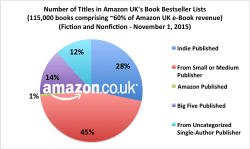
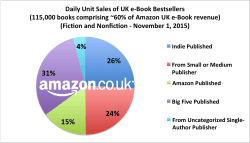
Back in November 2015 Data Guy turned the Author Earning Reports' spiders loose on the UK Kindle Store, and he found that self-published titles made up 40% of the titles on the best-seller list, and 30% of the revenue:

The Kindle Store dominates the UK market even more so than the US market, and for all intents and purposes it is the whole of the market (I wouldn’t argue if you called it a monopoly, even).

So which do you think is closer to being correct, Nielsen or Author Earnings Report?

Given what we learned about the AE Report at BDW, I have a higher confidence that the Report is correct than that Nielsen’s surveys would prove an accurate extrapolation of the aggregate UK consumer.

But that report is close to six months old, so the data is stale. But does that mean it’s no good?

image by MissMessie

"Stop Procrastinating" App Offers a Distraction Free Writing Experience, Can Save You up to $500

Saturday’s post on the Freewrite reminded me that there are more options for distraction-free writing than that $500 retro word processor or its cut-price competitors.

One could simply disable one’s internet access, but for those of us who lack the willpower (me) to leave it turned off there are more extreme options.

For example, apps like Stop Procrastinating let you block internet access for a set period of time.  You can choose how long the firewall will remain active, which sites will be blocked, and whether you want to keep the firewall active after you reboot your computer. (That last option was developed for those of us who know we’re going to enable the app and then want to disable it right away.)

If you’re wondering why one might need this app or apps like it, ask yourself the following questions: How often do you browse the web or use social media while in a meeting? How often do you use it on the toilet? Is getting on the internet the first and last thing you do everyday? Do you often lose track of conversations because you were distracted by the tiny screen in front of you?

If your answer to these questions is yes, then you could probably use an app like Stop Procrastinating to help you concentrate while working. The app is available for Windows and OSX, and costs $5 after a 90-day trial period.

image by Zak61099