Kindle Unlimited Funding Reaches New Peak in January 2016 as the Per-Page Payment Drops

Amazon delivered the first blow in a one-two punch on the future of subscription ebooks on Monday. (The second blow is coming Tuesday.)

Amazon announced on Monday that the retroactive funding pool for Kindle Unlimited totaled $15 million for January 2016, up from $13.5 million in December and almost double the $8.5 million paid out in January 2015.

More people than ever are using the service, which helps explain why the KENP per-page rate dropped to $0.00411 per page in the United States last month, down 11% from the December 2015 rate. That’s a huge change for just one month.

This is both the largest funding pool, and the lowest per-page rate, since Amazon switched to the new plan in July 2015, and while the news is disappointing it still makes a lot of sense.

Amazon sold a "record" number of Fire tablets and other devices this holiday season, and all those devices came bundled with a free trial month of Kindle Unlimited. The retailer also bundled Kindle Unlimited subscriptions during a few of their promotions, and discounted it a couple times last fall.

And with more reading devices activated on Christmas day than any other day of the year, it would make sense that KU usage would reach a new high in January (this is also why there is usually a post-Christmas surge in ebook sales).

While the per-page rate has dropped ever since Amazon switched over to the new system in July, there could be a light around the corner. Remember, Amazon is shaking up the way Kindle Unlimited works starting next month, when they switch over to the new KENP 2.0. The new system counts page sizes a different way. Some authors have reported that the page counts for their books went up, while others reported a drop.

We’re still waiting to see whether authors will come out ahead, obviously, but if the per-page rate drops too much then authors and publishers will need to ask themselves if they can do better outside of Kindle Unlimited than they can inside.

That is not an easy question to answer, and the answer will vary from one publisher/author to the next and even from one title to the next. And while each borrow page read in Kindle Unlimited does count towards a title’s rank in the Kindle Store (thus boosting sales indirectly), publishers and authors should always ask whether they can make more by adopting a wider strategy and selling in other ebookstores.

And after tomorrow’s news, authors and publishers are going to have to ask themselves whether the whole idea of subscription ebooks has a future at all.

P.S. Here are the pages read payouts for a handful of countries:

  • United States: $0.00411 per page (USD). That’s a drop of 11% from December’s payment of $0.00461.
  • United Kingdom: £0.00262 per page (GBP). That’s also a drop of 14% from December’s £0.00306.
  • Canada: $0.00476 per page (CAD).
  • Spain: €0.00408 per page (Euro).
  • India: ?0.1008 per page (INR). That’s nearly identical to December.

P.P.S. Here’s a list of the monthly funding pools.

  • May 2014: $1.2 million
  • June 2014: $1.2 million
  • July: $2.5 million (Kindle Unlimited launches early in the month)
  • August: $4.7 million
  • September: $5 million
  • October: $5.5 million
  • November 2014: $6.5 million
  • December 2014: $7.25 million
  • January 2015 – $8.5 million
  • February 2015: $8 million
  • March 2015: $9.3 million
  • April 2015: $9.8 million
  • May 2015: $10.8 million
  • June 2015: $11.3 million
  • July 2015: $11.5 million
  • August 2015: $11.8 million
  • September 2015: $12 million
  • October 2015: $12.4 million
  • November 2015: $12.7 million
  • December 2015: $13.5 million
  • January 2016: $15 million

Chris McMullen

images by Elsie, Jorge Franganillo

BookTrust: Survey Says 76% of Parents Think Their Children Prefer Print Books

On Wednesday the UK’s leading literacy non-profit released the results of a survey of UK parents. Some 1,500 parents were polled last summer about what they thought their kids' reading preferences were, and the results were released this week.

You can find press coverage at The Guardian and The Bookseller, and the report itself can be downloaded from the BookTrust’s website.

At 72 pages long, it’s rather dense and I am inf act still reading it myself.  I don’t think it can be summarized in a single blog post (The Bookseller tried, and flubbed the headline). So here are a few of the highlights:

  • Most parents have concerns over children using interactive e-books, with only 8% having no concerns. Concerns include that interactive ebooks will:
    • increase children’s screen time (45%),
    • mean they lose interest in print books (35%), expose them to inappropriate content (31%) or too much advertising (27%),
    • affect a child’s attention span (26%),
    • reduce parents’ ability to monitor what children look at (22%) or result in children purchasing add-ons without parents’ knowledge (21%),
    • inhibit learning (14%),
    • harm a child’s brain (10%).
  • Parents want advice about interactive e-books. Almost half of parents would like more advice regarding interactive e-books with 62% of these parents wanting advice concerning how they can be harnessed to support their child’s learning and 58% wanting advice about how they can be used to entertain their child.
  • Print books are the preferred reading format for children. There is a strong preference for print books for reading for pleasure (76%) and educational reading (69%) over interactive e-books (30% reading for pleasure and 34% educational reading) or simple e-books (15% reading for pleasure and 15% educational reading).
  • Even highly digitised households use print books for children’s reading. Although 92% of parents and 73% of children were said to be confident users of technology, only 19% of children use an e-reader daily and 57% never use one despite having one in the home.
  • Half of parents said their children read alone for pleasure. 51% of parents report that their child reads print books alone every day or almost every day, with only 7% reading interactive e-books and 5% reading simple ebooks alone every day or almost every day.

When you read this survey, or the news coverage, it’s worth remembering that this was a survey of some 1,511 parents in the UK, who were asked a total of 38 questions about their kids.

In other words, any factoid pulled from this survey report should be assumed to read "Parents said …", even when it’s not explicitly stated.

That distinction is important because, as Carrie Morgan points out on Twitter, there’s a huge difference between what parents think their kids like and what the kids actually like. This report tracks the former, but will likely be misreported as the latter.

image by davidmulder61

In 2015 Rakuten Took a $70 Million Write Down on Kobo, and Paid Five Times More Than OverDrive Was Worth

Rakuten released its annual financial report on Friday. While the news was generally good, the report also revealed embarrassing details about Rakuten’s ebook ventures.

Overall company revenues rose by 19% to 713 billion JPY for the year. Quarterly revenues were also up 14%, to 198 billion JPY, while net profit for the year slipped 38% to 44.3 billion JPY.

eBooks were hardly mentioned at all. There were a couple mentions of OverDrive, which Rakuten acquired in March 2015 for $410 million, yes. It’s library loans were up 23.5% YoY in the fourth quarter, and Rakuten indicated in its "Vision 2020" brief is that the combined EBITA for Kobo+OverDrive will be positive in 2016. That is a first for Kobo, which has stayed a money pit even two years after Rakuten put a fixer in charge of the ebook company.

The single most important mention of Kobo was in a related document where Rakuten explained the write offs it is taking this year on several of its subsidiaries.

The Japanese retail conglomerate announced a 7.8 billion JPY goodwill impairment on Kobo.

According to Wikipedia, in this situation goodwill is an accounting term for a certain type of intangible asset:

Goodwill represents assets that are not separately identifiable. … Examples of identifiable assets that are not goodwill include a company’s brand name, customer relationships, artistic intangible assets, and any patents or proprietary technology. The goodwill amounts to the excess of the "purchase consideration" (the money paid to purchase the asset or business) over the total value of the assets and liabilities.

Shane Leonard, CFA and CEO  of Stockflare.com, has a simpler explanation. Over on Quora this certified accountant explains that "goodwill" is used to describe the difference between the amount paid to buy a company and what its assets are really worth. (Several other accountants chimed in with similar explanations.)

Basically, if company A pays $200 million to buy company B, and company B has assets which are worth $100 million, then company A lists the difference between the actual value of company B and the purchase price as goodwill.

It is, as a reader pointed out, a concept that was invented by the Ministry of Accounting in Orwell’s 1984.

And when a company decided to take that goodwill as a loss, it is called a goodwill impairment.

In this case, the Kobo write off is worth about $69 million, or about a fifth of the $315 million Rakuten paid for Kobo in 2011. You could frame this as Rakuten conceding that they overpaid for Kobo way back when, but that’s not quite true.

At the end of 2014, Rakuten showed 20 billion JPY in goodwill on Kobo, but that was cut down to 10 billion JPY in goodwill at the end of 2015 (after which Rakuten took the goodwill impairment).

And at the end of 2012, Rakuten was listing 16.8 billion JPY in goodwill on Kobo, meaning that Rakuten overpaid by about $149 million when it bought Kobo in 2011 for $315 million.

That’s pretty bad, but the situation with OverDrive is actually worse.

According to Rakuten’s own documents, they’re currently carrying 37.6 billion JPY in goodwill on OverDrive. That comes to about $333 million, on a company that was acquired for $410 million.

Yes, Rakuten paid about five times what OverDrive’s assets were worth when they bought the company last year.

There’s no way for outsiders to tell why that happened, but do you suppose they had to outbid Amazon?

P.S. TechCrunch reported on this story on Friday, but they accidentally swapped two of the figures and misreported the Kobo write off as 17.2 billion JPY. That is not correct. (They also neglected to explain the meaning and context of goodwill, and missed the detail about OverDrive.)

images by cogdogblog, galactic.supermarket,

GfK Releases Conflicting eBook Stats for France for 2015

GfK shared some new stats last week on French ebook consumption that have me scratching my head.

Citing Livres Hebdo, The Bookseller reported on Thursday that ebooks made up a tiny fraction of ebook sales in France last year:

Quoting figures compiled by market research firm GfK, e-book sales in France rose by a brisk 29% in unit numbers and 24% in value in 2015, trade magazine Livres Hebdo reported. This meant that sales totalled €79.1m for 10.7m files downloaded, said Sébastien Rouault, head of GfK’s book panel.

Nonetheless, despite the much stronger sales increase than reported for print versions last year, e-books still represented only 1.9% in value and 2.9% in volume of total book sales.

The Bookseller is saying that this was a sign of significant growth, but there’s a few huge problems with the data. The first is that both stories are paywalled, and the second is that there’s no public source for the statistics.

But the more important problem with the data is that it is radically different from the stats released by SNE, the French publishers trade group, for 2014.

Back in June 2015 I reported that ebooks made up 6.4% of French book sales in 2014:

Book sales in France totaled 2,652 million euros on 422 million units sold in 2014. That’s down 1.3% in value and 1.2% in volume compared to 2013, which is relatively good news considering that the music market dropped a reported 7%, and the video sales decreased by 10%.

…

The ebook market also grew in France in 2014; it now represents an estimated 6.4% of book sales in France, up from 4.1% in 2013. France’s ebook market totaled 161.4 million euros in 2014, up 53.3% from the previous year.

Did you notice the huge difference?

SNE said that the French ebook market was twice as large in 2014 as GfK said in 2015. It’s hard to say why they arrived at such different results, but I have a couple theories.

It’s possible either SNE or GfK pulled a Nielsen and misunderstood how much of the market they were tracking, but I think the more interesting possibility is that both are correct and that they are simply measuring different things.

GfK is a market research firm, and that frequently means consumer surveys. SNE, on the other hand, collected accounting data from French publishers.

If both sets of figures are valid then the difference between them reflects the ebooks that French publishers are selling to consumers outside of France.

The great thing about ebooks is that you don’t have to be limited to just a single national market; you can sell them to anyone who has an internet connection and a valid payment method anywhere in the world. South African authors could revive a moribund industry by, for example, targeting the US market.

And that is why I think we’re seeing the impact of international sales on French language  ebooks. Does anyone know if that is a valid conclusion?

Do you have any insights on the topic? The comments are open.


image by Kathleen Tyler Conklin


Amazon Now Demanding That You Update Your (Very Old) Kindle

As a rule, Amazon tends not to update their older Kindle models. For example, the most recent Kindle firmware update (v5.7.2) was only made available for the 2013 Kindle Paperwhite and the more recently released Kindle Voyage and basic Kindle.

But now it appears Amazon is making an exception to this policy.

Several sources have reported that Amazon is sending out emails demanding that Kindle owners update their ereaders. The email includes instructions on how to download the update, as well as this ominous warning:

If you do not update the devices' software by March 22, 2016, you will no longer be able to access Kindle services or get the update via Wi-Fi or a wireless connection. To resume access, you will need to manually update the software on each of your Kindle devices. Please visit our Help page for more details on how to update automatically: www.amazon.com/ku2016

I have not received this email, but I’m told that Amazon is sending it to all Kindle owners, including people who own older Kindle models like the Kindle DX, original Kindle, and the Kindle Keyboard.

While that would appear to be a mistake, members of MobileRead have investigated and discovered that Amazon has released updates for the older Kindle models, including the original Kindle (which launched in November 2007).

The update for the original Kindle is only 12KB in size, and according to the techie who unpacked the update it only makes a small change to a single folder (/opt/usr/java/lib/security/cacerts).

Based on the context this is clearly a security update of some kind. It’s most likely one which affects how the Kindles communicate with Amazon’s servers.

So if you get a notice, you should update your Kindle immediately. (Better yet, why wait?)

P.S. Did you get the notice, and have you acted on it? (Not everyone has received it.)

image by Strupey

Amazon Releases New Kindle Publishing Guidelines, Kindle Previewer

Do you like fancy ebooks? Then you should probably go somewhere other than the Kindle platform.

But if you like your Kindle ebooks to have basic web features like hyphenation and drop caps, I have some good news for you. On Monday Amazon released  a new beta version of Kindle Previewer, the app that many developers use to convert Epub to Kindle ebooks.

It’s available for OSX and Windows, and can be downloaded from Amazon.  This is a beta release and thus not for the faint of heart, but the changelog does give us at least one good reason to try it:

  • Support for previewing books with Enhanced Typesetting and Bookerly
  • New widget through which you can easily change the device type and orientation, navigate through the table of contents, and search within the book
  • Simplified installer for Mac that does not require you to manually download and install Java and X11
  • Full-page previews without having to scroll
  • Ability to change the fonts during preview
  • Separate navigation pane for quicker page navigation
  • Faster text search, page navigation, and book re-open

Yes, the app will let you preview an ebook with the enhanced typography that Amazon added to the Kindle platform in may of last year.

It doesn’t say whether the app will let you _make_ the ebook with the enhanced typography, however.

Does anyone know if that works?

O O O

In related news, Amazon has also released a new version of the Kindle Publishing Guidelines (PDF). This document details all of the tools you can use to make Kindle ebooks. According to its changelog the new set of guidelines have been updated:

• Reorganized document.
• Updated 2.2.2 Kindle Previewer Software
• Added 2.2.3 Kindle Textbook Creator
• Added 2.2.4 Kindle Comic Creator
• Added 2.2.5 Kindle Kids’ Book Creator
• Added 3 Comparing Formats
• Updated 9.3 Text Guidelines
• Added 12 Creating Fixed-Format Books Without Pop-ups
• Added Appendix A Enhanced Typesetting

MobileRead, EpubSecrets

image by Steve Nagata

San Diego Booksellers Bemoan the Imminent Arrival of a Local Amazon Bookstore

We’ve known since Wednesday that Amazon is planning to open a retail location in San Diego (and judging by the related job openings, that is only the beginning), and booksellers in the San Diego area aren’t happy.

The San Diego Union-Tribune reported on this story yesterday in an article rife with ant-Amazon propaganda, hostility, and errors (an early version of the piece referred to the Amazon Nook – no joke).

The piece is generally not worth reading, but there were a couple nuggets of useful info, including confirmation that Amazon is looking for retail space in the area. Reg Kobzi, senior vice president for commercial real-estate brokerage CBRE, confirmed the report but could not comment further due to a confidentiality agreement.

Amazon’s imminent arrival has some local booksellers responding with expected hostility. According to Mysterious Galaxy co-owner Mary Elizabeth Yturralde, Amazon should be investigated every time Jeff Bezos takes a deep breath, changes his pants, or has an extra cup of coffee at breakfast.

"Anything that Amazon does is something that needs to be viewed with concern because of their predatory business model," said Yturralde. "They operate in the Walmart mode where they don’t add any value to any community they move into.”

No value – except for the jobs, low prices, and tax revenue in local coffers. But none of that is worth anything to anyone.

Of course, not all of Amazon’s competitors are afraid, and some are downright unconcerned. Reached for comment, the co- founder of Powell’s Books in Portland Oregon was indifferent at best.

“We did check out the store in Seattle, and found their model not very compelling to us,” said co-founder Michael Powell, whose flagship store has an inventory of a million titles spread across 70,000 square feet. “I’m not in any panic mode. We’ve survived Barnes and Noble, I think we can survive Amazon.”

Adrian Newell, a book buyer at Warwicks in La Jolla, is described as not being happy about Amazon moving in either, but she was able to move beyond the initial reaction to make the astute suggestion that Amazon is interested in meet-the-author events. “That’s the one thing they haven’t been able to duplicate,” she said. “Otherwise, why would Amazon take on the additional costs of leasing space?”

That’s a novel idea, but so far as we know Amazon has been using its only retail bookstore less to engage with authors and more to gather data on how consumers browse for books. And what with traditionally published authors (and Big Five authors in particular) running the risk of being blacklisted if they held an event at Amazon Books, there won’t be a lot of demand for events.

Frankly we don’t know how Amazon will be using the space.

Edit: But that hasn’t stopped some from speculating.  Writing over on his blog "I love my Kindle", Bufo Calvin has thrown together a list of all of Amazon’s promotional and physical retail  activities and proposed that Amazon should do it all under one roof:

  • Showcase books, like they are doing in Seattle
  • Show off Amazon devices, which might include simulated rooms, like you can see in some electronic stores
  • Amazon lockers, where you pick up some things you order online before you get there
  • Have a Fed Ex store part of it, to handle returns, but whatever else you wanted to ship
  • Maybe have a print-on-demand machine, to do print books
  • Perhaps have a sort of test kitchen/coffee place, but I’m not sure about that. It would help them to have people try some of the things online
  • Amazon’s “home of tomorrow”, showing off possible future things, including doing focus groups
  • Author talks by Kindle Direct Publishing/Amazon imprint/Amazon independent paperbook authors

Some of these don’t make any sense to do under the same roof. For example, consumers tend to treat POD in a store more like a print shop then a bookstore, so there’s little reason to include a POD machine in a bookstore. And Amazon lockers don’t have to be co-located with a bookstore, so it would make more sense to place the lockers a couple miles away where rent is cheaper.

The test kitchen and "home of tomorrow" are kinda like what Amazon has done with pop up stores in the past, and they’re space intensive. But if you combine that area with the author event space, you might be able to kill two birds with one store.

And as for the FedEx store idea, that’s just another name for the unstores Amazon is installing on and near college campuses. It doesn’t really serve the same market (but it also doesn’t necessary require a lot of space so why not include it).

But no matter how Amazon uses their stores, the Union-Tribune’s Lori Weisberg opines that "Amazon’s brick-and-mortar business plans, then, are sure to make the company even less popular" with certain parts of the book industry.

I for one am looking forward to seeing what that would look like; I have trouble imagining how Amazon could be more hated than they are now. I mean, in the past six months we’ve seen a biased report on Amazon’s supposed negative impact on local tax revenues, a farcial letter to the DOJ, and (just last week) a recital where Amazon’s evilness was the main topic.

What could Amazon’s detractors do next to show they dislike Amazon, start making Amazon’s employees disappear under mysterious circumstances?

I really don’t see how Amazon could be more hated by their competitors (and suppliers), but that doesn’t extend to its customers. Amazon has always scored high with consumers, and based on the 4.2 star Yelp rating for the Amazon Books location in Seattle, consumers are pleased with Amazon’s first bookstore.

That store carries around 5,000 titles (as well as Amazon’s gadgets) in a 7,500 square foot space, or about a tenth as many titles as the average indie bookstore would squeeze into the space, and most consumers don’t seem to mind the limited selection nearly as much as Amazon detractors. This includes John Mutter of Shelf Awareness, who said that "For the amount of space Amazon has, (the store’s selection) felt kind of skimpy".

Will Amazon future stores receive similar mixed reviews?

It’s hard to say, but one thing we can safely predict is that Amazon wants to open more retail locations. The latest rumor suggests that Amazon has plans for other types of stores besides bookstores, and that rumor is born out by the job listings mentioned in the first paragraph of this post.

According to Amazon’s site, Amazon Books (apparently the name for the broader brick and mortar program at Amazon) is looking for a data engineer, financial analyst,  senior program manager , and curators for literary fiction, nonfiction, and children’s books.

"Join the team that just launched the first-ever Amazon Books retail store. We’ve applied Amazon’s 20 years of online bookselling experience to build a store that integrates the benefits of offline and online book shopping," the listings say. "Our doors opened November 3rd and it is very much still Day One. We are looking for entrepreneurial, analytical, creative, flexible leaders to help us make Amazon Books the world’s most customer-centric bookstore and a place that customers love to shop."

Those positions are all head office jobs and will be based in Seattle, and that suggests that Amazon is going to have enough stores in operation to justify the overhead.

Amazon is rumored to be planning to open a dozen or so stores over the next couple years, and given the confirmed details we have now I’d say those rumors are all but confirmed.

images by SounderBruce
If You Get Your News From Apple News, You’re Not Getting the Whole Story

Apple’s news aggregator app has been called many things in the five months since it launched, including Flipboard killer, but one thing you can’t call it is well-made.

Or thorough.

Or competent.

My blog has been in Apple News for just under a week now, and in that time I have found numerous problems that frustrate me both as a publisher and as a news junkie.

As a publisher I am disappointed by the lack of publisher tools. I have no access to stats, or any way to add my own. There’s no way for me to fix a post, or even reset it, if Apple News is displaying it wrong. I also have no control over the topic tags, and no way to adjust the formatting.

Yes, Apple has touted the fancy formatting tools they’ve built into the platform, but the reality is those tools are only available to a handful of publishers (Wired, for example). According to the Apple bot I blocked on Twitter, only 350 publishers have the tools, out of millions of websites.

The vast majority of web publishers are in the same position as me, and can’t do anything about the formatting in Apple News.

Heck, I can’t even affect the formatting by changing the feed at the other end. There’s no best practices guide to tell me how to format the body of a post so it looks good in Apple News, and what little Apple does tell us includes false information (embedded video in RSS feeds is not supported, for example).

As a result it’s hit or miss whether articles in Apple News look good – assuming you can find the articles at all.

As a news junkie, I have been paying close attention to how the feeds I follow look in Apple News, and I am frustrated by the flaws I have found.

For one thing, the formatting often leaves a lot to be desired:

That looks bad (and neither the publisher nor the reader can do squat to fix it), but what’s even more important than the articles that look bad are the ones which are misclassified.

If you’ve used Apple News you may have noticed that you can follow all the posts on a topic, but what you might not have noticed is that the topic tags are applied at the whim of a drunken monk who lives in a wine barrel under Tim Cook’s house.

My recent story on Google’s Editions at Play, for example, was tagged as Google Maps. My morning link posts were tagged variously as ebook, beverages, ebook readers, and digital publishing. And my recent posts on Amazon were tagged US Media and e-commerce (there was also a third article, but it never appeared in Apple News).

I could go on, but I think you get my point. The topic tags don’t make any sense whatsoever, but I would suppose that poorly organized topic tags are better than articles not showing up at all.

Over the past three days, Apple News has mislaid three posts from my RSS feed. None of the missing posts were earth-shattering news, but they still should have been delivered to the reader. And no, Apple News support has no idea why the articles went missing.

Frankly this is not a good news reader app; it fails to deliver the news whether by publisher or topic. At this point Apple News makes Facebook look competent and impartial at delivering the news, and that’s saying something.

If you have an alternative, you should use it and wait for Apple to get their act together.

Google’s "Future of the Book" Cannot be Printed, And It Also Cannot Be Viewed on Many Devices

For a little over a year now Google has been working with London-based print book designers Visual Editions to develop new experimental concepts for the future of the book. Dubbed Editions at Play, the goal is to make books which "are actually digital. i.e. when the ‘book’ could not exist without the internet:"

What about stories where the ubiquity of digital information is not incidental but integral to the narrative? Books where, without the internet, there is no book.

The project has not succeeded in that goal off the bat, but it is early days yet.

Much has been written about this elsewhere, so let me boil this idea down to the simplest form. Each "ebook" is actually a website (with a URL and everything) which has been artificially constrained by labeling it a book rather than a story, website, etc.

Here is what the "ebooks" may look like on your phone:

You can buy access to one of these websites through Google Play Books, where the ebooks cost $4.25 (or the equivalent in local currencies). The first two launched this week, with more to follow.

One book, The Truth about Cats and Dogs, is a simple short story told from two points of view. Oh, it gilds the lily with a few fripperies made possible by HTML5 and other web tech, but when stripped down to the core idea there’s nothing in this book which could not be done with Epub (and probably already has).

It hardly justifies the price tag, but the other book might.

Entrances and Exits is a short story that integrates clippings from Google Maps into the story. E&E tells the tale of a broken relationship and how a husband tries to avoid the pain of his wife leaving him by going on trips.

It starts at the main character’s home, before going to a train station, Bath, and then (after he finds a magic book) elsewhere in the world. The clips from Google Maps are used to convey location as well as the character’s bewilderment when he walks through the wrong door and ends up in a different city on the other side of the world.

It is an intriguing story idea, albeit one which has been done before (set piece videos in video games). Also, it doesn’t actually require the internet. All you would need is 3d video (and a lot of local storage). If you integrated chunks of text into Google Spotlight stories, for example, you could write a story similar to E&E.

Speaking of which, if you haven’t tried Spotlight stories, you should make the time. It’s a platform for interactive 3d video which enables new types of stories which are a lot of fun to view/read/experience. The platform is available on both iOS and Android and requires a lot of storage space, but it’s worth it.

And so is E&E – if you can get it to work on your device.

Google’s "future of the book" comes with a major caveat; it won’t work on all devices. I read E&E just fine on my iPad Air, but a friend says he had trouble reading it on his iPad 2, and I couldn’t read this "ebook" on my $50 Fire tablet or the generic RCA tablet I am using right now.

And that is a problem, because if this is the future of books then books have no future. Google has just doomed books to the scrapheap of history.

O O O

Jokes about technical issues aside, the first two releases suggest a fundamental flaw in the whole idea behind Editions at Play, one which will limit its success.

Rather than being viewed as a new way to tell stories, this project is described as a reinvention of the book. In addition to pissing off book people, the two "ebooks" we’ve seen so far suggest that that description has acted as a set of blinkers on the minds at Visual Editions.

The folks behind this project have artificially limited themselves to choosing to make new types of books (as opposed to inventing new ways to tell stories), and in doing so they’ve cut themselves off from radical story-telling ideas like Google Spotlight stories.

If they had instead started with the idea that Editions at Play wants to tell stories on websites then it opens up the conceptual possibilities. They don’t just have to focus on text and create a book; a story could incorporate elements from games, videos, and other story-telling mediums.

It’s regrettable that Visual Editions didn’t figure that out before spending a year on this project, but on the upside they can still expand their focus.

And maybe they already have. More books are coming, so we’ll have to wait and see.

RoundUp: Amazon Won’t be Opening 400 Bookstores, But That Hasn’t Quelled the Speculation

The rumor that Amazon was opening 300 to 400 bookstores lasted less than 24 hours before being retracted by the original source, but that was more than enough time for the tech blogosphere to pen a double dozen stories on, around, and about the rumor.

Here are the several best stories I found this evening.

To start, Longform weighed in this morning with an oblique commentary on yesterday’s rumor. It published its own linkpost titled The Longform Guide to Journalism Hoaxes, Pranks and Lies which rounded up seven old stories on journalistic hoaxes, frauds, and outright fabrications.

Re/code also weighed in with a tangential post that is rather light on the details but also hints that Amazon that Amazon has b&m plans beyond bookstores.

PW has the one most interesting story of the bunch; they found Amazon job openings in San Diego for booksellers, suggesting that Amazon has at least one store in the works.

The Dallas Morning News sought out the opinion of Half-Priced Books, the third-largest bookstore chain in the US. VP Kathy Doyle Thomas felt vindicated by the rumor, saying that "We’ve known for 44 years that people like to browse and shop bookstores".

And last but not least Rich Bellis, formerly of DBW, writes over at Fast Company that "Amazon’s Rumored 'Bookstores' Probably Won’t Be What You Think".

P.S. Even though this rumor proved to be false, it did shake loose a few new leaks which said that Amazon might be planning to open a dozen stores in the next couple years. That detail came from independent reports by Shelf Awareness and the NYTimes, and is based on confidential sources, but it is still more plausible than yesterday’s rumor.

image by SounderBruce

Amazon Reportedly Planning to Open a Dozen, And Not Hundreds, of Stores

Amazon has yet to officially comment on yesterday’s wild rumor that the retailer plans to open 300 to 400 hundred stores, but what they are saying off the record would fill pages.

In addition to an off-the-record denial last night, word is now leaking out that Amazon is thinking about opening a much more plausible dozen or so stores in the next year or two, not hundreds.

The "dozen or so stores" figures comes via Shelf Awareness, the newsletter that originally broke the news on Amazon Books last fall, and the NYTimes has a similar and independent report which says:

The Internet retailer plans to open more brick-and-mortar bookstores following the unveiling last year of one such location here in its hometown, according to a person briefed on the matter who spoke on the condition of anonymity to discuss confidential plans.

But the company’s plans for physical stores are modest, this person said, especially in comparison with reports of an expansion suggested by an unusual source, the chief of a large shopping mall operator.

The NYTimes did not share specifics or have any additional detail, however.

At this point we have three anonymous sources contradicting the word of one mall operator CEO who blabbed Amazon’s secrets during an earnings call.

Which do you believe?

Edit: Don’t believe the CEO; he’s retracted his remarks and said that his remarks were "not intended to represent the company’s plans."

I am still waiting for convincing evidence that the original source knew what he was talking about, but others aren’t so cautious.

Writing over at Vox, Matt Yglesias concluded that because Amazon is "driven by a relentless desire to conquer everything in its path, and brick-and-mortar retail is a thing", the retailer must be planning to open more stores.

The Vox piece is good for an eye roll or two. After first waving his hands at an explanation for the initial focus on bookstores, Yglesias then goes on to misunderstand what the mall bookstores could be used for:

A store can be a same-day delivery hub

The bigger, less irony-laden thing that Amazon is working on right now is same-day delivery for Amazon Prime members. Currently, same-day delivery is sporadically available — for some products, in some cities, some of the time. It feels kind of like magic when it works, but it’s not nearly predictable enough right now to be a real driver of business rather than an impressive occasional delight for custom.

Yeah, Amazon doesn’t need a chain of stores to serve as delivery hubs; warehouses would fill the need better than retail stores, and even in urban areas they would be cheaper, too.

Furthermore, you couldn’t carry enough stock in a store the size of Amazon Books to offer a diverse selection for delivery; at 5,500 sq ft, it just isn’t big enough.

Yglesias disagrees, writing:

The geography of same-day delivery depots, in other words, looks a lot like the geography of classic big-box stores. You wouldn’t have just one Borders serve an entire region. Instead, a given metro area would feature one or more downtown locations plus a bunch of mall spots in the surrounding suburbs. The goal was to ensure that nobody who bought books regularly was ever all that far from a Borders.

The problem with this is that in the DC metro area Amazon is serving same-day delivery from their existing warehouses. I live in suburbia about 40 miles outside of DC, and I can get thousands of products besides books delivered the same day (and so can the Maryland side of the DC metro area).

So no, stores aren’t required. Looking at how Amazon currently operates, retail stores would almost be redundant for that purpose.

Unsubstantiated Rumor: Amazon to Open as Many as 400 Bookstores

The Wall Street Journal got into the gossip game today with a new report that Amazon is planning to additional bookstores:

The Seattle company plans as many as 400 bookstores, Sandeep Mathrani, chief executive of large mall operator General Growth Properties Inc., said on an earnings call with analysts Tuesday.

“You’ve got Amazon opening brick-and-mortar bookstores and their goal is to open, as I understand, 300 to 400,” said Mr. Mathrani in response to a question about mall traffic.

That compares to the 640 stores Barnes & Noble Inc. operates and the 255 locations Books-A-Million Inc. said it had as of last summer. Both companies spent years building out their retail operations.

Amazon has not officially commented on this, but one source told me off the record something that I can’t repeat, but which inspired me to call this story gossip and an unsubstantiated rumor. (Take that for what you will.)

Even without the info from Amazon, I had trouble believing this rumor. That CEO would have violated multiple NDAs to make that claim in the earnings call. Yes, people are that stupid sometimes, but I have trouble believing it in this case.

The mall operator in question has interests in 120 malls, and exposing Amazon’s plans risks Amazon choosing to sign leases elsewhere. That is millions of annual revenue walking away due to this one slip.

Plus, why would Amazon have told this one CEO their entire plan?

I mean, Jeff Bezos may be a Bond villain (he has rockets, robots, and an empire that spans the news and book industries) but he’s not the type to ruin things by monologuing his plans to an outsider.

Yes, Amazon has a single bookstore in Seattle, as well as a double handful of kiosks in malls around the world, and they could well be planning to open more. But 300 stores, when the first store has only been opened for a few months?

It would take years to accomplish, and would involve scouting locations, signing leases, and hiring staff. And that is why this story doesn’t pass my sniff test.

What do you think?

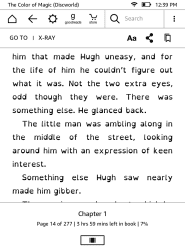
Kindle Update v5.7.2 Adds Open Dyslexic Font, New Home Page (Screenshots)

Amazon is rolling out a major software update for its ereaders this week.

The  v5.7.2 update is available for all current models, including the basic Kindle, the Voyage, and all the latter two Paperwhites. The update adds a new optional home screen layout, a new Open Dyslexic font, improved book recommendations, a tweaked sharing menu, and a new quick actions menu.

The update is going to be rolled out to Kindle owners over the next month, but you can also go download it manually. I did, and I have a few screenshots to share.

First up is the home screen. You now have the option of a more stylized home screen with book recommendation on the bottom, your most recently opened books in the upper left, and a list of reading lists on the right.  The reading lists draws on your Amazon wishlist, as well as any list you may have created on Goodreads.

Here’s the new home screen option, along with the other two options:

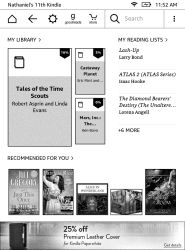
As you can see, the menu bar across the top has changed. It now features a quick action menu icon third from the left, and a search bar.

That quick action menu lets you adjust the frontlight, enable airplane mode, sync your Kindle, or open the settings menu:

And last but not least, Amazon has also added a new dyslexic font as your 8th font choice.

This font is intended to help those with reading disabilities by emphasizing parts of each character and so make the characters easier to recognize. There is some dispute among experts whether this helps or not, but as you can see the font does look distinctive.

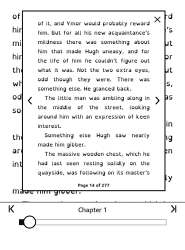
The menu inside the book looks a little different from before, and it also offers a new browse option I haven’t seen before. (Is it new? Edit: No.)

OverDrive offers a similar font in its reading app, and you can also download a open dyslexic font for free and use it with your preferred reading app.

The update can be found on the software update pages on the Amazon website.

image by gminguzzi

Amazon Adjusts Page Size Measurement for Kindle Unlimited Royalties, Also Adds a Cap

Ever since July 2015 Amazon has been paying authors and publishers with works in Kindle Unlimited by the page, and on 1 February 2016 Amazon adjusted how it calculated the page size.

Amazon quietly announced on the KDP support forums on Monday that it had developed a new algorithm for calculating the Kindle Edition Normalized Page Count, or KENPC.

The retailer said that the new method, which has been dubbed KENPC v2.0, "makes a number of improvements to how we standardize font, line height, and spacing used to normalize the length of each book relative to one another. This change will impact the KENPC of some titles while others will remain unchanged. The average KENPC will change less than 5%, although individual books’ changes may be larger or smaller. The new KENPC approach will be applied uniformly to all KDP Select books and all versions of those books."

In related news, Amazon has also added a cap on the maximum number of pages an author can earn from a single reader  in a single title (3,000 Kindle Edition Normalized Pages).

Amazon says that only the very longest books will be affected, and given that authors have reported that, say, a 300 page paperback has a KENPC of around 500 to 600 and that a box set ran to around 2,000, I would bet Amazon is correct in that regard.

However, early reports suggest that the new  KENPC v2.0 algorithm will not have a similar mild impact. Several authors are reporting a sharp decline. One said that "I had one of my 15 books drop 12.5% in KENP".

Another reported "Mine dropped by exactly 13% which would amount to about 26 cents per book based on a half cent per page payout. The format and fonts are pretty normal and everything is straight text with no gaps."

And a third said that "I went over all my books and didn’t find any significant changes – maybe a dozen pages here or there, out of 300-600. So no problems here."

So clearly results are mixed.

images by pjmorse, wonderferret, marco_1186

Fire Tablet Sales Boost Amazon to Third Place in a Shrinking Tablet Market

We knew that the $50 Fire tablet was popular this past holiday season when it largely went out of stock on Amazon’s website, and according to the latest estimates from IDC the tablet was more successful than even Amazon’s wildest dreams.

Amazon shipped 5.2 million tablets in the fourth quarter (up from 1.9 million the previous year), boosting Amazon into third place in the global tablet market behind Apple, Samsung.

With 16.1 million and 9 million tablets shipped, Apple and Samsung continued to outsell Amazon, in spite of the Fire tablet’s low price and popularity. And even though both tech companies saw a drop in tablet sales last quarter, they will likely continue to outsell Amazon.

IDC cautioned in the press release this morning that Amazon isn’t likely to keep its position. “Amazon’s success in the tablet market has thus far been purely based on price,” the research firm says in a news release about the numbers. “While this bodes well during the holiday season, it’s unlikely the Kindle’s success will continue in the remainder of the year.”

I would say the success of the Fire tablet is due as much to marketing as price (also, decent hardware). At $50, the Fire tablet has a value which is hard to beat, and Amazon made sure everyone knew about it.

Also, Amazon’s hot tablet last year was the 6″ Fire HD6, which IDC doesn’t classify as a tablet. In short, Amazon’s success this year over last year is due almost as much to launching a device that IDC is willing to count a tablet as it is to actual sales.

But if we look at the annual figures, we can see that IDC is mostly right about Amazon’s success being a one off in the 4th quarter, but also a fluke that won’t be repeated in the other three quarters.

Overall tablet sales dipped 13% last quarter, to an estimated 65.9 million. Total annual sales dipped 10.1%, to 206.8 million. And of that 20o odd million, the top five tablet makers were Apple, Samsung, Asus, Lenovo, and Hauwei.

Amazon didn’t even make the top five for the year, and that is true for most years. Amazon’s single best quarter for tablet sales is the 4th quarter, after which sales drop until the next model is launched.

Geekwire