Kindle Oasis FCC Paperwork Show Bluetooth, Audio Support

When Amazon announced their latest ereader last week, they told us it had Wifi, page turn buttons to one side of the screen, and a ridiculously high price tag, but that’s not all it can do.

Newly uncovered FCC filings have revealed that the Kindle Oasis might have a few hidden abilities. The paperwork doesn’t name the Kindle and can’t be tied directly to Amazon, but all signs point to this being Amazon’s hardware.

The two filings listed below tell us that last week two faceless companies each sent a Wifi- and Bluetooth-equipped tablet like device through the FCC. Neither company exists online or in the real world, and yet both coincidentally used the same model number, had their device tested on 10 July last year, and then filed the FCC paperwork on 12 April 2016 while having all the useful images embargoed.

Also, that model number has been positively tied to the Kindle Oasis. In other words, these belong to Amazon.

The paperwork doesn’t show us what was tested (we have to wait until October to find out), but it does tell us that both devices were tested for Wifi and Bluetooth. One was even tested with a Bluetooth earphone, thus confirming audio support.

There was also a report (from AFTVNews, the blog that found the filings) that the test units had a headphone jack, but I can’t find any evidence to support that.

While the Kindle Oasis does not officially have Bluetooth, the first leaks suggested that it would have this feature. I was in fact the first news site to report on that leak (I also beat the WSJ to the news on the battery case), and now it has been confirmed.

Alas, I can’t tell you why Amazon left this feature out or disabled it, but I’m sure I’m not the only person looking forward to the teardowns which will reveal whether the Oasis still has the chip for Bluetooth.

Do you suppose Amazon is going to add Bluetooth-support in an update?

If nothing else, it would go a long way towards justifying the Oasis’s $290 price tag. Bluetooth support would let you stream audio to a BT speaker, or connect the Oasis to Amazon’s home automation.

Amazon might be planning to enable BT when they release a matching keyboard case.  While that is pure speculation, I don’t think it is such a crazy idea given that the case already has its own battery.

How would you like to use the Bluetooth on the Kindle Oasis?

FlexCase Puts an E-ink Screen Inside Your Smartphone Case

About three months back word went around that Microsoft was working on some type of secondary E-ink screen for smartphones. We knew almost nothing about the screen at the time, but this week we got our first look.

Gizmodo has turned up a video from one of Microsoft’s research teams which shows the FlexCase, Microsoft’s concept for the future of the smartphone case.

Developed in partnership with researchers at Joanneum Research and the University of Applied Sciences Upper Austria, the FlexCase combines a flexible 4″ E-ink screen with a touch sensor and flex sensors to give you more ways to interact with your smartphone.

This isn’t even close to the cover guessed at three months ago. T^hat sounded more like the PopSlate or secondary E-ink screens like the ones Alcatel was working on in years past.

Instead, the FlexCase is more like a smartphone-sized version of the never-released Microsoft Courier. It should also remind you of one of the research projects we’ve seen from Queens University. As you can see in the following video, a user can tap on the secondary screen or bend it to use it as an input device.

The researchers have proposed several modes of use, including book mode (as seen in the lead image), where a user holds the phone in one hand and uses the other to manipulate the screen. There’s also a laptop mode, and an option for folding the screen behind the phone.

It’s a great concept, but this strikes me as one of those ideas that would not last long in the real world. The flexible part would wear out quickly whether through use or simply through getting banged around in your pocket.

Still, one can dream.

What do you think of the design?

Report: That Shortened URL You Just Shared Could Also be a Shortcut to Your Sensitive info

URL shorteners are a great way to clean up long and messy links and share them, but their use comes with a security warning: don’t click on links from people you don’t know/trust.

Now we have a new rule: don’t use one to share personal documents or information which may compromise your privacy.

A new report (PDF) from the Freedom to Tinker Foundation has revealed that the random-looking shortened URL you shared earlier today isn’t nearly as safe or anonymous as one might think.

Most shortened URLs consist of a known service like Bitly followed by strings of 5 to 8 characters, and researchers have found that it is not impossible to randomly guess those strings and get back links to sensitive info.

Do you know how security experts say you’re not supposed to use a short password because it can be guessed? Some URL shortener services have that exact same problem (or at least they did).

For example, the researchers found that users are sharing links to OneDrive which lead to documents anyone can edit:

We show how to use short-URL enumeration to discover and read shared content stored in the OneDrive cloud, including even files for which the user did not generate a short URL. 7% of the OneDrive accounts exposed in this fashion allow anyone to write into them. Since cloud-stored files are automatically copied into users’ personal computers and devices, this is a vector for large-scale, automated malware injection.

The researchers also found that once they had a link to a file in a OneDrive account, they could traverse the account and find other public files, thus compromising an entire account through one lapse in security.

Fortunately the trick the researchers used no longer works, but this is no guarantee that a hacker won’t find other tricks. So caveat emptor.

The researchers also identified a problem with Google Maps' own URL shortener. Google is now using 11 character strings for any URL shared via Google Maps, but at the time the researchers were investigating the service Google Maps was only using a 5 character string on shortened URLs.

Again, the researchers found one could guess at shortened URLs and find valid links, including to personally identifiable info:

The endpoints of driving directions shared via short URLs often contain enough information to uniquely identify the individuals who requested the directions. For instance, when analyzing one such endpoint, we uncovered the address, full name, and age of a young woman who shared directions to a planned parenthood facility. Conversely, by starting from a residential address and mapping all addresses appearing as the endpoints of the directions to and from the initial address, one can create a map of who visited whom. Fine-grained data associated with individual residential addresses can be used to infer interesting information about the residents. For instance, we conjecture that one of the most frequently occurring residential addresses in our sample (see Figure 4) is the residence of a geocaching enthusiast. He or she shared directions to hundreds of locations around Austin, TX, many of them specified as GPS coordinates. We have been able to find some of these coordinates in a geocaching database.

You can find the full report here.

The report is scary reading, but rather than getting bogged down in the details, I think we should instead consider what we can learn from this report.

This report found flaws in OneDrive and Google Maps, but it also points to a more general problem with how people are using URL shorteners.

My takeaway is that now is a good time to make sure that our cloud storage accounts are secure. Yes, this report focused on OneDrive and didn’t say anything about other services, but I’d rather secure my accounts now than learn about a security flaw after the fact.

Also, we need to be more aware of how easy it is to guess a shortened URL from the services we use. Twitter, for example, now uses a 10-character string consisting uppercase, lowercase, and numbers. At 62^10, that’s 839 quadrillion possible combinations. Amazon’s URL shorterner, on the other hand, only leads to Amazon links so its 7-character string is relatively safe – but easy to guess, so you might want to be careful about sharing links to sex toys and the like.

Those are just two of the many tech companies with their own URL shorteners. Each one needs to be evaluated in terms of security and any service which is not secure should be avoided.

Basically you should ask yourself if you would feel safe using the string from a shortened URL as your secure password. If the answer is no then you should not use the service that gave you the shortened URL, either.

FTTF via Techdirt, Ars Technica

images by vetaturfumare, ** RCB **, Prayitno

Google’s New "Save to Google" Chrome Extension is a Half-Hearted Clone of Pocket, Instapaper

OMGChrome reports that Google has released a new "Save to Google" Chrome extension which looks like it is intended to be a Pocket or Instapaper competitor.

The official Chrome Web Store description for the browser bolt-in puts it thusly:

Easily save interesting webpages to Google with the new Save to Google extension.

One-click save: Click the star to save webpages for later viewing. Easily navigate your saves via an intuitive visual UI.

One spot for webpages and Images: Your saved webpages and saved images from Google Image Search will live together at google.com/save.

That certainly sounds like an alternative to Pocket, but in reality it falls far short.

I tested the service and can report that "Save to Google" doesn’t snag a copy of the article; it creates a bookmark. There’s no option to read the article you’ve saved; instead you are taken to the original page. In spite of the confusing name, this is less a save-for-later service than an uber-bookmarking service where you can bookmark a link and then tag it, edit the description, and organize the links into folders and groups.

That’s great, but it’s really only about half of the features promised by the name and description, making this only about half as useful as the competition.

And frankly, I’m not surprised. There was a time where Google could release a product like Gmail, Chrome, or Google Reader and absolutely trounce the competition. Sadly, as we saw with Chrome’s distraction-free reading mode last year and now the new "Save to Google" service, that time is long past.

Have you tried the service yet? Is it any good?

Chrome Web Store via TNW

Kobo Expands KWL’s Author Services With Editorial, Conversion, Design Services

Kobo announced on Wednesday that it had negotiated deals with digital publishing service companies to offer discounts to authors and publishers who contract through Kobo Writing Life's Author Services.

Initially announced in August 2015, Author Services was launched earlier this year to offer authors and publishers a discount on audiobook production and a (worthless) discount on ISBNs.

And now Kobo is expanding Author Services. According to the press release(PDF), authors and publishers can now secure editorial, cover design, formatting, and other services through the portal. The services are provided by experts at companies like Aptara, Nord Compo, AcePub, and NewGen, rather than Kobo.


Or at least that is what the press release says; the Author Services page disagrees.

I just logged into my KWL account to check which services are available, and when I clicked the "get more info" buttons for each of the offered services, only about half of the response emails explained how I could move forward. The other half indicated that they were under development.

When this service has been set up, we will reach out to our authors with more information.

According to Kobo’s own website, I can’t get an ISBN, audiobook, or editorial services through Kobo Writing Life. And that’s strange because two of the three were supposed to have been set up back in January.

Isn’t it odd that Kobo would send out this email when their site still isn’t up and running?

Is anyone else wondering whether this ill-considered press release for an under-prepared portal might be a response to some other company’s ereader launch today?

image by Matt Hampel

The $290 Kindle Oasis Wants to be Your Refuge in a Reading Desert

We have had so many leaks over the past couple weeks that the launch of the Kindle Oasis is almost an anti-climax, but there is still more to report.

Amazon’s latest ereader went live this morning both on Amazon’s site and was announced via a press release. It costs $290 and comes with a battery-case, a 300ppi Carta E-ink screen, and page turn buttons to one side of the screen, as we expected.

Thanks to Paul Durrant of MobileRead, I can point you to the quick start guide and the user manual. I also have a bevy of links to first-hand reports, but first let me answer one question which had been vexing me.

Yes, the Oasis has a USB port.

There was some unhinged speculation over at Teleread a few weeks back to the effect that Amazon might drop the USB port from the next Kindle, and that has not happened. Len Edgerly of The Kindle Chronicles said that both the battery-case and the Oasis have their own charging ports. (He was at the launch event last week.)  A photo from Engadget showed the USB port on the upper edge of the Oasis next to the power button.

Here’s a list of the reviews. The posts by Mashable, Re/code, TechCrunch, Fortune, and TNW are not really worth your time.

If you are short on time then read The Verge’s piece, or what Slashgear says about the construction. There’s also a discussion on Slashdot.

So tell me, are you going to get one?

I am sorely tempted.

1985 Pop-Up Book Takes Us Inside the PC (video)

The latest pop-up books can take us on a tour of the White House or remind us of the phobias we’d rather forget, but that’s nothing compared to what has been published in the past.

I’ve just come across a video for a 30-year-old pop-up book called Inside the Personal Computer. The book takes readers on a tour of the latest computer tech from 1985, showing them everything from the case to the chips inside, the floppy drive, and the printer. It even explains what binary is, how a CRT screen works, and what ASCII codes are.

The book is a fun reminder of just how far computers have come in the past 30 years. And coincidentally, you can buy this book on Amazon.

If the commentary on this video bothers you, there is a similar video on Vimeo. It has a sound track but no commentary.

The level of detail is fascinating, but this book would be a whole lot cooler if someone had published it in 2016. Thanks to Raspberry Pi and other cheap single-board computers, it’s now possible to build an actual computer into a pop-up book rather than just a model.

True, I don’t know where you would put the screen, but it’s not the craziest of uses of a pop-up book. One designer has invented a pop-up book which is also a functional camera. Her other pop-up book uses a smartphone (not included) to become a planetarium or  speaker.

Really, the only thing stopping someone from building a Raspberry Pi into a pop-up book is that no one has thought to try it yet (or rather, I can’t find any sign that some has).

Does anyone want to give it a shot?


Kindle Oasis Leaks on Amazon.Ca, Lists For $999

When I reported on the leaked Kindle Oasis images this morning I wasn’t sure whether they were real or a hoax, but now Amazon has removed all doubt.

Someone at Amazon.ca has inadvertently updated the listing for the Kindle Paperwhite with a new comparison. The Kindle Oasis has been added to the chart. I have pasted a screensnap of the chart below (and uploaded a copy to the Internet Archive), but the short version is that  the leaked chart confirms just about every detail we learned this morning.

The Kindle Oasis has a lopsided design built around a 6″ Carta E-ink screen. It weighs 131 grams, comes with a touchscreen, page turn buttons, and the battery-cover. It will come in both Wifi and 3G varieties, and boasts a battery life of months.

Virtually everything we thought we knew from this morning has been confirmed, leaving only two details unknown.

We don’t know the price, or the release date.

The latter is not mentioned in the comparison chart, and the chart says that the Oasis will cost $999 CAD. Obviously that is a placeholder for the real price, which Amazon will probably announce this week.

The latest guess says that Amazon will announce the Kindle Oasis on 13 April – Wednesday. While I expect that rumor to come true, I have no evidence to back it up.

Stay tuned.


Kindle Oasis Leaks in China, Has an Asymmetrical Design

Jeff Bezos promised us we would hear more about the next "top of the line" Kindle this week, and once again we didn’t have to wait for official sources.

A new leak out of China confirms that the new Kindle Oasis has the battery-case, page turn buttons, and accelerometers mentioned in previous leaks, only they’re not quite in the places you would expect.

Update: Amazon leaked additional details on its Canadian website which confirm this report.

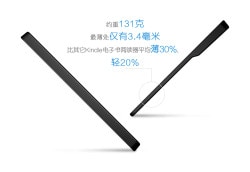
If these images are real (and I’m still waiting for a denial/confirmation from Amazon) then Google Translate tells us that the Kindle Oasis will measure 3.4mm thick at its thinnest point, weigh 131 grams, and have a 300 dpi E-ink screen. (In comparison, the Kindle Voyage weighs 180 grams, and measures 7.8 mm thin.)

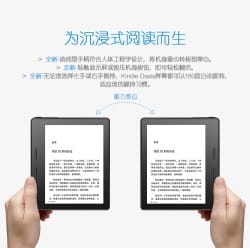
And best of all, the Oasis appears to feature an asymmetrical design with page turn buttons on one side of the screen. Far from being a one-handed design, the Oasis will use the accelerometers to automatically invert the text when you flip the device around and hold it with your other hand:

The leak also suggests that the Oasis will have a frontlight which has 60% more light sources, and another image confirms the powered connection between the case and the Oasis:

I’m still putting the images through Google Translate so I can parse additional detail, but that’s all I have for now.

I have not, for example, found a mention that the new Kindle is waterproof. So it looks like that guess was wrong.

If you would like to help translate the text in the images, I have embedded them below.

P.S. This is not the first ereader with a lopsided design, though it will certainly be the most famous. The never-released txtr Reader had a left-handed design when it was announced in 2009, and Ukrainian ereader maker Pocketbook has released a couple 8″ models, including the Pocketbook Inkpad. I fucking loved mine, so don’t listen to naysayers who call the new Oasis ugly. Try it first.

Edit: Pocketbook also released the 360, a one-handed ereader with a 5″ screen. That was a great device, which could even play Doom.


Thanks, Steve, for the tip!

Tapas Wants to Gamify the eBook Market, But Will Consumers Go Along?

Publishers Weekly brings our attention to Tapas Media, an ebook startup which wants to gamify ebook retailing by selling in-app credits which can then be used to buy segments of an ebook.

The company’s newest product is Tapas, a mobile app and marketplace that takes the company’s model of providing content in small amounts and applies it to literary content. The app uses the “freemium” business model—offering some content to consumers for free as an incentive to pay to get more—that has proven successful in the mobile gaming market and brings it to the mobile reading market. Readers are able start books and other stories for free, and then pay to unlock subsequent episodes, or pay for the entire book or story, with prices based on the books’ current market value. Essentially, it’s Candy Crush for books.

Tapas, available on iOS and Android, provides a range of media (all literary at the moment), from books to comics, created by professional writers, all in the form of what Tapas refers to as “bite-sized micro chapters,” or episodes, of 2,000 to 4,000 words. In addition to the freemium model, it enlists a user-engagement model, with features such as rewards for peer-to-peer sharing.

In-app purchases are a big deal in the games/apps market, and that segment accounts for a larger share of revenue that app/game sales.

This has inspired some to think the same model could work for ebooks. Chang Kim, CEO of Tapas Media, told PW that: “We’re trying to apply the proven business model and user-engagement model from the mobile gaming world to reading. If there’s one industry that’s figured out how to monetize content and engage users on mobile, it’s really the gaming industry.”

The problem with that argument is that it overlooks fundamental differences between the ebook market and the app/game market. It also sidesteps the question of whether authors and publishers should want the new model.

One key difference between the ebook and game markets is that it’s easy to download a sample of an ebook and see if it’s any good, but it’s not so easy to sample a game before you buy it.  As a result consumers are less willing to buy a game because they don’t know whether it will suck or not.

Also, ad-supported games have inculcated the expectation that games should be free, and free-to-play games with in-app purchases are arguably just an extension of that trend. (The ebook market has free ebooks, though, which might be pushing that market in the same direction.)

Another difference is that both of the two major app stores (Apple and Google) support in-app purchases. The largest ebook retailer, Amazon, has in-app purchases for games and a digital currency (Amazon Coins), but the coins can’t be used to buy ebooks – not yet, anyway.

With Amazon dominating ebook sales, Tapas' plan to gamify ebook sales will only succeed if Amazon adopts it (Apple and Google will follow suit). Until then, it will remain a niche market, at best.And even if the plan does succeed, Tapas will only play a tiny part, with most of the revenue passing through Amazon, Apple, and Google.

And it’s not clear that the model will succeed, or that authors and publishers should push for it. Right now there’s hardly any content in the Tapas app, but that should change as it leaves beta.

But the more important question is whether authors and publishers should want this model to take hold in the ebook market. Yes, it works in apps/games, but how well?

Given that half of the in-app purchase revenue comes from a fifth of one percent of users, the model arguably doesn’t work very well:

As the 2015 annual Swrve Monetization Report reveals, 64% of all revenues from IAPs in F2P games comes from a mere 0.2% of all players. This number reveals an increase from last year’s report where only 50% of all revenues came from the top 10% of paying players. Further to the point, 60% of all payers (players who make at least one purchase) contribute just a tad over 8% of a game’s total revenue, also known as not enough for developers to care about or cater to.

Do you want that model to become the standard in ebooks?

image by tao_zhyn

Next Kindle to be Called Kindle Oasis, Will be Waterproof

Jeff Bezos promised to share more details about the next Kindle next week, but we don’t have to wait that long.  In what looks to be a technical snafu, Amazon’s retail site in Japan has leaked the name of the new Kindle.

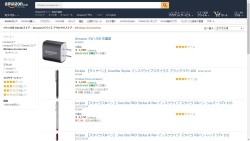
According to a page in the "Kindle accessory store", it’s going to be called the Kindle Oasis. We don’t have any specs today, but the page is showing styluses and a charger and is identifying them as the Whiskey accessories. That name had been previously identified as a codename for the new 8th-gen Kindle, and now Amazon has given us a second confirmation.

According to hints dropped in a recent firmware update, the Kindle "Whisky" might have page turn buttons, but won’t have the haptic feedback found on the Kindle Voyage. There’s also talk of a matching case codenamed "Soda", although fewer details are available on that.

Edit : According to Monday’s leak, the Kindle Oasis has page turn buttons on one side of its 6″ screen.

Edit 2: And now Amazon has confirmed the name and specs with yet another leak.

Given the name Oasis, this probably means that the new Kindle is waterproof like the Kobo Aura H2O, Nook Glowlight Plus, or the aftermarket Kindle Paperwhite from Waterfi.

Coincidentally, the URL www.kindleoasis.com belongs to Brilliance Audio, an Amazon subsidiary.

Alas, that’s all we can say about it at this time. Various investigative methods, including steganographic analysis and tracking Jeff Bezos' blinks for code patterns, has failed to turn up additional detail.

Stay tuned.

MobileRead

You Shouldn’t Read Too Much Into the Legal Threats Over Brave’s Ad-Blocking Browser

Brave put itself on a collision course with web publishers when it announced its ad-filtering web browser in January, so it should come as no surprise that a bevy of media companies have responded to last week’s launch with legal threats.

No fewer that seventeen web publishers, including the Washington Post, Gannett, and the Tribune company, have signed off on a letter which calls the browser’s built-in ad-blocking features ”blatantly illegal.”

Users have been blocking adverts in web browsers since long before Apple made content-filtering a core feature in iOS 9 last year, and there are even web browsers which offer ad-blocking as a built-in feature, but Brave takes the idea one step further.

This browser blocks adverts and replaces them with less-toxic ads sourced through a trusted ad network. The revenue generated by the ads is then split between the web publisher, Brave, and users, with the final group getting paid in Bitcoin.

Yesterday the media companies sent a letter to Brave, calling its browser illegal and describing the business model as copyright infringement. Brave responded with a public statement.

From Business Insider:

With Brave, publishers get around 55% of revenues: 15% go to Brave, 15% go to the partner that serves the ads, and 10% to 15% goes back to the user, who can choose to make bitcoin donations to their favorite publishers in order to get an ad-free experience on their websites, Eich told Business Insider in January.

But the 17 newspaper-publishing companies that cosigned the cease and desist letter sent to Eich on Thursday say that this business model is "blatantly illegal" because they claim Brave is profiting from the "$5 billion" a year the industry spends on funding journalism.

The publishers argue that Brave’s advertising-replacement plan would constitute copyright infringement, a violation of the publishers' terms of use, unfair competition, unauthorized access to their sites, and a breach of contract.

You can read more over on WSJ or Business Insider, and I have included both of the letters below.

But I wouldn’t read too much into the letter from the newspapers. It is less a threat of legal action than it is the first round of negotiations.

Or at least that is how things played out before. This whole incident is basically a repeat of the launch of Flipboard. That news aggregator app faced similar questions when it launched in July 2010, and so did its smaller competitor Zite.

Both Flipboard and the now-deceased Zite got their content by scraping websites and republishing the articles. That’s arguably copyright infringement, and in fact, Zite received a cease-and-desist letter in March 2011 over its site scraping because it was posting whole articles. According to coverage at the time, Flipboard managed to avoid the public nastygram by only showing excerpts, but some publishers still complained.

And yet, both Zite and Flipboard continued to operate right up until one was acquired by the other.

And Flipboard is still around today, so don’t count Brave out just yet.

O O O

Here’s the cease-and-desist letter sent to Brave:

Dear Mr. Eich:

Brave Software, Inc. (“Brave”), a company you founded, has announced that it intends to launch a browser and mobile applications that will display publishers’ content but replace publishers’ advertising with advertising that Brave sells for its own profit. You are hereby notified that Brave’s plan to replace our clients’ paid advertising content with its own advertising violates the law, and the undersigned publishers intend to fully enforce their rights.

Your plan to use our content to sell your advertising is indistinguishable from a plan to steal our content to publish on your own website. Your public statements demonstrate clearly that you intend to harness and exploit the content of all the publishers on the Web to sell your own advertising. “We can provide access to all of the top publishers through a single channel with guaranteed ‘share of voice,’” Brave’s website claims. “This combination of better targeting and first-look access to all of the premium placements our users browse is something that no one else can provide.” There’s a simple reason “no one else” is purporting to “provide” all the content on the Web in one place for its own profit, without investing a penny in creating that content: everyone else has recognized that it would be blatantly illegal for one company to hijack all the content on the Web for its own benefit.

We publish some of the most highly valued and widely read sites on the Web. Our sites and mobile applications provide news reporting, photojournalism, video content and feature writing that is researched, reported, edited, and produced at extraordinary cost. Our industry spends more than $5 billion per year on reporting in the United States alone. We distribute that reporting online for free or at highly subsidized rates, in no small part due to revenue from online ads.

Your apparent plan to permit your customers to make Bitcoin “donations” to us, and for you to donate to us some unspecified percentage of revenue you receive from the sale of your ads on our sites, cannot begin to compensate us for the loss of our ability to fund our work by displaying our own advertising. We expressly decline to participate in any way in Brave’s supposed business model. We explicitly reject any compensation or consideration Brave plans to offer to us as part of its ad-blocking and ad-replacing scheme, and we refuse to accept any “site wallet” that you propose to create for our supposed benefit. In addition, you are not authorized to use our names, trademarks and logos in any way in connection with the promotion or operation of your business.

We stand ready to enforce all legal rights to protect our trademarks and copyrighted content and to prevent you from deceiving consumers and unlawfully appropriating our work in the service of your business. Unauthorized republication of our copyrighted content to support Brave’s illegal advertising model violates protected rights of publishers under the Copyright Act and other laws. We reserve the right to seek all remedies for this infringement, including but not limited to statutory damages of up to $150,000 per work pursuant to 17 U.S.C. § 504. Brave’s use of publishers’ trademarks to sell its own advertising will confuse consumers, infringe upon publishers’ exclusive rights in their brands, and dilute our highly distinctive marks. We believe your planned activities will also constitute unfair competition and misappropriation under relevant federal, state and common law. Brave’s unauthorized activities involving our content and websites also violates our terms of use. By engaging in Brave’s plan of advertising replacement, Brave is liable for breach of contract, unauthorized access to our websites, unfair competition, and other causes of action.

Very truly yours,

O O O

And here’s is Brave’s response:

The NAA sent a letter to Brave Software that is filled with false assertions. The NAA has fundamentally misunderstood Brave. Brave is the solution, not the enemy.

The NAA’s letter to Brave Software asserts that any browser that blocks and replaces ads on the browser user’s device performs "unauthorized republication" of Web content. This is false on its face, since browsers do not "republish", serve, syndicate, or distribute content across the Internet or to any computer other than the one on which they run.

Browsers are the end-point for secure connections, the user agent that actually mediates and combines all the pieces of content, including third-party ads and first-party publisher news stories. Browsers can block, rearrange, mash-up and otherwise make use of any content from any source. If it were the case that Brave’s browsers perform "republication", then so too does Safari’s Reader mode, and the same goes for any ad-blocker-equipped browser, or the Links text-only browser, or screen readers for the visually impaired.

The NAA letter also falsely asserts that Brave will share an "unspecified percentage of revenue", when our revenue share pie chart has been public and fixed from our first preview release in January. We give the lion’s share (pun intended), up to 70% of ad revenue, to websites, keeping only 15% for ourselves and paying 15% to our users.

We sympathize with publishers concerned about the damage that pure ad blockers do to their ability to pay their bills via advertising revenue. However, this problem long pre-dates Brave. We categorically reject the claim that browsers perform "republication", and we repeat that Brave has a sound and systematic plan to financially reward publishers. We aim to outperform the invasive third-party ads that we block, with our better, fewer, and privacy-preserving ads.

Finally, we note that malvertisement has gotten onto the websites of the New York Times and the BBC recently through the ill-designed, unregulated, and poorly-delegated third-party advertising technology ecosystem. Truly, this tracker-based ad-tech ecosystem is what is damaging the brand value of content publishers and driving users to adopt ad-blocking software. Brave blocks and replaces only third-party ads and trackers. Our system thus actually repairs the damage that publishers have carelessly allowed their ad partners (and partners' partners, to the seventh degree of separation) do to their trademarked brands and names.

Make no mistake: this NAA letter is the first shot in a war on all ad-blockers, not just on Brave. Though the NAA never reached out to us, we would be happy to sit down with them for an opportunity to discuss how the Brave solution can be a win win. We will fight alongside all citizens of the Internet who deserve and demand a better deal than they are getting from today’s increasingly abusive approach to Web advertising.

image by finalcut

B&N Outsources Nook Functions to Indian Tech Company

When Barnes & Noble shut down the UK Nook Store as well as the Nook App Store last month, we took it as a sign that B&N was going to kill off the Nook platform quickly. Now it seems B&N is going to let the Nook wither on the vine.

B&N announced on Thursday that it had inked a deal with Bahwan CyberTek, an Indian outsourcing firm, for BT to take over certain Nook tech services. To be more exact, B&N said that the firm would be responsible for cloud management, development support for Nook software, and other services.

“Over the last two years, the Company has done a significant amount of work to improve NOOK’s overall performance,” said Fred Argir, Chief Digital Officer at Barnes & Noble. “While we have been able to reduce costs, we still have a lot more work to do to rationalize the business. We believe that by outsourcing certain technology functions of our Nook business we will further improve Nook’s performance.”

B&N also took the time to reaffirm its commitment to the Nook platform, and add that as a result of the deal it is closing both its Taiwan and Santa Clara, Calif. offices by July 2016.

The Nook platform, however, will remain open as B&N adopts benign neglect as its digital business model.

And yes, benign neglect is the best term for today’s news; had B&N really been interested in rebuilding Nook then they would have invested capital rather than outsourcing key functions.

That’s what Amazon would do; remember, Amazon has a habit of buying companies with tech it needs (Kiva Systems, Mobipocket, Liquavista, etc).

That B&N is choosing not to invest tells us all we need to know about their plans for the Nook platform.

Now would be a good time to get your ebooks out, if you can.

image by Kansas Poetry

Goodreads Reaches New Milestone: Fifty Million Reviews

Goodreads secured its position as the world’s largest book-focused social network this week. The Amazon subsidiary announced yesterday that users had posted an aggregate 50 million reviews. 

"Many of our reviewers have developed their own distinctive style and won an audience that loves their creativity as much as their recommendations," Goodreads founder Otis Chandler wrote on the Goodreads blog on Wednesday. "The amazing diversity of reactions and approaches is what makes Goodreads reviews so unique and enjoyable. And now, just over nine years later, we’ve reached a new milestone: 50 million reviews! "

Chandler didn’t share how many reviews had been removed during one of Goodreads infamous purges, but he did thank members for the reviews which made it through the culling. "On behalf of the Goodreads team, I wanted to give a huge thank you to all of you who’ve written such amazing reviews over the years. I hope you’ve found it as rewarding as I do to look back at your reviews."

Amazon bought Goodreads in early 2013, and clearly the site has thrived under Amazon’s influence.

image by deeps.adhi

New Kindle to Have Rechargeable Case, New Basic Kindle "Woody" On the Way

Jeff Bezos has promised that we would hear more about the new Kindle next week, but thanks to a new leak we do not have to wait.

The WSJ confirmed my report from yesterday that the new Kindle had a battery-powered case, and added that we might not see it any time soon:

Also under development is a separate Kindle case with a battery that can be charged using solar power. It is unlikely this case will be released in the immediate future, another person familiar with the matter said.

…

The new Kindle and case are code-named "Whiskey" and "Soda," respectively, and the solar-powered case is known internally as "Sunkiss" among engineers at Lab126, Amazon’s Silicon Valley hardware development unit, one of the people said. The division is responsible for other Amazon devices including its Echo virtual assistant, Fire tablets and Fire TV set-top box.

So it’s a solar-powered case? Interesting, but not ground-breaking. There were third-party solar-powered battery cases for the Kindle Touch and the Kindle (no-touch). They were released in early 2012, and the quietly vanished as the stock was sold off. (You can see one of the cases in the lead photo.)

I have one of those cases, and I never thought it was worth the extra mass. It just wasn’t useful enough to justify the nuisance, so I rarely used it.

It’s not clear why Amazon is reviving that old idea, but one does hope that it points to a Kindle which needs the extra battery life (Liquavista …). But that’s for the future; what matters now is the Kindle to be announced next week.

While I don’t have any details about the case codenamed "Soda", I can independently confirm that the codename "Whiskey", or rather "Whisky", has been found in the recent Kindle Firmware update.

Edit 1: And now we know the name is the Kindle Oasis.

Edit 2: Another leak confirms the battery-case, and that the Oasis has page turn buttons.

Edit 3: And Amazon has put the cherry on top with a leak on Amazon.ca.

A hacker has taken apart the update and found references to a new basic Kindle codenamed "Woody" as well as the Kindle "Whisky". He said that the new Kindle we’re going to hear about next week lacks the haptic feedback found on the Voyage (yay!) but may have page turn buttons (double yay!) and accelerometers.

He called it a "hybrid between a PW and a Voyage", one which could run on the Paperwhite’s firmware, and added that both the new  models "would run on a new storage solution at the HW level". Also, the "Whisky" model and the new "Woody" Kindle are going to use a new mainboard codenamed "Duet".

So there you have it, folks; we have not one but two Kindles in the pipeline.

And you read it here first.