Nate Hoffelder

Nate Hoffelder

Google Play Books Rep Throws Up Hands, Tells Dutch Publisher That Nothing Can be Done About Obvious eBook Pirate

Google has a serious problem with piracy in Google Play Books.

It lets just about anyone set up ebook shops in Google Play Books, and stock them with pirated ebooks. The pirates are allowed to upload copy after copy after copy of a pirated ebook, secure in the knowledge that Google won’t do anything more than remove a pirated ebook named in a DMCA notice.

Google’s only response so far has been to release a statement saying that "Google Play takes piracy seriously". It hasn’t changed its policies in response to my news stories, and it hasn’t taken any active steps to fight piracy when American authors and publishers complain.

And now Google has made it clear that it won’t even take the complaints of a European publisher seriously.

I just got an email from a digital account manager from a Dutch publishing house. He exchanged emails with a senior account manager concerning an obvious pirate ebook account.

He was told by the Google Play Books rep that:

I checked the link you’ve shared and noticed that the book in question has been submitted to Google Books by dragonletebooks, through their Partner Program account. As we are not authorized to make changes to a book submitted by a partner through their account, I’d recommend you to contact the publisher directly to request removal of this book. If contacting them doesn’t help, and you believe that this listing violates your rights as a copyright holder, you can file a formal legal complaint and our legal team will review the notice promptly.

This is utter bollocks, and it is utterly reprehensible that Google refuses to take any active steps.

This is one of those cases where the pirate has set up its own shop in Google Play Books. The perp picks a bogus author name (in this case Flamanca Hollanda), and uploaded pirated ebooks under that author name.

This is a problem I documented at length when I first broke the news on piracy in Google Play Books, and pirates are still using it to their advantage. Thanks to how Google organizes Google Play Books, the pirate has its own shop which only lists pirated ebooks, including Dutch translations of John Grisham, James Patterson, Stephen King, and more:

Just to be clear, the pirate in question is so obvious that it can be identified algorithmically, much less be identified by anyone with the brains of a goldfish.

And Google won’t do anything other than respond to specific DMCA notices (whereas Amazon and Scribd, to name a couple of examples, do use algorithms to filter pirated and other content out of their respective ebookstores).

But that may be changing soon.

This issue hasn’t gotten much press coverage in English (IB Times is the only news site to pick up the story), but the Dutch publishing news site Boekblad reported on this issue today and they say that NUV is working on the case.

The NUV, or Nederlands Uitgeversverbond, is a Dutch publishers trade group. The fact that they are interested should worry Google, because while Google can ignore me and it can ignore the complaints of individual publishers, it cannot ignore a trade group like the NUV.

Should the NUV threaten to sue, Google will have to change its policies and actually do something about the rampant piracy problem in Google Play Books.

Isn’t it a shame that nothing short of a lawsuit will get Google’s attention?

It’s Official: German Media Retailer Saturn Takes Over Bankrupt Txtr

We’ve known for close to a month and a half that Saturn Media group, the parent company for the Media Markt, Saturn, and Redcoon chains of electronics stores, was taking over txtr’s bankrupt ebookstore.

And now txtr’s customers have been officially informed (finally).

I just got an email from txtr with the news that Juke Entertainment, one of Saturn Media’s subsidiaries, is taking over txtr’s operations. The email was in German and only referred to the customers of txtr.de (the German ebookstore). This does not bode well for Saturn’s continued support of txtr’s international customers, but at least the customers outside of Germany, Austria, and Switzerland are still being supported (for now).

I am similarly concerned about the lack of information on txtr’s own website. There’s no announcement of the change in ownership, so it is entirely possible that a txtr customer would learn of the news when their credit card statement said Saturn and not txtr.

Here’s the email:

Dear Readers,

We want you today to inform you that your usual eBook service under txtr.de is operated in the future of the JUKE Entertainment.

For you as a customer, this means no restriction or deterioration. Quite the opposite: JUKE will continue to manage the portfolio of services initially unchanged and expand in the future to many exciting features and new content – Stay tuned!

For you nothing changes! Your login remains, their books remain available, you can still more books relate and enjoy.

With best regards,
Your txtr JUKE team

Launched in 2009, txtr was a Berlin-based ebook startup which failed earlier this year.

The company was originally formed with the goal of building an ereader. That fell through in 2010, after which txtr pivoted to offering a whitelabel ebookstore platform with apps for Android, iOS, and Windows.

Txtr later tried to launch the beagle ereader, but that went over like a lead balloon. And then last summer, when txtr was circling the drain, a number of its best people left the company to spin off Blloon, the subscription ebook service.

There were rumors that txtr was nearly acquired in late 2014 as a move to stave off the bankruptcy, but that didn’t happen. Instead txtr filed for bankruptcy in January 2015.

Kindle Unlimited Payout up Slightly to $1.35 in April 2015

Kindle Unlimited set a new record in April 2015 both for the number of ebooks loaned and the funding level.

Amazon announced in the KDP support forums on Friday that they had boosted the funding for KDP Select to $9.8 million, up $300,000 from March 2015.  With a reported payout of $1.35 for each time an ebook was read, that boosts the estimated number of loans to 7.26 million, up from 7.14 million loans last month.

As you can see in the above chart, the payment per loan dropped to $1.54 in August 2014 (as a result of Kindle Unlimited launching in July 2014). Thanks to Amazon taking care to limit funding to only grow as fast as the number of ebooks loaned, it has continued to stay below $1.50 since October 2014.

Foner Books

Wattpad Releases Amazingly Useful iWatch App

With a screen measuring under 2″ diagonally, there isn’t much that you can do with a device like Apple’s smartwatch but that hasn’t stopped some reading app developers from finding ways to use it.

Instapaper, for example, lets you control its TTS feature from the iWatch. The social reading app Glose added a speed reading feature. And now Wattpad has released its app for the iWatch.

Wattpad’s app won’t let you write on the iWatch, but it will let authors track their stats. The new app pairs with the Wattpad app for the iPhone, and according to Wattpad:

The Wattpad team created this app for on-the-go writers who love keeping tabs on their latest stats. For writers, votes and read counts serve as a way to understand a story’s momentum, and seeing a spike in votes and reads often encourages them to keep writing.

The Wattpad app for Apple Watch gives writers real-time story analytics including total cumulative read and vote counts, as well as percent increases between app checks so they can keep track of readers’ reactions to their stories.

I can’t speak for you but that strikes this stats-obsessed blogger as a great idea. I really do obsess over my site’s traffic to the same degree that authors track their reading and sales stats, so I do appreciate the tool Wattpad has placed on author’s wrists.

alas, Google Analytics hasn’t released a similar iWatch app, so I will be forced to sit back and be jealous.

You can find the app in iTunes.

Hoopla Adds eBooks, Digital Comics to Its Pay-per-Loan Library Service

Hoopla’s long-promised library ebook service unexpectedly launched today.

Few details will be available until next week, but I can report today that users have been informed that their respective libraries can now loan ebooks via Hoopla. I caught the news via MobileRead, and I can confirm that the Hoopla website is now listing ebooks.

However, Hoopla’s apps for Android and iOS have not been updated, and Hoopla has not officially announced the launch nor shared any details. When asked, Hoopla’s PR rep said that she was "not able to share any further details on this until May 19th".

As a result I don’t really have much to report at this time, but I can tell you that Hoopla’s new service is only showing 5509  ebooks from smaller publishers (Tyndale House, Melodrama Publishing, Chicago Press Review) as well as titles from Rosetta Books (they distribute a lot of backlist titles from before the ebook era).

Hoopla’s catalog is notably lacking in ebooks from the major publishers. I can’t even see any ebook titles from Macmillan, which is a little odd. Hoopla announced a deal to distribute Macmillan audiobooks only last week, and I would think that deal would cover both formats.

And while we’re on the topic, Hoopla is also listing 579 comics from IDW, Book Studios, Valiant, and other small presses, but I don’t see any titles from Marvel or DC.

Based on what Hoopla was reporting last week, both the ebooks and digital comics are new. I can see from last week’s post that as of last week Hoopla offered over 300,000 video, music, and audiobook titles and claimed 680 libraries as partners.

Those 680 libraries more or less rent the content from Hoopla under a pay-per-loan model. And to be clear, the several library websites I checked describe this as a loan, and not a sale.

Hoopla has been offering this service for going on two years now, and it has yet to sign 1,000 partners. Do you suppose this is a sign that the service is unwanted or unattractive to libraries?

Virginia Launches Statewide Open-Source Textbook Pilot

One of the largest college systems in the US has just launched an open source textbook pilot.

The Virginia Community College System announced on Monday that it had secured a $200,000 grant from the William and Flora Hewlett Foundation. The funds will be used to launch a pilot program at 15 of Virginia’s 23 community colleges.

Based in part on Tidewater Community College’s OER (open educational resource) Z-Degree initiative, if all goes well this pilot is projected to save some 50,000 students over $5 million in its first year alone.

And that is not an exaggeration or a typo; it could well happen.

With 273,000 students enrolled each year, the VCCS is one of the largest college systems in the US. It accounts for 60% of the undergraduates in the state, many of whom attend a community college because they are cash-strapped.

Virginia’s community colleges are focused on offering technical certificates and two-year associate degrees, and as a result the colleges have a high concentration of students taking basic classes like Biology, Physics, or Chemistry 101.

These are the same students who are screwed over by textbook publishers each time those basic textbooks are re-released as new editions every third year, but now thanks to the pilot at least some of the students will have a chance to avoid wasting hundreds of dollars on textbooks that they cannot resell.

Instead, the students will have the opportunity to download perfectly functional and free digital textbooks which were customized by the colleges to fit each school’s academic requirements.

In fact, some students already are using those textbooks. At least two community colleges in VA have been developing their own textbooks for the past several years. In addition to Tidewater mentioned above, my local Northern Virginia Community College (NOVA) also started using OER textbooks in its distance learning classes in 2013. These classes are taught online, and the switch from print to free digital textbooks saves students the cost of shipping as well as the cost of textbooks.

NOVA librarians also maintain a resource page on OER curricula, although it’s not clear whether it is widely used.

***

No matter whether that page is used by instructors, today’s announcement is still bad news for Follett, Nebraska Book Co, and most especially B&N College. These three companies run the college bookstores for many of the 23 community college systems in Virginia. Less money spent on textbooks means lower revenues, and that in particular means trouble for B&N as it proceeds to spin off its college bookstore division.

As I pointed out when B&N made that announcement 3 months ago, the college bookstore industry is in a state of flux. Bookstore revenues are declining at a lot of schools (including the three that signed deals with Amazon), and while programs like the pilot mentioned above are not the cause of the drop in revenue, they are contributing to it.

As college textbook prices continue to skyrocket at rates faster than inflation, healthcare, or housing, students are spending less and less.  In short, the above pilot is merely the inevitable end result of textbook publishers pricing themselves out of the market.

In Buying Engadget, Verizon is Also Buying Its Editorial

Yesterday’s announcement that Verizon is buying AOL for $4.4 billion is still percolating through the blogosphere, but it has already generated quite a few editorials.

One in particular caught my eye. Michael Gorman, the editor-in-chief at Engadget, took to the blog to proclaim its editorial independence. He says that Engadget will not cater to Verizon’s demands:

In the time that I have been editor-in-chief, the Engadget team has done some incredible work to deliver on the editorial mission I laid out just over a year ago. And things are going according to plan. Engadget’s audience is larger than it’s ever been (thanks!), and we continue to grow thanks to the strength of our reporting. We will continue to tell the stories that give you the full picture of how technology is changing our world and affecting our lives. And yes, that includes coverage of some of Verizon’s not-so-favorite topics, like the Patriot Act, net neutrality and online privacy.

…

Of course, I understand the questions about Engadget’s ability to maintain its editorial integrity in the wake of this acquisition. After all, Verizon has done nothing to earn us any benefit of the doubt — quite the opposite, actually. But it doesn’t matter who pays our salaries; we’re not in the business of censorship. Engadget’s editorial isn’t for sale. It never has been, and it never will be. Not as long as I and Executive Editor Christopher Trout are running things. Actions speak louder than words, however, and it’s time to get back to work. Stick around, I promise you won’t want to miss what’s next.

Those are pretty words, but the words that really matter here are the ones printed on the check. And the fact of the matter is, Verizon is going to be signing the checks from now on.

So yes, Verizon has bought Engadget’s editorial, which means they could follow NewsCorp’s lead and use Engadget as an official mouthpiece the way NewsCorp uses the Wall Street Journal.

And given Verizon’s history, I would not be surprised if that happens.

As I pointed out yesterday, Verizon has previously dabbled in owning a tech blog, only it didn’t end well. Last fall Verizon started a blog called SugarString, and then proceeded to make the name ironic by limiting coverage of key issues including net neutrality or government surveillance to only the most saccharine of coverage:

Verizon is getting into the news business. What could go wrong?

The most-valuable, second-richest telecommunications company in the world is bankrolling a technology news site called SugarString.com. The publication, which is now hiring its first full-time editors and reporters, is meant to rival major tech websites like Wired and the Verge while bringing in a potentially giant mainstream audience to beat those competitors at their own game.

 There’s just : In exchange for the major corporate backing, tech reporters at SugarString are expressly forbidden from writing about American spying or net neutrality around the world, two of the biggest issues in tech and politics today.

Verizon shut down SugarString after heated criticism from media pundits, but that doesn’t change the fact that Verizon exerted editorial control over its tech blog.

Are you really so sure that they won’t try the same trick with Engadget,  TUAW, and The Huffington Post?

I can’t estimate the probability, but I’m also not willing to dismiss it out of hand.

Luckily for us there is a way out. Re/code and other sources reported yesterday that Verizon is looking to sell The Huffington Post.

The talks have been most serious with Axel Springer, the German media conglomerate, but a number of private equity firms have also expressed interest in the high-profile property. Sources said the Huffington Post has been valued at above $1 billion in this scenario, which would either be a complete sale or, more likely, structured as a joint venture.

We don’t know at this time whether Verizon wants to sell the entire blog group or just the one site, but I bet it’s the former. Someone at Verizon clued in on the point that they could be criticized for how the blogs cover certain topics even if Verizon never interferes.

Selling off the blogs would remove the chance of negative publicity entirely (this is why I don’t fully believe re/code’s report), and Verizon would be a fool not to go ahead with any reasonable offer.

image by Robert Scoble,

PaPiRus from Pervasive Displays Adds an E-ink Screen to a Raspberry Pi

Between the screens offered by Embedded Artists and ADAFruit, and the e-Paper Hat which showed up on Kickstarter last month, there’s no shortage of ways to add E-ink screens to a raspberry Pi (you can even use a Kindle). And now Pervasive Display is getting in to the market.

I just got an email from Pervasive Display which tipped me to the news that its new partner, Pi Supply, had developed a new screen component for the Raspberry Pi.

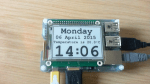
The PaPiRus is an epaper Hat which mounts on top of the Raspberry Pi in order to give it a close-fitting screen option. It quietly launched as a Kickstarter campaign last week, and has already exceeded its funding goal.

The PaPiRus is not the first epaper Hat for the Raspberry Pi but it is arguably the better. Both the e-Paper Hat (which crossed my desk last month) and the PaPiRus have a battery and switches, and they both work with the RePaper open source DIY code, but that’s about all they have in common.

They do look similar, though:

The PaPiRus has 4 switches above the screen (compared to two on the e-Paper Hat), GPIO breakout connector and solder pads on the underside, and a digital temperature sensor and thermal watchdog.

And as we can see when we flip the boards over, the PaPiRus (left) is the much more complicated design:

You can find the PaPiRus on Kickstarter. Depending on the funding level, it comes with one of three replaceable screen panels: 1.44″, 2″, and 2.7″ E-ink screen from Pervasive Displays (the e-Paper Hat only came with the 2.7″ screen).

It’s expected to ship in July 2015, or about a month ahead of the competition.

Thanks, Sjoerd!

No, Attention Spans Are NOT Getting Shorter

The internet is making us dumb.

You may have read Nicholas Carr espousing the idea, and I’m sure you’ve seen the research that shows that concentration and comprehension suffers when reading online, and now we have authors suggesting that books should be written for shorter attention spans.

I think that is a terrible idea, but that is the argument Judith Briles made on The Book Designer last week.

The standard how-to and business book tomes of yesterday have become dinosaurian. Blame it on TV … the way we take in information … the Internet. The fact is, attention spans are shrinking. As a writer and author, the probability that your words need to shrink between the covers of your book is high.

…

When I stepped away from writing and speaking in the healthcare field in mid-2000 exclusively dedicating my time to authors and publishing, two truths bubbled up.

First the need to write visually; and second, to write short … or at least, shorter.

While I don’t doubt that there are more shorter nonfiction works today than were published ten years ago, I don’t believe the change was caused by shortening attention spans. I think what we’re seeing is digital production removing the artificial commercial constraints imposed by the printing industry.

In the olden days books had to fall into certain page counts so they could be fed into the sausage-making machinery and spat out with predictable production costs and price tags.

Now, ebooks let us publish books of any length we like, and POD enables us to print those books. This frees writers from constraints and enables ideas to exist at their natural length and not be stretched to fit the book-length requirement of old.

Rather than having to fit the round hole of yesteryear, books can now be squares, rhomboids, or any other shape. This is not the fault of attention spans but rather the benefit of tech making the industry more efficient.

If you want to write a shorter story, you should do it. Let a story grow to its natural length, and then end it.

But don’t rewrite a story because you think readers have shorter attention spans. That is simply not true.

Are readers more distracted these days? Yes.

Do we flit from social network to news article to video and back to social network? Sure.

Does that impair concentration and comprehension? Absolutely.

But I would not assume that the same problem extends to books.

One needs to write to keep readers interested, yes, but that is not the same thing as writing for a short attention span. If an author can keep a reader interested then the reader will come back to a book each time they put it down. What’s more, if the reader is interested they’ll pick up the next book in the series and continue reading.

Part of the reason I find this premise of a short attention span so ridiculous is that I just finished a 5 book series.

Over the course of a month, I started and finished Larry Niven’s Fleet of World series. I picked up the first book, and when I finished it I moved on to the next and the next and the next. They’re not his best work, and I won’t read them again, but I did read them one-two-three-four-five.

Rather than being short, my attention span for this author and this series lasted over a month. (And that’s not even the first time this attention-deficit blogger has finished a series in one go; I sometimes consume whole series when I discover new authors I like.)

Folks, you’re welcome to write for short attention spans. I think you’re sabotaging yourself, but it is your choice. I would recommend, though, that you write to keep a reader’s interest rather than assume the reader is deficient.

A reader’s attention may be fractured, but I would not assume that it is short.

Allow me to prove my point.

If you made it to this point in the post then you just proved that it is possible to catch and keep a reader’s attention even on the web in these busy times. Chew on that.

If I can keep your attention through a 700 word blog post, do you really think that books need to be written for shorter attention spans?

images by David Blackwell, Enokson

UK Publishers Association Reports eBook Sales Up, Print Sales Down in 2014

Here in the US the AAP reported that 2014 was a good year for book publishers, but the news coming out of the UK today is not so good.

The new edition of the Publisher Association’s Statistics Yearbook was released today, and it reports that the combined print and digital revenues of UK publishers fell by 2% in 2014, to £3.3 billion.

Print revenues dropped 5%, to £2.7 billion, while ebook revenues increased by 11%, to £563 million. That is not nearly as fast of a growth rate as 2013 (19%), but it is a new record high for ebook revenues (both unit sales and market value).

The Statistics Yearbook is not available to the public, but some details have been released. The PA announced this morning that digital was strong across academic and children’s segments. Digital subscriptions now make up 79% of revenues for journal publishers, and consumer fiction is growing almost as fast. The PA said that this digital segment had increased to 37% of the reported fiction revenues – a "trebling in absolute terms in three years".

Children’s ebooks grew 36%, which is great, but at £22 million that segment is still only a tiny fraction of  the  £349 million in kid’s books sold last year.

Digital textbook revenues were also up 17%, now accounting for 24% of sector sales. Downloadable audiobooks were also up 24%, and sales of digital curricula were up 20%.

According to PW, the Statistics Yearbook is administered by Nielsen and is based on the Publishers Association Statistics Monitor. The Monitor collects sales data from publishers and is believed to represent  about 75% of UK publishers' sales.

Whether it accurately reflects the entire industry is another matter.

PW

P.S. In case you’re wondering why my report differs from the one in PW, I went looking for more info and found the PA’s press release. I’m glad I did because otherwise I would not have known about the wild growth in genre ebooks.

images by Leonard Bentley, PA

Google Says "Google Play Takes Copyright Seriously"

Earlier this week I broke the news that Google had a rampant piracy problem in Google Play Books, and today Google has finally responded.

Far more so than most ebookstores, Google is a safe haven where pirates can operate with impunity. Pirates can upload copy after copy of a pirated ebook, secure in the knowledge that Google won’t delete their account. This leaves authors and publishers with little recourse but to play a never-ending game of whack-a-mole.

Luckily that game is coming to an end. Google told me today that they feel authors' pain:

Google Play takes copyright seriously. We take swift action when we receive a DMCA complaint, which the copyright holder can complete here. Additionally, we’re constantly improving our systems to provide a better experience.

Yes, they take this issue very seriously – just not seriously enough to actually do anything.

When I asked what Google was doing to fight piracy in Google Play Books, they were unable to name a single activity. When I asked what it would take to get a commercial ebook pirate banned from Google Play Books, the Google rep was unable to even confirm that they would even ban a pirate after dozens of valid DMCA notices. When I asked what improvements they planned to make, none came to mind.

But that should not worry you; Google Play takes copyright seriously. It says so right there in their statement.

Folks, when I first covered this issue on Monday morning I suggested that it would take either a lawsuit filed by publishers or lots of pressure+publicity before Google would take an interest in fighting piracy in Google Play Books.

Viacom sued Youtube, and we got ContentID. The RIAA and MPAA spent years beating up Google over search results, and Google started deranking pirate site from its search results.

Unless and until the Big Five decide to pursue one path or the other, Google simply won’t give a damn.

Google Play Books for Android v3.4.5 Adds Hints Of Google Drive Sync For Notes, New Font, New Translation Interface

Most major ebook platforms let readers sync notes and highlights across the devices on their account, but now Google Play Books is going one better.

The latest version of Google Play Books for Android showed up yesterday in Google Play. This wasn’t a major update but it did add a couple features and drop a hint about Google’s future plans.

The app features a new Serif font, Literata. This typeface developed by Type Together. It was commissioned by Google to replace Droid Serif, and as any font nerd can tell you they look nothing alike.

Next up, there’s a new translation interface.

GPB used to take up the full screen with the translation menu when you translated a word or phrase in an ebook, and now it displays the translated phrase on a card:

That is going to prove useful, but not nearly as useful as the new notes feature.

Android Police went digging through the install file for Google Play Books, and they found hints in the code which they say suggests that Google is going to start syncing your notes and highlights to some location in Google Drive.

This code is not active yet, but I agree that it does point to the possibility.

Google Play Books already syncs the annotations you make in the personal ebooks you upload; now it looks like Google is going to start storing the notes and highlights in an easily accessible location in the cloud.

And more importantly, an easily sharable location. Getting your notes out of GPB is great in and of itself, but sharing is even more important. Once the notes are in Google Drive, they can be shared with just about anyone. And that is what could be the killer feature here.

Many ebook platforms let you share notes inside the platform, or even share _a_ note on social networks, but Google offers the promise of sharing a complete set (or some subset) of notes from a book.

The possible benefits for collaboration are obvious.

How to Get Google to Swat eBook Pirates? Public Shaming (Nothing Else Works)

Google has yet to officially respond to Monday’s post on the rampant piracy in Google Play Books, but my work is already having a visible effect.

On Tuesday I noticed that the ten pirate accounts I called out in Monday’s post had all been disabled. The author listings have vanished, and so far as I can see the listings for the pirated ebooks are no longer visible in Google Play (the ebooks I purchased are still there, though).

That is good news, but I would not celebrate just yet. Google may have swatted a handful of ebook pirates, but they have not addressed the underlying problems which led to the rampant ebook piracy.

Google has not enacted any policies to fight piracy, and the industrial-scale ebook piracy will continue until they do so. They have only removed a handful of the more blatant pirates and leaving the more subtle pirates to continue their operations.

If you would like to find examples of pirated ebooks in Google Play Books, simply search for an author’s name: Douglas Adams, for example.

If you look closely you will see that there are 4 copies listed for Mostly Harmless or The Restaurant at the End of the Universe (to name a couple of examples). One copy is published by Del Rey, two copies are foreign editions published by Macmillan, and one copy is published by Fire & Ice Books.

That last copy is almost certainly a pirated ebook. It is priced at $1.99, while the legit copies are priced at $5.99 and above.

While I can’t guarantee that those Adams ebook are pirated, the pirated copy of Mario Puzo’s works is easier to spot:

The Penguin-published copies of The Godfather are priced at $7 and above, but the pirated copy I just bought cost me $1.99, came with a generic cover, and was published by Fire & Ice Books. That publisher also offered other pirated books in the series.

Another useful trick for finding pirate ebooks is to search for last name, first name. For example, King,Stephen reveals a long list of defunct listings for pirated ebooks.

Or you could search for Roberts, Nora, and note that some of the pirates had been allowed to upload the same ebook 4 or 5 times. Several of those pirates have since moved on to pirating other titles, but are still active in Google Play Books.

What’s more, Google’s piracy problem extends beyond just English language books. For example, Google Play Books is home to both a legal and a pirated copy of the Spanish language version of George RR Martin’s A Storm of Swords.  That helpful pirate has in fact uploaded the first 3 books in the series, and is selling them at a reduced price.

Speaking of GoT, that brings me to another industrial-scale pirate operating in Google Play Books; Ispanyolca was pirating Spanish translations of popular novels, including 50 Shades, Hunger Games, and Game of Thrones (source).

Luckily for us it too was swept up in the Tuesday morning cull.

On Monday I wrote that Google is not doing a damn thing to fight piracy in Google Play, but as we can see today that is not entirely true. They can be shamed into taking action.

Now if only that action would extend to changing their policies, then we would be going somewhere. Google may be the king of search engines and know more about algorithmic filtering than anyone, but they have yet to turn any of their tools to fighting piracy in Google Play Books.

Google will only respond to DMCA notices, and will only remove the specific titles mentioned in a notice. Under Google’s current policy, pirates are allowed to continue operating no matter how many ebooks are removed (the Tuesday morning cull was an exception).

Remember, on Monday I showed you that at least one of the industrial-scale ebook pirated had been operating in Google Play Books for several weeks (at a minimum), even though it was blindingly, nay, algorithmically obvious that it was a pirate operation.

In comparison, the other major ebookstores will close accounts after enough DMCA notices; Amazon, in fact, will suspend an account that receives too many complaints about issues as trivial as the formatting, much less piracy.

But Google will allow pirates to continue to harm authors and publishers. And yes, authors are being harmed.

It’s not just that they are losing revenues in Google Play Books; a pirated ebook in Google Play Books can impact sales in the Kindle Store and elsewhere.

As any author or publisher can tell you, Amazon aggressively watches prices in competing stores. If Amazon finds a lower price they will match that price in the Kindle Store. It doesn’t matter if it is a pirated copy or a legit copy; Amazon doesn’t care.

I’ve been told by several sources, including an author who saw it first-hand, that Amazon will price-match against a pirated ebook. I was also told that:

I have yet to confirm the tweet with a first hand report, but I do have a similar report from a second source.

I can also tell you that it is in keeping with Amazon’s ToS for KDP, and that it fits with Amazon’s sometimes capricious behavior (publishers have been banned for less).

Now if only Google would adopt a similar policy for pirates; that would solve a lot of the piracy problems.

Alas, Google won’t even fully remove the pirated ebooks, much less ban the pirates themselves. When Google gets a DMCA notice, they will disable the buy button on a listing but leave the listing visible. You will still be able to see the cover image, description, and other details. For example: (one, two, three).

The cover image and description are copyrighted, so leaving them visible would arguably mean that Google has not actually complied with the DMCA notice. But given all of the other bad policies Google has in place, that is a relatively minor issue.

The real issue here is the ease with which you can find pirated ebooks in Google Play Books, and Google’s general silence on the issue.

As always, Google was contacted several before I published this post. They were first contacted Sunday night, and as of Tuesday evening they have so far declined to respond. Should they respond I will amend this post.

image by victoria white2010


Is the Kindle App Draining the Battery on Your iPad/iPhone?

With literally months of standby time, Apple’s mobile devices have excellent battery life. Most users will tell you that their iPhone lasts at least a day of heavy usage (the iPad lasts even longer) but lately there have been reports from some users that battery life has dropped significantly.

James Kendrick of ZDnet was the first blogger to notice, and yesterday he reported that:

About two weeks ago I noticed that my iOS devices were using more battery than ever before. A couple of days the iPhone was very low at the end of the day, and the same with the iPad Air 2. Each time it happened I couldn’t think of anything I’d done differently. The iPhone 6 Plus and iPad Air 2 were hitting the battery harder than before.

Looking at battery usage by app in Settings>General>Usage>Battery Usage I quickly homed in on the culprit. The Kindle app from Amazon is now always the app that is using a greater percentage of my battery, and often by a wide margin.

I read a lot of Kindle books but rarely for hours at a time; a typical reading session is only 15 minutes or so. Rarely does my accumulated daily reading time exceed an hour. The usage of other apps far exceeds this, especially Safari and Evernote. These don’t come close to how hard the Kindle app hits the battery.

From the sound of it, the app must be active and running in the background, even when it is not being used. That is a surprise; IOS is great at putting apps to sleep when you’re not using them. This cuts down on the resources they use – or at least it is supposed to.

I don’t use my iPad enough to see an appreciable drain on the battery, but I have gotten anecdotal confirmation from a couple of friends. They all said that they saw a battery drain similar to what Kendrick reported:

What’s more, Amazon has confirmed the initial reports, telling ZDnet that they had: "checked and see that number of eligible customers have contacted us regarding this issue and our technical team is currently working to address this problem. "

Update: Amazon’s PR dept is disputing this report. They deny the scale of the problem. Okay, but I’ve now heard from several more people on Twitter who have experienced this problem. They also deny that the app is running in the background, and I could be completely wrong on that point.

Amazon is expecting to release an update which fixes this problem in the next few days. Until then, you might want to shut down the Kindle app when you’re not using it.

In order to see what apps you have running, press the home button twice.  This will bring up a menu which shows all the apps running in the background. If you’re running iOS 8, it will be a full screen menu. Earlier versions of IOS will show a taskbar menu across the bottom of the screen with icons.

To turn off an app (on iOS 8) simply select it and swipe towards the top of the screen. In earlier versions of iOS, press the little red X on the app’s icon.

Amazon is Killing it in the Subscription eBook Market

If you were hoping that new retailers in the subscription ebook market could grow large enough to balance Amazon, then you might want to look for a plan B.

A new survey report from Peter Hildick-Smith’s Codex Group reveals that Amazon is dominating subscription ebooks to a surprising degree.  Even though Amazon doesn’t have any ebooks from major publishers, the ebook giant has many more subscribers than either of its US competitors.

According to the Codex Group’s April 2015 consumer survey, 12.4% of ebook buyers also have a Kindle Unlimited subscription.  In comparison, only 1.4% of respondents reported that they had a Scribd membership, and even fewer were paying for Oyster.

The report also showed that Amazon’s subscriber base grew by 10% between November 2014 and April 2015, while the customer base of its smaller competitors fell by an average of 30% over the same period.

I do believe we just learned why Oyster really launched a retail ebookstore; they are smaller and they were losing subscribers. And that wasn’t Oyster’s only problem; they were also the least well-known of the three services.

Four out of five members of the survey group knew about Kindle Unlimited, while 24% knew of Scribd and 16% had heard about Oyster. The respondents were also more interested in signing up with Amazon than its competitors, with 4.2% of ebook buyers thinking about getting a Kindle Unlimited subscription.

As I sit here typing this post in May 2015, Kindle Unlimited is just about to turn 10 months old. KU (inadvertently) launched in July 2014, and its competitors Oyster and Scribd launched in October 2013.

Amazon’s competitors have been in this market for about twice as long as KU, offer more titles from the major publishers, and yet they can claim (at best) a subscriber base that is but a fraction of Kindle Unlimited.

While it would be wrong to call the game for Amazon, they are certainly winning this round, and that is both good and bad news for publishers.

Oyster’s and Scribd’s relatively low adoption rates should allay concerns that the subscription ebook services will cut into retail ebook sales; they just don’t have enough subscribers for that to be a problem. On the other hand, they also don’t have enough subscribers to be a major source of revenue.

And given that Kindle Unlimited is funded (for the most part) from a pool worth $9.5 million in March 2015, at present that isn’t a major source of revenue either.

As a result, the subscription ebook market is in its second year and it has so far proven to be less than the game changer some pundits had expected and some publishers had feared. Instead it is just another niche, and there is little reason to believe that will change in the near future.

BuchReport